Japan Airlines E190-E2 — japan Airlines announced on Oct. 14 that it had selected the Embraer E190-E2 to replace regional jets flown by subsidiary J-AIR.
The agreement comprises 16 firm aircraft orders and 10 options; the first deliveries are scheduled for Japanese fiscal year 2029. Options are not firm deliveries.
Table of Contents
What the announcement establishes
J-AIR operates regional flights from Osaka Itami using existing E170 and E190 aircraft. JAL said shifting domestic demand, demographic trends and higher costs informed its decision.
An aircraft commitment is a fleet plan, not evidence that the aircraft has already entered service. Delivery and route assignments will be determined later.
JAL put the replacement decision within its Management Vision 2035 strategy, which treats domestic air links as infrastructure for communities, not simply a question of adding seats. The airline pointed to lower domestic business demand, demographic change and cost pressure as factors shaping fleet renewal. A smaller regional jet can serve thinner routes with a different economic profile from a much larger single-aisle aircraft, although the announcement did not identify individual routes or publish route-level cost comparisons.
What the change means
The E190-E2 is a newer-generation regional jet. JAL says the program should help improve fuel use, environmental performance and operational economics compared with the types it will replace.
The airline has not specified every route to receive the aircraft or the exact dates for individual frames, so service plans remain future decisions.
JAL listed a standard capacity of 97 to 114 seats, depending on configuration, alongside a 36.3-meter fuselage, 33.7-meter wingspan and Pratt & Whitney PW1900G engines. The stated range is 5,463 kilometers, but that technical figure should not be confused with a promise to operate particular longer routes. The carrier emphasized fuel efficiency, lower noise and maintenance economics as expectations for the replacement fleet. Those are company claims about aircraft performance, not independently measured results from J-AIR operations.
Limits, questions and next steps
JAL framed domestic flights as critical links for regional communities, emphasizing network sustainability rather than merely adding capacity.
The fleet transition will take time. An order with options leaves flexibility to adjust the final number of purchases, while delivery scheduling and subsequent entry into airline service remain separate milestones. The company did not announce registration numbers, a cabin layout, first operating routes or a retirement schedule for every older jet. Its Itami-based regional subsidiary will therefore continue working with its current fleet while the new program moves from a commercial order into production and delivery planning.
The fleet decision has significance beyond replacing aging aircraft one for one. J-AIR operates domestic regional services from Osaka Itami, connecting communities that may not support the passenger volumes of larger narrowbody aircraft. JAL framed the E190-E2 purchase within its Management Vision 2035 and linked it to Japan’s changing demographics, subdued business travel and higher operating costs. The carrier therefore presented the aircraft choice as a network-sustainability measure rather than simply an expansion of seat capacity.
JAL’s published specifications describe an aircraft seating about 97 to 114 passengers, with Pratt & Whitney PW1900G-family engines and a range of 2,950 nautical miles. The stated range describes aircraft capability; it does not mean J-AIR has announced new international routes or intends to fly the model to the limit of that range. The carrier has not provided a complete route-by-route deployment list.
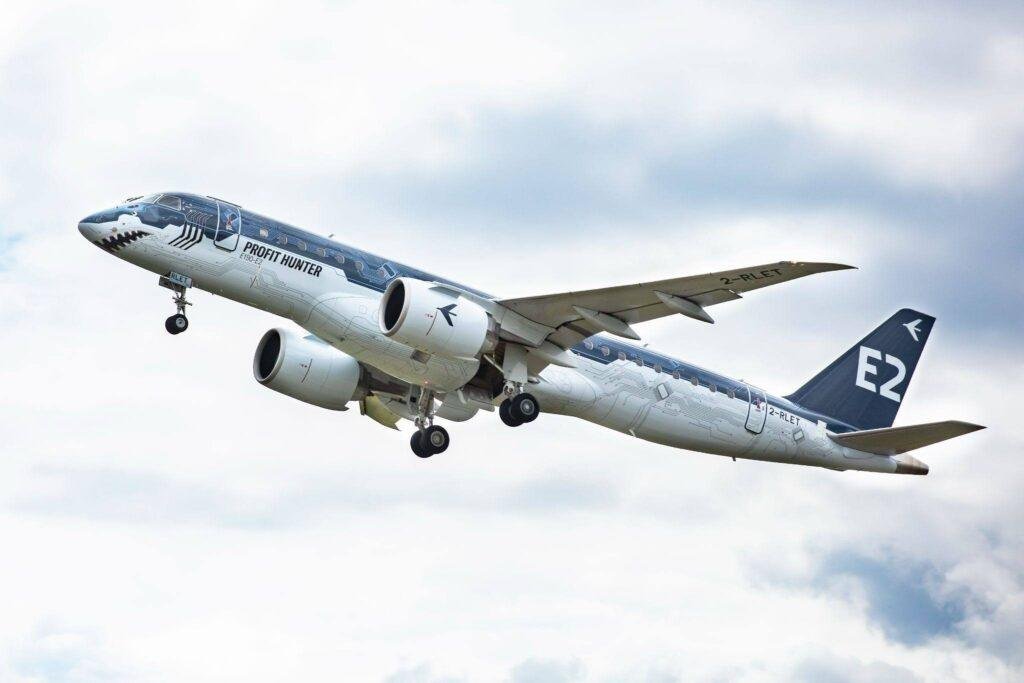
The financial language also requires precision. Sixteen aircraft are firm orders; ten are purchase options that may or may not ultimately be exercised. The announcement did not provide a transaction price or a committed delivery calendar for every airplane. Initial deliveries are scheduled for fiscal 2029, leaving several years for fleet and network planning. The accompanying Embraer aircraft photo is a manufacturer image of the model, not evidence of an E190-E2 already in J-AIR service.
FAQ: Japan Airlines E190-E2
How many E190-E2s has JAL firmly ordered?
JAL announced 16 firm aircraft and 10 additional options. The options are not confirmed deliveries.
When will the first new regional jet arrive?
JAL targets Japanese fiscal year 2029 for initial deliveries, with precise individual delivery dates still to be announced.
Who will operate the E190-E2 aircraft?
J-AIR, the Japan Airlines regional subsidiary based at Osaka Itami, is the planned operator.
Looking Ahead
JAL currently targets fiscal 2029 for initial deliveries; subsequent deployment details and the handling of its existing fleet remain to be announced.
Sources
https://press.jal.co.jp/en/release/202610/009762.html