NASA icing research is targeting a difficult aviation hazard: supercooled large droplets that may freeze on aircraft surfaces beyond the areas protected by conventional anti-icing or deicing systems.
The agency described renewed instrumentation experiments in its Icing Research Tunnel at Glenn Research Center on October 5. Scientists are refining how large droplets are created, measured and compared with engineering models.
The work is an experimental safety study, not a new aircraft certification rule. Its purpose is to improve the evidence available to engineers evaluating flight in less common cloud conditions.
Table of Contents
NASA Icing Research Targets Unusually Large Drops
Water in clouds can remain liquid even when its temperature falls below freezing. When these supercooled droplets hit an aircraft, they may turn into ice and change the aerodynamic shape or performance of exposed surfaces.
NASA explains that conventional icing test conditions often use droplets around 2 to 100 microns across. More unusual supercooled large droplets can reach around 2,000 microns, potentially allowing water to splash or flow farther back before freezing.
That difference matters because ice may form behind leading-edge areas where protection is concentrated. Designers need credible data about how droplet size affects where water strikes and how it freezes.
NASA icing research: New Measurement Probes in the Icing Tunnel
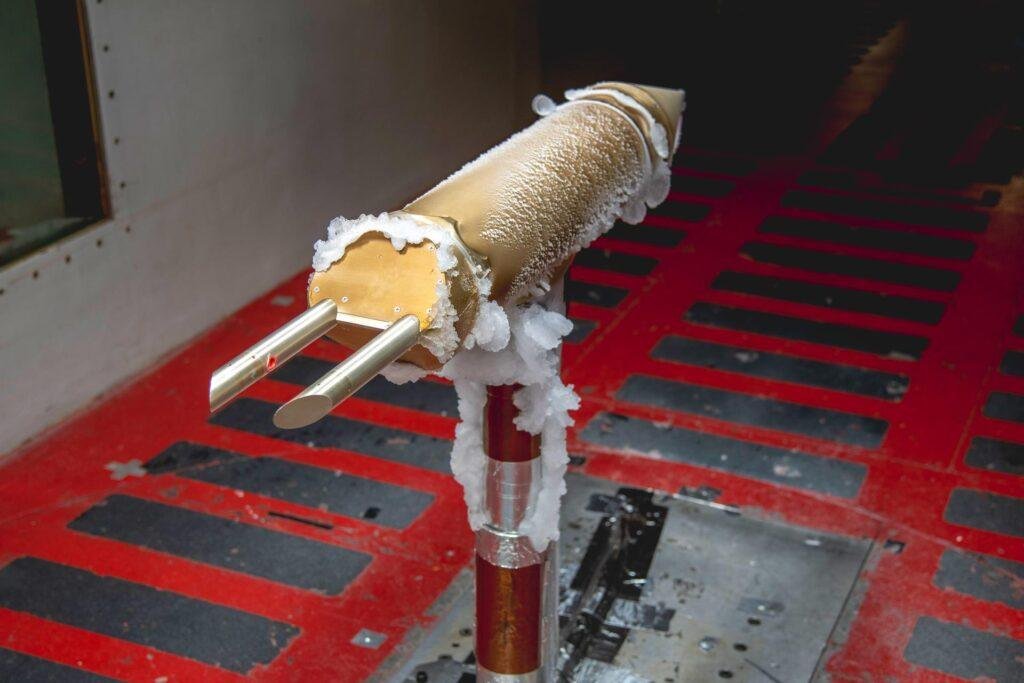
Researchers at Glenn’s tunnel have tested probes intended to examine and calibrate the sizes of droplets in experimental clouds. NASA says one instrument can detect drops larger than 45 microns and analyze their size in real time.
The team plans comparisons with more labor-intensive image processing and a separate probe for droplets smaller than 45 microns. Using complementary methods helps engineers judge whether the facility is reproducing the cloud conditions under study.
The experiment also examines equipment behavior when ice accumulates on parts of the measurement system. That is a practical problem: a sensor trying to characterize an icing cloud must remain interpretable in the very environment being investigated.
How Research Data Can Support Airplane Design
Aviation manufacturers use wind-tunnel evidence and computational tools to assess possible icing behavior. Better controlled experiments can inform validation of those tools, especially for droplet regimes less common than standard small-drop clouds.
Such experiments cannot guarantee that any single aircraft is safe in every possible weather condition. Aircraft operating limitations, certification testing and pilot procedures remain part of the larger icing risk-control system. The NASA icing research tests are intended to help refine engineering predictions in challenging cloud conditions.
NASA did not announce a completed new certification standard or quantified reduction in icing accidents in this update. The next value of the research will depend on whether the new measurement data can reliably improve engineering predictions.
FAQ: NASA icing research
Why does NASA icing research study large droplets?
They are unusually large liquid cloud droplets that remain unfrozen below the freezing point until they strike a surface or encounter freezing conditions.
Where is NASA carrying out these tests?
The experiments are being conducted in the Icing Research Tunnel at NASA Glenn Research Center in Cleveland.
Why are large droplets a concern?
They can splash or travel behind conventional ice-protected areas and freeze on additional aircraft surfaces.
Looking Ahead
The next research steps are probe comparison and improved icing-cloud calibration. Aircraft design benefits will depend on testing and later validation of predictive models.
Sources