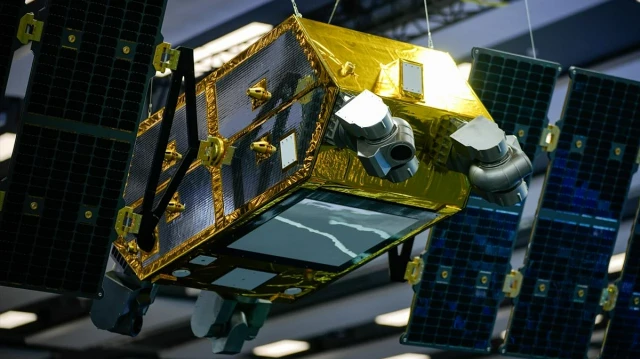
The Aselsan Astralink constellation has been unveiled as a Turkish low-Earth-orbit communications network intended to serve military, public and civilian users.
Aselsan CEO Ahmet Akyol presented the Gokbagi, or Astralink, project during IAC 2026 in Antalya. Anadolu reported that Aselsan plans to begin launching the first satellites within the next few years, while Aviation Week said the company is looking at deployment beginning in roughly two to three years.
The announcement establishes the project’s direction but not a completed constellation. Aselsan has not publicly disclosed the final satellite count, launch providers, total program cost or a firm date for the first launch.
Table of Contents
Aselsan Astralink Constellation Is Designed for Dual Use
Anadolu described Astralink as a dual-use network intended to provide rapid and secure communications for Türkiye’s military, public and civilian sectors. The project moves Aselsan beyond supplying individual space components toward a more integrated satellite-system role.
Akyol said the company designed the project from the chip level upward and displayed it publicly for the first time at IAC 2026. The company also showed other satellite and payload technologies at the congress, placing Astralink within a broader expansion of its space portfolio.
The network is planned for low Earth orbit, where satellites move rapidly relative to the ground and require a constellation rather than a single spacecraft to provide sustained coverage. The sources reviewed do not state how many satellites Aselsan intends to deploy.
Deployment Timing Remains a Target, Not a Launch Date
Anadolu reported Akyol saying the first satellites should begin launching within the next few years. Aviation Week gave a more specific planning range, reporting that Aselsan is looking to start delivering the constellation in about two to three years.
Those statements are program targets rather than confirmed launch reservations. No launch provider, launch site or first-spacecraft date was identified in the reports reviewed for this article.
That distinction matters because the Aselsan Astralink constellation would become operational in stages. A first launch could demonstrate the spacecraft and network architecture without providing the coverage planned for the completed system.
Astralink Expands Aselsan’s Role in Türkiye’s Space Industry
Aselsan is best known as a defense-electronics company, but Aviation Week reported that Astralink would also move the company from space-component work toward providing a satellite platform and network capability.
The project was introduced during a major international space congress hosted in Türkiye, giving Aselsan a venue to present the constellation alongside other national space capabilities. Anadolu said the company also highlighted radar payload receivers and work connected to Turkish satellite programs.
The next evidence of progress will come from hardware, contracts and launch arrangements rather than presentation material. Until those appear, Astralink should be described as a planned constellation with an announced deployment objective.
FAQ: Aselsan Astralink Constellation
What is the Aselsan Astralink constellation?
Astralink, also called Gokbagi, is a planned Turkish low-Earth-orbit communications satellite network.
Who will use the Aselsan Astralink constellation?
Aselsan says the dual-use network is intended for military, public and civilian communications.
When will Astralink satellites launch?
Aselsan says first satellites are targeted within the next few years, but no firm launch date has been announced.
Looking Ahead
Watch for Aselsan to disclose a first satellite design, launch contract, launch date or planned constellation size. Any of those would turn the current deployment target into a more measurable schedule.
Sources
- Anadolu Agency — Türkiye’s Aselsan reveals homegrown communications satellite constellation
- Aviation Week — Aselsan Eyes LEO Satcom Constellation Deploying In 2-3 Years