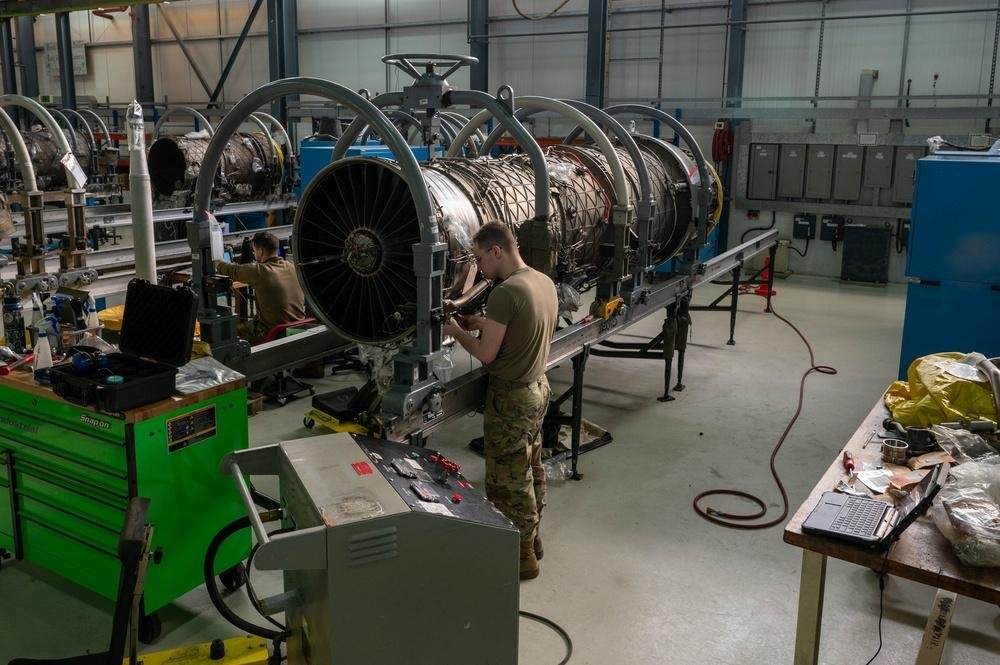
F100 engine maintenance for U.S. Air Force fighters will receive predictive diagnostics after StandardAero announced a contract supporting the F100-220 engine program.
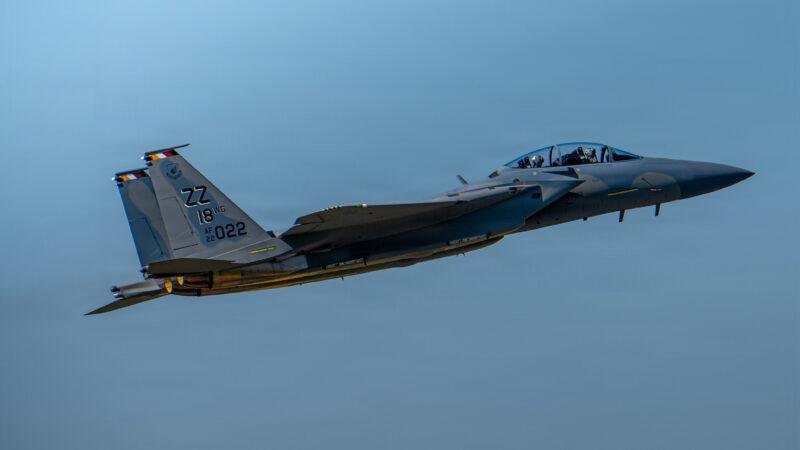
The company said on October 6 that its Maintenance Insight suite will support engines powering more than 175 F-15 aircraft. The addition expands its predictive-maintenance program to a fifth Air Force engine type.
The announced award concerns diagnostic tools and readiness analysis. It is not an announcement of new F-15 purchases, a powerplant replacement program or proof that all forecast maintenance savings have already been achieved.
Table of Contents
F100 Engine Maintenance Moves Toward Data-Based Forecasting
StandardAero says the software analyzes patterns of engine reliability and likely failure modes so propulsion managers can plan work scopes, deployment needs and preventive maintenance. Those uses are intended to reduce avoidable downtime.
The company describes a mix of artificial intelligence, machine learning and digital twin methods hosted in the Air Force cloud environment. A digital twin in this context means a data-informed representation used to assess engine condition and maintenance needs.
Predictive models do not replace inspection findings or maintenance authorization. Their value depends on how well forecast outputs match physical engine behavior and how maintenance teams incorporate those outputs into actual work orders.
F100 engine maintenance: An Expansion Across Several Military Engine Fleets
StandardAero says the new contract extends an established family of maintenance analytics already used for other Air Force engines. Earlier work covers the T56 used on C-130 transports and the J85 associated with T-38 training aircraft.
The company also lists the TF33 associated with B-52 bombers and the TF39 among engine families supported by its diagnostic capabilities. Each platform has different operating and maintenance conditions, so technical models need engine-specific evidence.
The F100-220 has served in fighter applications for decades. Managing aging engines is partly about component condition and spare-parts planning, not simply tracking aircraft flight hours or assigning a generic age-related replacement schedule.
What the Contract Does Not Yet Establish
The company’s announcement does not give a publicly confirmed award value, deployment schedule for each unit or independently measured reduction in engine failures. It describes expected benefits in readiness, reliability and cost control.
The Air Force’s decision-making remains with its maintenance and propulsion personnel. StandardAero supplies analytical tools intended to inform that process, not a fully autonomous authority to return aircraft to flight. The F100 engine maintenance award adds analysis capabilities rather than modifying aircraft propulsion hardware.
For observers, meaningful future proof would be published performance results such as forecast accuracy, time on wing and differences in maintenance burden. None of those results can be inferred from award of the contract alone.
FAQ: F100 engine maintenance
What does F100 engine maintenance software provide?
StandardAero says the contract supports F100-220 engines powering more than 175 U.S. Air Force F-15 aircraft.
What is predictive engine maintenance?
It uses operating and reliability data to estimate possible maintenance needs before failures cause avoidable downtime.
Does software perform physical engine repairs?
No. The tools provide analysis to maintenance managers and technicians, who remain responsible for inspection and repair decisions.
Looking Ahead
The next milestone is implementation of the analytics on the F100-220 fleet. TAD will watch for Air Force performance evidence rather than assume the stated efficiency goals are already realized.
Sources
Image credit: U.S. Air Force / A1C Alexander Vasquez / DVIDS (US-GOV-PUBLIC-DOMAIN; reuse terms). Featured image is an archival or contextual illustration, not the reported event.