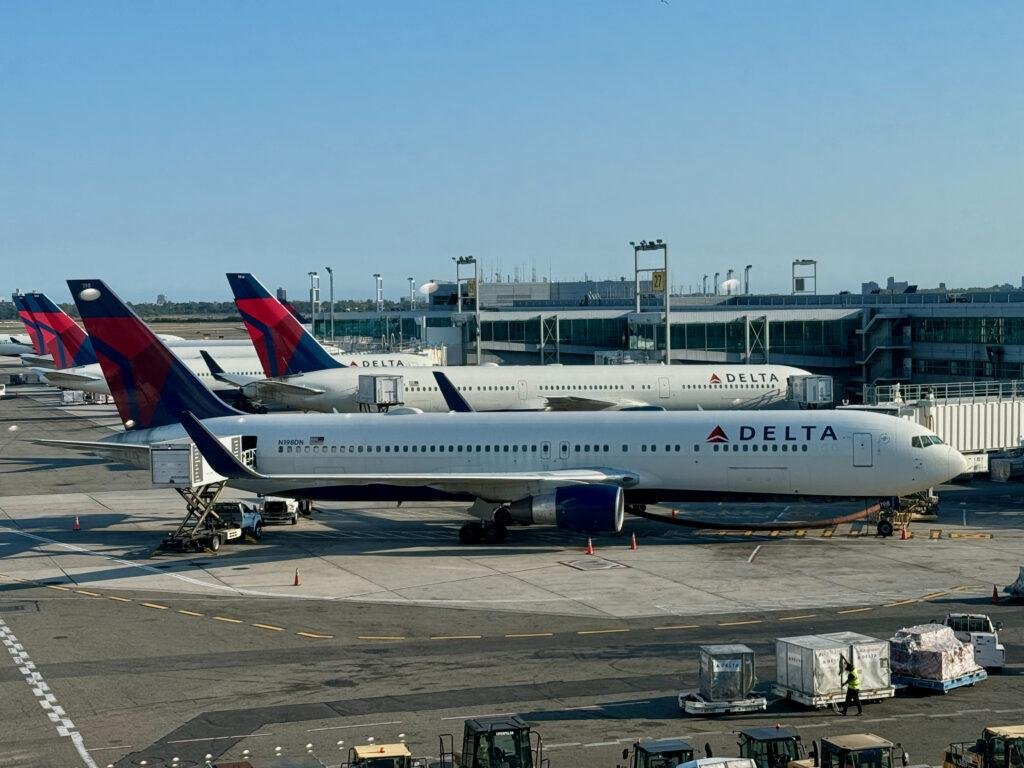
The Delta profit outlook for 2026 fell on Oct. 9, 2026, when Delta Air Lines said it now expects full-year adjusted earnings of $5.10 to $5.60 per share. In July, the airline had affirmed a range of $6.50 to $7.50. Its free cash flow forecast also fell, to approximately $2.5 billion from the $3 billion to $4 billion it affirmed in July.
The release points to fuel. “For the full year, we expect to generate a pre-tax profit of roughly $4.5 billion, absorbing a $6 billion increase in fuel costs,” Chief Executive Officer Ed Bastian said in the September quarter results release.
Demand held up. Delta reported record September quarter adjusted revenue of $17.6 billion, up 16% from a year earlier on flat capacity. Even so, adjusted earnings of $1.72 per share, against $1.70 a year earlier, fell short of the $2.00 to $2.50 Delta had forecast for the quarter in July.
How Delta’s 2026 Profit Outlook Changed
Guidance is the forecast a company gives investors for future periods. It is not a reported result, and Delta labels it forward-looking. Delta’s guidance figures are non-GAAP measures, meaning they exclude certain items that standard accounting rules (GAAP) would include.
The airline’s July 10 release on its June quarter said it was affirming full-year guidance for adjusted earnings per share (EPS) of $6.50 to $7.50 and free cash flow of $3 billion to $4 billion. At the time, Bastian said Delta was affirming “the guidance we set at the start of the year to grow earnings by 20 percent, overcoming a multi-billion dollar fuel headwind.”
Besides the lower earnings ($5.10 to $5.60) and free cash flow (about $2.5 billion) ranges, the Oct. 9 release gives this outlook:
- Gross leverage, measured as adjusted debt to EBITDAR, of approximately 2.2 times at year-end. In July, Delta had guided to approximately 2 times.
- December quarter total revenue up approximately 20% year over year, with an operating margin of 7% to 9% and earnings of $1.15 to $1.65 per share.
Delta presents the new range as its full-year outlook and does not call the change a cut; AeroTime reported it as a cut to the profit forecast. The comparison with July comes from Delta’s own two releases.
GAAP and Adjusted Results Tell Different Stories
Delta publishes both GAAP results and adjusted results. The adjustments are made “primarily for third-party refinery sales, gains/losses on investments and Monroe hedge results.” Monroe Energy is the Delta subsidiary that operates the Trainer refinery. The gap between the two sets of numbers was wide this quarter.
On a GAAP basis, September quarter operating revenue was $20.2 billion, up 21%. Operating income was $1.5 billion, a 7.2% margin compared with 10.1% a year earlier. Pre-tax income fell 40% to $1.1 billion, and net income fell 47% to $756 million, or $1.15 per diluted share against $2.17. Results below the operating line included a $218 million net loss on investments, compared with a $311 million gain in the same quarter of 2025.
When Bastian says Delta “delivered September quarter pre-tax profit of $1.5 billion, matching last year’s performance,” he is using the adjusted measure, which rose 1%; on that basis the operating margin was 9.4%, down from 11.1%.
Fuel Ran Above Delta’s July Assumptions
Fuel cost Delta $4.1 billion in the quarter on an adjusted basis, 62% more than in the September quarter of 2025, at an adjusted price of $3.61 per gallon, up 60%, after a refinery benefit of 13 cents per gallon. Consumption barely moved: Delta used 1,146 million gallons, up 1%.
In July, Delta’s September quarter guidance assumed an all-in fuel price of approximately $3.15 per gallon; its December quarter guidance, issued Oct. 9, assumes approximately $4.25, based on the Oct. 2, 2026, forward curve and a refinery benefit of approximately 40 cents per gallon.
“Delta delivered earnings of $1.72 per share in the September quarter, in line with last year while absorbing more than $500 million of higher fuel costs compared to our guidance in early July,” Chief Financial Officer Erik Snell said.
The release gives no baseline year for the $6 billion fuel increase Bastian cited; AeroTime reported it against 2025.
Other airlines are also responding to fuel costs. Air India this week revised its fuel surcharges, citing higher aviation turbine fuel costs.
Premium, Loyalty and Cargo Drove Record Revenue
“September quarter revenue grew approximately 16 percent over prior year, on flat capacity, driven by broad demand strength and healthy yield growth as we cover higher costs and manage the business for margins,” said Joe Esposito, Delta’s chief commercial officer.
Adjusted total unit revenue (TRASM) rose 15%. Delta reported growth across segments:
- Premium: revenue rose 18% on a 6% increase in seats.
- Main cabin: unit revenue grew 17% while seats fell by a low-single-digit percentage.
- Domestic: unit revenue rose 16%.
- International: unit revenue rose 12%, led by Latin America at 22%. Transatlantic unit revenue grew 11%, and transpacific revenue rose 13% on 8% more capacity.
- Loyalty: total loyalty revenue rose 18%. American Express remuneration grew 15% in the quarter, and Delta said that positions the full year to exceed $9 billion.
- Cargo and maintenance: cargo revenue rose 29%, and maintenance, repair and overhaul (MRO) revenue grew 28%.
For the December quarter, Esposito said seats are growing “less than 2 percent, including a reduction in Main Cabin seats.”
Unit Costs Rose 7.3% as Delta Pays Down Debt
Non-fuel cost per available seat mile (CASM-Ex) was 14.03 cents, up 7.3% from a year earlier. Snell said the increase was “driven primarily by higher crew and revenue-related costs on capacity growth that was several points below our original plan, including nearly one point of impact from summer storms.” Delta expects that rate of increase to ease by 1 to 2 points in the December quarter.
Free cash flow was $463 million for the quarter, and Bastian put the year-to-date total at $1.9 billion. Delta said it plans to pay down more than $2 billion of debt in 2026. Adjusted net debt stood at $13.4 billion at the end of the quarter, and liquidity was $6.9 billion. The airline has also accrued nearly $900 million in employee profit sharing toward a payout next February.
New Aircraft, New Routes and SAF Deals
Delta took delivery of 13 aircraft in the quarter, including Airbus A350-900, A321neo and A220-300 jets. It also announced new international routes for 2027: Seattle to Tokyo-Narita, Los Angeles to Manila, Austin to Paris-Charles de Gaulle, Detroit to Athens and Boston to Venice.
On sustainable aviation fuel (SAF), the release lists a multi-airport agreement with Shell Aviation to expand SAF access and a new SAF blending facility at Flint Hills Resources’ Pine Bend Refinery, which serves Delta’s Minneapolis-St. Paul hub. Delta was also a founding member of the Georgia SAF Coalition launched in Atlanta.
FAQ: Delta Profit Outlook
Did Delta cut its 2026 profit forecast?
Yes. Delta’s full-year adjusted EPS outlook is now $5.10 to $5.60, below the $6.50 to $7.50 range it affirmed in July. Delta’s release presents the new range as its outlook without using the word “cut.”
Why does Delta report two revenue figures?
GAAP revenue of $20.2 billion includes $2.6 billion of third-party sales by Delta’s refinery. Adjusted revenue of $17.6 billion excludes those sales.
What fuel price is Delta assuming for the fourth quarter?
About $4.25 per gallon all-in, based on the Oct. 2 forward curve and including a refinery benefit of about 40 cents per gallon.
Looking Ahead
Delta’s December quarter results will show whether it lands in its $1.15 to $1.65 per-share range. Those results will also show whether full-year adjusted EPS comes in at $5.10 to $5.60, with December quarter fuel near the assumed $4.25 per gallon. Snell said earnings at the upper end of the quarterly range would be “consistent with last year.” Looking to 2027, he said Delta remains “on track for low-single-digit unit cost growth as capacity normalizes.”
Sources
- Delta News Hub — Delta Air Lines announces September quarter 2026 financial results
- Delta Air Lines via PR Newswire — full September quarter 2026 release and financial tables
- U.S. SEC — Delta Air Lines Form 8-K, Exhibit 99.1 (Oct. 9, 2026)
- Delta Air Lines via PR Newswire — June quarter 2026 financial results (July guidance)
- AeroTime — Delta cuts 2026 profit forecast as fuel costs climb by $6 billion