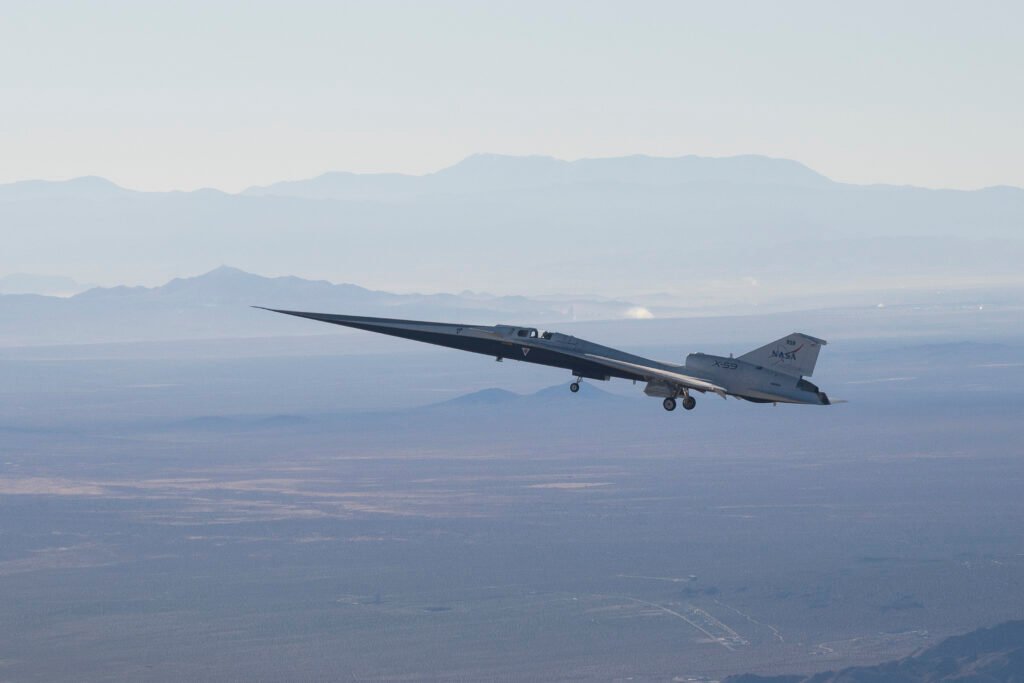
NASA X-59 flights reached a new test pace when the experimental quiet-supersonic aircraft completed six sorties in one week and recorded a top speed of Mach 1.53.
NASA reported the results on October 2, covering a series of two-flight days during the week of September 21. The aircraft had completed 38 test flights by the end of the period.
The results are part of envelope expansion rather than a declaration that public noise-response flights or commercial supersonic passenger service have started. NASA still must test systems and the aircraft across additional conditions.
Table of Contents
NASA X-59 Flights Expand Speed and Sortie Pace
NASA says the X-59 flew twice on September 22, twice on September 24 and twice on September 25. That total broke its prior single-week record by two flights, giving engineers more observations in a concentrated test window.
The top speed of Mach 1.53 is approximately 1,010 mph under the reported conditions. It exceeds the planned typical cruise test speed of Mach 1.4, demonstrating that the aircraft is being explored beyond the reference speed for certain missions.
The flight-test campaign also evaluates operation at multiple altitudes and through different maneuvers. A record speed does not, by itself, establish the acoustic performance that is central to NASA’s broader Quesst research.
NASA X-59 flights: Why the X-59 Is Different From an Airliner
The X-59 is an experimental research aircraft designed to study how a carefully shaped supersonic vehicle can alter the way sonic pressure waves reach the ground. NASA hopes the aircraft will produce a quieter acoustic signature than familiar loud sonic booms.
Engineers are interested in the responses of people who hear those quieter sounds. The agency plans to share research with regulators considering future data-based rules for supersonic operations over land.
The X-59 is not a prototype passenger airliner, and no new commercial overland supersonic route follows automatically from this week’s flights. Regulatory changes would require separate evidence and decisions.
Maintenance Before the Next Flight Series
Following the six-flight week, NASA placed the aircraft into scheduled maintenance estimated to last about three weeks. The team then plans a systems review before returning to a faster flight-test pace.
An organized inspection period is normal in development flying because intensive operations create data for engineers to evaluate and components to examine. The release does not identify a mishap as the reason for the scheduled break. The NASA X-59 flights were part of envelope expansion, not the public acoustic response campaign.
The agency has not yet established the date of its next public community-response phase in the October 2 update. The immediate step is restoring the research aircraft to flight status after planned checks.
FAQ: NASA X-59 flights
How fast have NASA X-59 flights reached?
NASA reported a Mach 1.53 top speed during its September 2026 flight-test week.
How many flights did the X-59 complete that week?
It completed six flights, bringing its cumulative total to 38 at the time of the update.
Can the X-59 carry airline passengers?
No. It is an experimental NASA research aircraft designed to collect supersonic flight and acoustic data.
Looking Ahead
NASA expects scheduled maintenance and a systems review before another flight series. Later community-noise research is a separate milestone requiring additional tests.
Sources