NASA lunar 5G development is moving into a contracted demonstration phase after the agency awarded Modulate Space Corporation work valued at approximately $38 million.
The September 30 announcement describes development of a standards-based communications system for future lunar surface operations, combining cellular technology with Wi-Fi 6 functions.
The award does not mean the Moon already has a functioning public 5G network. The agency described work phases for laboratory evaluation and a later flight demonstration, each subject to execution and mission readiness.
Table of Contents
NASA Lunar 5G Begins With Laboratory Development
The contract covers hardware, software and firmware needed to evaluate an integrated communications capability. NASA wants a scalable approach that can evolve as lunar surface activities increase in complexity.
One phase focuses on a 5G network-in-a-box and laboratory demonstration, scheduled from October 1, 2026, through January 31, 2028. Testing on Earth should help engineers examine equipment behavior and communication architecture before committing a system to lunar conditions.
A lab demonstration can establish technical performance under test conditions, but it is not proof of end-to-end operation across the lunar terrain. NASA’s announcement does not report a functioning lunar 5G installation.
NASA lunar 5G: A Later Flight Phase Combines 5G and Wi-Fi
The second work area addresses an integrated lunar 5G and Wi-Fi surface network with a planned flight demonstration. NASA lists a performance window starting November 30, 2026, and ending December 31, 2028.
Cellular and local wireless networking could support different communications ranges and device types for future surface science and infrastructure. The announcement frames that capability as technology development, not a final Moon Base communications specification.
The agency did not identify the launch vehicle, landing mission or precise demonstration location in this contract release. Those details require separate mission announcements and must not be inferred from the contract dates.
What the Contract Means for Surface Infrastructure
NASA expects lunar operations to involve multiple scientific and support systems that need information exchange. A communications system capable of integrating devices may help future missions coordinate equipment, sensor data and crew operations.
The award is firm-fixed-price, which describes the contracting structure and announced value. It does not reveal the cost of a fully deployed lunar network or commit NASA to purchase a production constellation or long-term service. The NASA lunar 5G project will have to progress through staged demonstrations before any deployed network can be claimed.
Before presenting performance claims, engineers will need measurements from testing in the relevant environment. Dust, terrain, thermal extremes and system power are examples of engineering considerations, not features that NASA says this award has already overcome.
FAQ: NASA lunar 5G
Who won the NASA lunar 5G development contract?
NASA awarded the technology-development contract to Modulate Space Corporation.
What is the reported contract value?
The agency describes a firm-fixed-price contract worth approximately $38 million.
Is a Moon-based 5G service already operational?
No. NASA describes future laboratory and lunar surface communications demonstrations, not an established service.
Looking Ahead
The laboratory milestone runs through January 2028, and the later lunar-surface demonstration has a published period ending in December 2028. Changes will require updated NASA notices.
Sources
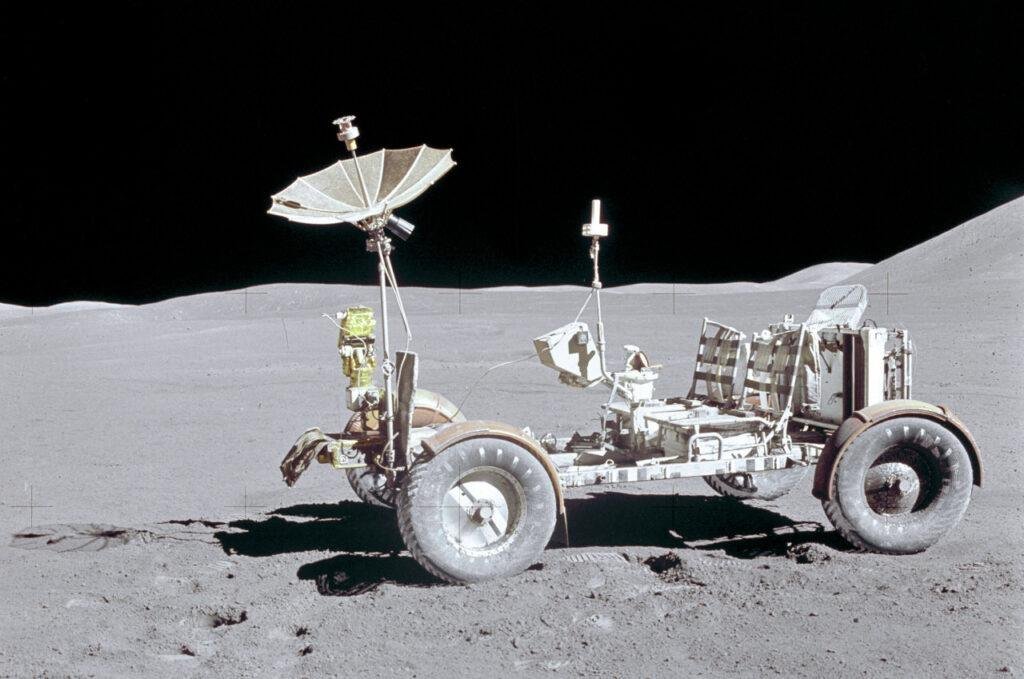
Image credit: NASA / Dave Scott (US-GOV-PUBLIC-DOMAIN; reuse terms). Featured image is an archival or contextual illustration, not the reported event.