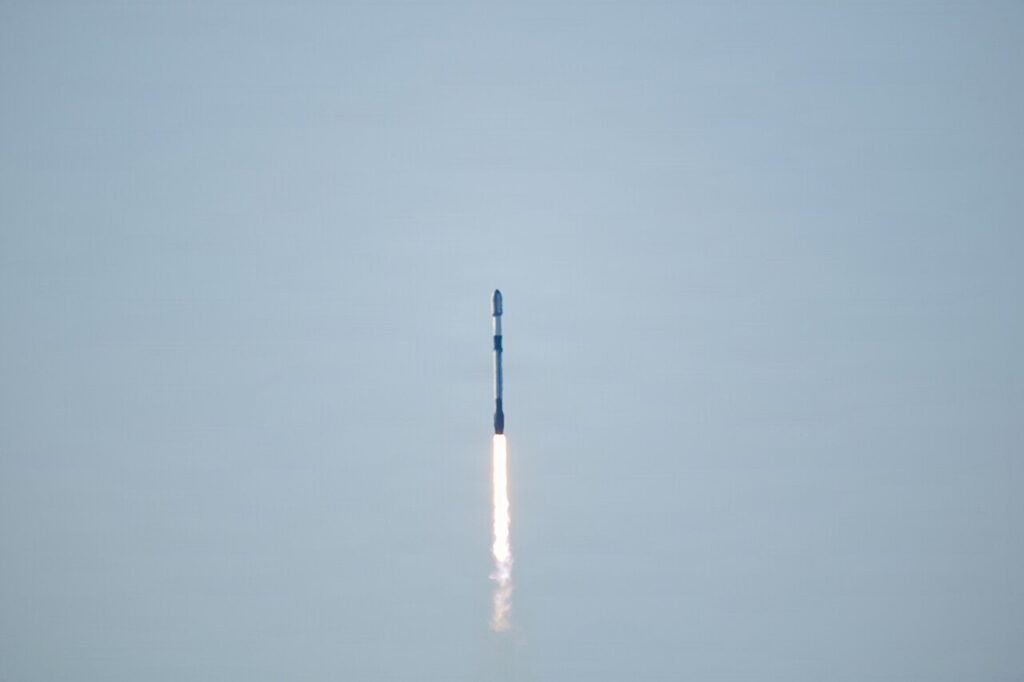
Tranche 1 satellites reached 84 spacecraft deployed to orbit after a Falcon 9 launched 21 additional U.S. military data-relay satellites from California on Saturday, Oct. 10, the Space Development Agency said. The new mission delivered the fourth orbital plane of the agency’s transport layer.
Northrop Grumman built the 21 spacecraft launched from Space Launch Complex 4 East at Vandenberg Space Force Base. The latest Tranche 1 satellites add to a distributed network. The agency described the successful launch as an expansion of a distributed low-Earth-orbit system intended to support military communications and missile-threat tracking.
The launch itself is complete, according to the agency. That does not mean the full Tranche 1 architecture is operational or all planned satellites have been deployed; the initial warfighting capability is targeted for 2027.
Table of Contents
Tranche 1 Satellites Add a Fourth Orbital Plane
The Space Development Agency said Saturday’s Falcon 9 carried 21 Tranche 1 Transport satellites built by Northrop Grumman. Their addition brought its reported on-orbit Tranche 1 satellite total to 84, with the launch campaign continuing until the constellation is fully delivered.
The Tranche 1 satellites launched Saturday marked the fourth orbital plane in the current delivery effort. Its success followed a postponed launch attempt on Oct. 5, when Falcon 9’s automated systems stopped the countdown just before liftoff. The agency did not describe the earlier halt as a launch failure, and Saturday’s account did not supply a separate cause for that automatic stop.
The agency said the latest payload represented satellites built by the third of four vendors selected to provide Tranche 1 spacecraft. This is a distinction about industrial participation, not evidence that all four suppliers have completed their deliveries.
Why a Distributed Satellite Network Matters
Tranche 1 satellites are intended to move military data through a larger network of relatively small spacecraft in low Earth orbit. The agency describes the Tranche 1 system as providing resilient, secure, low-latency, beyond-line-of-sight communications, including connections for forces operating far from conventional line-of-sight radio networks.
According to SDA, the architecture is designed to support persistent regional tactical data links, missile-warning and tracking information, beyond-line-of-sight targeting and connectivity through both optical links and Ka-band systems. These statements describe planned system roles rather than independently demonstrated end-to-end performance from Saturday’s newly launched payload.
For Tranche 1 satellites, the use of multiple orbital planes, vendors and launches spreads deployment across successive missions. This model also means that a reported spacecraft count measures deployment progress but cannot alone establish coverage, reliability or active operational availability.
Who Oversees Delivery and What Remains Unproven
Tranche 1 launches are provided through the National Security Space Launch program and overseen by Space Systems Command’s System Delta 80 and the Space Force executive responsible for space access, SDA said. The October 10 release was issued through the Space Force missile-warning-and-tracking acquisition organization with support from SDA.
On Tranche 1 satellites, the agency characterized the mission as a step toward a more survivable communications architecture. It did not publish a satellite-by-satellite operational-readiness report, exact final constellation size in this release or dates for the remaining flights.
Northrop Grumman’s role in this mission is spacecraft manufacturing. SpaceX supplied the Falcon 9 launch vehicle; these are distinct responsibilities, and neither claim establishes a separate contract value for Saturday’s flight.
FAQ: Tranche 1 Satellites and Their Transport Mission
How many satellites launched on October 10?
The Space Development Agency says Falcon 9 delivered 21 Northrop Grumman-built Tranche 1 transport spacecraft.
How many Tranche 1 spacecraft have reached orbit?
SDA reported a total of 84 on-orbit Tranche 1 spacecraft after this fourth orbital-plane launch.
Is the military satellite network operational now?
SDA targets initial Tranche 1 warfighting capability beginning in 2027; Saturday’s launch alone does not establish full service.
Looking Ahead
For Tranche 1 satellites, SDA expects the broader Tranche 1 launch campaign to continue and says initial warfighting capability will begin in 2027. The next verifiable milestones will be further orbital deployments and later agency confirmation of what operational links and military services have been activated; no precise next launch date was announced in Saturday’s release.
Sources
- Space Development Agency — Fourth Orbital Plane of Tranche 1 Satellites, Oct. 10
- Featured image (file photo): U.S. Space Force / 2nd Lt. Andrew Taller / DVIDS; U.S. Space Force public domain (U.S.).