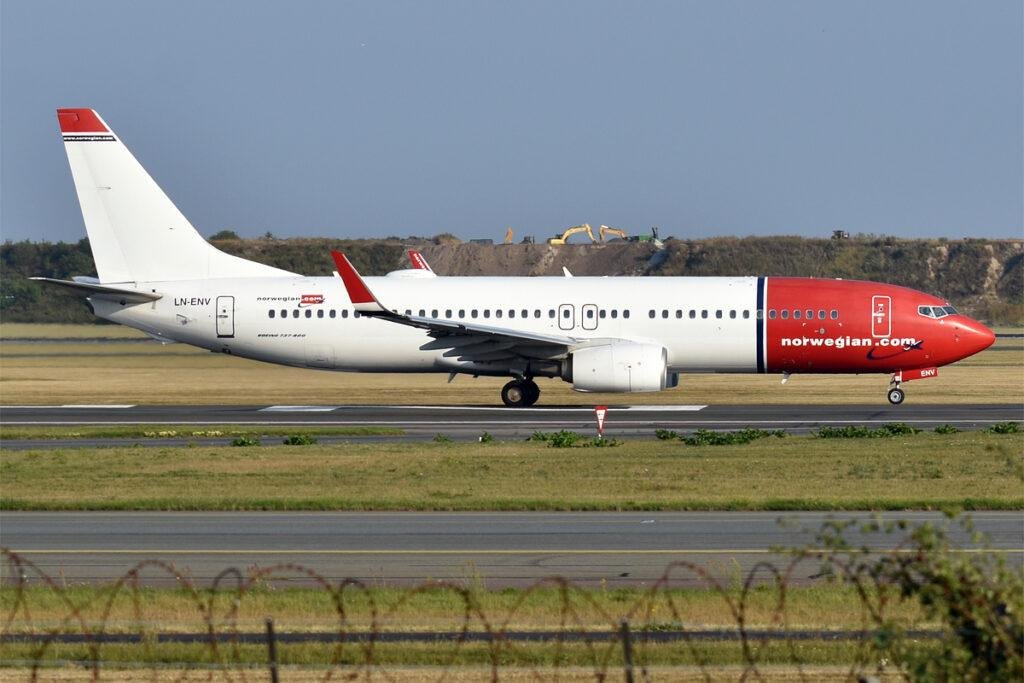
A Norwegian 737 engine shutdown prompted flight DY1122 to turn back toward Bergen, Norway, on Sunday, October 11, shortly after departing for Berlin. According to a report distributed by AeroInside from The Aviation Herald, the Boeing 737-800 landed safely at its departure airport after the crew shut down one of its engines.
The report identified the aircraft as registration LN-ENV and listed 140 passengers and six crew members. The flight departed runway 17, stopped climbing at approximately flight level 060, and landed on the same runway about 30 minutes after departure, the incident account said.
No injuries were reported in the material reviewed. The specific technical fault has not been established publicly, and an engine shutdown should not be described as a confirmed engine failure or an engine fire without additional evidence.
Table of Contents
How the Norwegian 737 Engine Shutdown Unfolded
The Bergen–Berlin service was in its initial climb when the pilots stopped climbing and elected to return. AeroInside’s report says the crew shut down a CFM56 engine after encountering a problem. It does not identify which engine, a particular component or a maintenance diagnosis.
The report says the crew requested increased preparedness from the airport without sending a formal emergency message. That description comes through the aviation incident reporter’s account of the airline’s statement; the actual operational communications were not independently reviewed for this article.
Bergen offered a practical return point because the flight was still close to its departure airport. The reported landing was completed safely, and the record reviewed contains no claim that a second engine had a problem.
Why a Controlled Engine Shutdown Is a Safety Procedure
The Boeing 737-800 is a twin-engine airliner. When a crew decides an engine should not continue operating normally, its procedures can call for isolating or shutting down the affected engine and planning a landing. The important distinction is that the crew’s action is known here, while the underlying cause is not.
An orderly return after a precautionary shutdown can avoid continued exposure to an uncertain malfunction. It does not prove there was a fire, internal engine damage or a loss of all thrust. None of those diagnoses appears in the opened incident report.
The aircraft’s flight level was reported as FL060, approximately 6,000 feet in standard pressure altitude. That is an aviation reporting level, not evidence of how high the jet was above the local terrain at every moment. Any reconstruction of the exact route would require verified flight data.
What Is Known About Passengers and the Aircraft
The reported total of 146 occupants consists of 140 passengers and six crew members. There is no sourced indication in the reviewed account of an evacuation or injury after landing. Absence of such detail should not be expanded into an assertion about medical evaluations or passenger handling.
The aviation report identifies LN-ENV as a Boeing 737-800 and gives its intended destination as Berlin. Public flight-history listings confirm DY1122 is associated with the Bergen–Berlin city pair, but the tracker information reviewed did not independently establish the incident sequence or final aircraft disposition.
Whether the aircraft was taken out of service, replaced for later flights or released following maintenance was not confirmed. The airline’s maintenance assessment, rather than the simple act of returning, would determine the next operational steps.
FAQ: Norwegian Flight DY1122
Where did the Norwegian 737 engine shutdown occur?
The crew turned back shortly after departing Bergen, Norway, on a scheduled flight to Berlin, according to AeroInside.
Did flight DY1122 land safely?
Yes. The incident report says the Boeing 737-800 landed back at Bergen about 30 minutes after departure.
What caused the engine to be shut down?
The reviewed report does not identify a confirmed technical cause; it says the crew shut down an engine after a problem.
Looking Ahead
The next meaningful confirmation would be a maintenance finding or a further Norwegian statement identifying the problem and the aircraft’s return-to-service status. No formal investigation timetable or technical diagnosis was available in the material reviewed. The safest description remains a reported precautionary engine shutdown followed by a successful return.
Sources
- AeroInside / The Aviation Herald — DY1122 engine shutdown, Oct. 11
- Flightradar24 — DY1122 route history
File photo (2022): Norwegian Air Shuttle Boeing 737-800 LN-ENV. Archive aircraft photo, not the October 2026 engine shutdown. Photo: Anna Zvereva / Wikimedia Commons; license: CC BY-SA 2.0.