FAA SMART AI tool use around Washington, D.C., is facing congressional scrutiny after 25 lawmakers urged the Federal Aviation Administration to pause the system pending answers about safety testing, controller training, and oversight. SMART entered limited use on September 21, 2026; the request itself does not suspend air traffic operations.
The Strategic Management of Airspace, Routes and Trajectories (SMART) platform draws on aviation data to support traffic-flow planning. The FAA says it is intended to anticipate congestion and weather disruptions, while people continue to make operational decisions.
The October 9 congressional letter asks the FAA and Department of Transportation to explain how the system was evaluated and what safeguards apply during its initial rollout. It does not establish that SMART caused an aviation incident or that controllers surrendered their authority to software.
Table of Contents
SMART Tool Draws Questions About Safety Review
The September 21 launch covered airspace around Ronald Reagan Washington National Airport, Washington Dulles International Airport and Baltimore/Washington International Thurgood Marshall Airport. The congressional letter describes an initial 90-day evaluation period before possible expansion to other regions.
In their request to Transportation Secretary Sean Duffy and FAA Administrator Bryan Bedford, lawmakers ask whether the agency completed a formal in-service decision and a safety risk management review. They also seek records identifying the AI models used, how accuracy was measured and whether any normal review steps were shortened or waived.
Lawmakers say they have not seen sufficient testing records or advance consultation with frontline personnel. That raises transparency questions but does not prove no safety review occurred.
The letter also asks why the National Capital Region was selected for the initial deployment. Its authors cite complex regional airspace and the January 2025 midair collision near Reagan National as reasons for careful scrutiny; neither incident is attributed to SMART.
AI Decision Support Differs From Controller Clearance
The FAA announced SMART as a platform that brings together approximately 200 data streams, including weather, flight paths, traffic demand and controller staffing information. Its stated purpose is to help specialists predict bottlenecks hours, days or weeks ahead and consider scheduling or routing adjustments.
According to the FAA, the tool cannot replace air traffic controllers or take control of an aircraft. FAA staff review its recommendations, and local air traffic facility leadership may accept or decline scheduling suggestions. A planning recommendation is therefore different from a clearance issued to a pilot by a controller.
Even so, human review is only useful when operators understand a system’s limits. Lawmakers have requested specifics on training, consultation with the National Air Traffic Controllers Association and other stakeholders, and the ability to override or document SMART recommendations. They also ask how officials would investigate a recommendation that might contribute to a safety event.
The FAA has promoted possible benefits such as fewer delays, more predictable traffic flows and better use of available airspace. Those are agency objectives, not independently verified results of the Washington-area evaluation. A credible assessment will need both performance measurements and evidence that safety procedures remain effective.
A Congressional Pause Request Is Not an FAA Shutdown
A letter requesting a pause does not itself suspend a federal program. As of October 14, the official FAA announcement and congressional materials reviewed for this article do not establish that SMART has been shut down. Any later operational change would require fresh confirmation from the agency.
The letter asks for answers by October 19, 2026, including how the 90-day trial will be evaluated, which benchmarks will govern wider use, and who provides independent oversight. It also seeks clarity on responsibility if a recommendation plays a part in a loss of separation or another safety incident.
That creates two questions for aviation readers to follow separately: whether the software can improve traffic-flow decisions, and whether the FAA can demonstrate that its deployment process meets safety and accountability expectations. Neither question can be settled simply by labeling the technology ‘AI.’
The next meaningful updates will be the FAA’s response, released assessments and verified changes to the trial.
FAQ: FAA SMART AI tool
What does SMART stand for?
Strategic Management of Airspace, Routes and Trajectories, an FAA traffic-management planning platform that uses AI-supported analysis.
Has Congress shut the SMART system down?
No. Lawmakers have requested a pause, but their letter does not itself order the FAA to suspend the system.
Does SMART replace air traffic controllers?
No. The FAA says SMART provides planning recommendations for human review; controllers retain their operational responsibilities.
Looking Ahead
The October 19 response deadline and any release of safety evaluations will be important next checkpoints. The Aviation Diary will distinguish official findings, congressional concerns and the FAA’s stated performance goals as further records become available.
Sources
- U.S. Senator Chris Van Hollen – October 9 congressional letter and questions
- FAA – September 21 SMART deployment announcement
- U.S. Representative Alexandria Ocasio-Cortez – October 13 press release
- FLYING – FAA urged to pause AI-based SMART system (October 14)
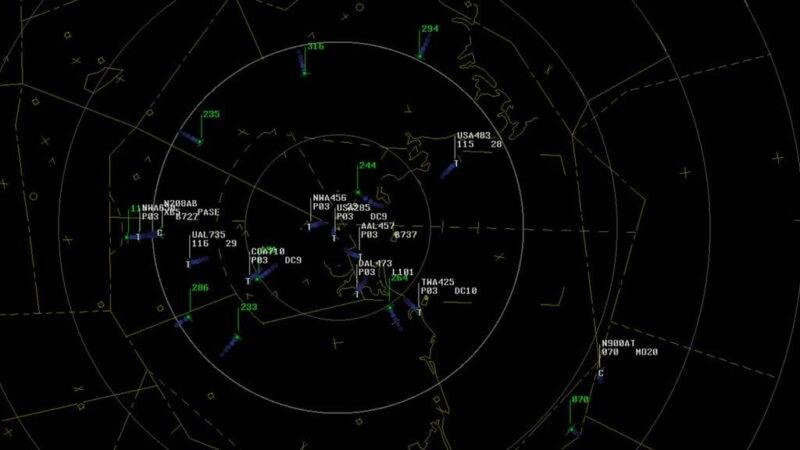
Featured image: Archival photo of an air traffic control tower at Washington National Airport (2005). Photo: dbking/Wikimedia Commons, CC BY 2.0. Illustrative; not a photograph of the SMART software or its deployment.