Corendon 737 radio communication trouble prompted an emergency response in Germany on October 13, 2026, when officials sent fighter jets to escort a passenger aircraft and temporarily restricted operations at Nuremberg Airport. The flight was traveling from Corfu, Greece, to Nuremberg with 178 passengers aboard.
German police said authorities received a cockpit code suggesting a possible hijacking and were unable to establish contact with the crew. Corendon Airlines subsequently attributed the alert to a brief radio-system malfunction and said there was no actual hijacking or danger to those aboard.
The Boeing 737-800 landed safely. According to the Associated Press, the precautionary airport response delayed six flights and diverted two incoming flights, even though the airline later said the flight itself was not experiencing a security threat.
Table of Contents
Corendon 737 Radio Alert Prompted a Security Response
Corendon told the Associated Press that its aircraft transmitted an emergency code while flying over Croatia because of a short disruption in radio communication. The airline said the aircraft continued safely and that passengers, crew and the jet were not endangered by a hijacking event.
A German police spokesperson explained that the cockpit signal suggested a possible hijacking, while attempts to communicate with the crew were unsuccessful. With that information, officials treated the event as a potential security emergency until they could verify the aircraft’s status.
Fighter aircraft were scrambled and the passenger jet was escorted toward Nuremberg. The emergency response was triggered by what controllers and authorities could observe at the time, not by evidence that a hijacker had taken control.
Neither the Associated Press report nor the airline statement established a detailed technical failure chain. The distinction matters: a radio problem and a hijacking indication can produce similar urgent operational responses but are entirely different underlying events.
Nuremberg Airport Delayed and Diverted Flights
Police temporarily secured and cordoned off areas of Nuremberg Airport while responding to the alert, according to information reported by German news agency dpa and carried by the Associated Press. The restrictions were precautionary while the aircraft’s condition was being established.
An airport spokesperson said six flights were delayed and two arriving flights were redirected. That operational disruption affected other travelers even though Corendon later described its own flight as safe throughout.
Authorities must make time-sensitive decisions when a cockpit code appears to indicate interference with a flight, especially when routine radio confirmation is unavailable. The response can precede a finding on cause.
The airline’s statement does not indicate that passengers were subjected to a completed evacuation or an injury-related emergency. The record does not detail onboard checks.
Why a Cockpit Code Can Escalate an Aviation Event
Air traffic control uses transponder codes and radio contact as separate sources of information about an aircraft. A code that signals possible unlawful interference demands attention, but controllers still need to verify the flight’s actual situation through communications and other means.
Corendon’s explanation raises a technical question about how the communication malfunction and alarming transmitted code coincided. Without investigation details, it would be premature to call the incident a deliberate false alarm or to assign blame to a pilot, controller or onboard equipment.
The episode illustrates why the early public description of an aviation emergency can change as authorities establish facts. Security measures are designed to address uncertainty quickly; their activation is not proof that the suspected event occurred.
For TAD readers, the central outcome is the combination of a safely completed flight and a measurable airport disruption. Any investigation into the radio system or the selection of the emergency code remains separate from the confirmed fact that no hijacking was reported.
FAQ: Corendon 737 radio
Was the Corendon Boeing 737 hijacked?
No. Corendon told the Associated Press there was no hijacking or danger and attributed the alert to a brief radio communication malfunction.
Why did German fighter jets escort the aircraft?
Authorities said the flight transmitted a cockpit code suggesting a hijacking and they could not establish contact, so they responded as a precaution.
How were Nuremberg Airport flights affected?
The Associated Press reported six delayed flights and two inbound diversions during the temporary security response.
Looking Ahead
The cause and precise sequence of the radio-system malfunction have not been made public in a final technical report. Further statements from the airline or German authorities could clarify how the emergency code appeared and how routine communication was restored. No safety findings should be assumed in advance.
Sources
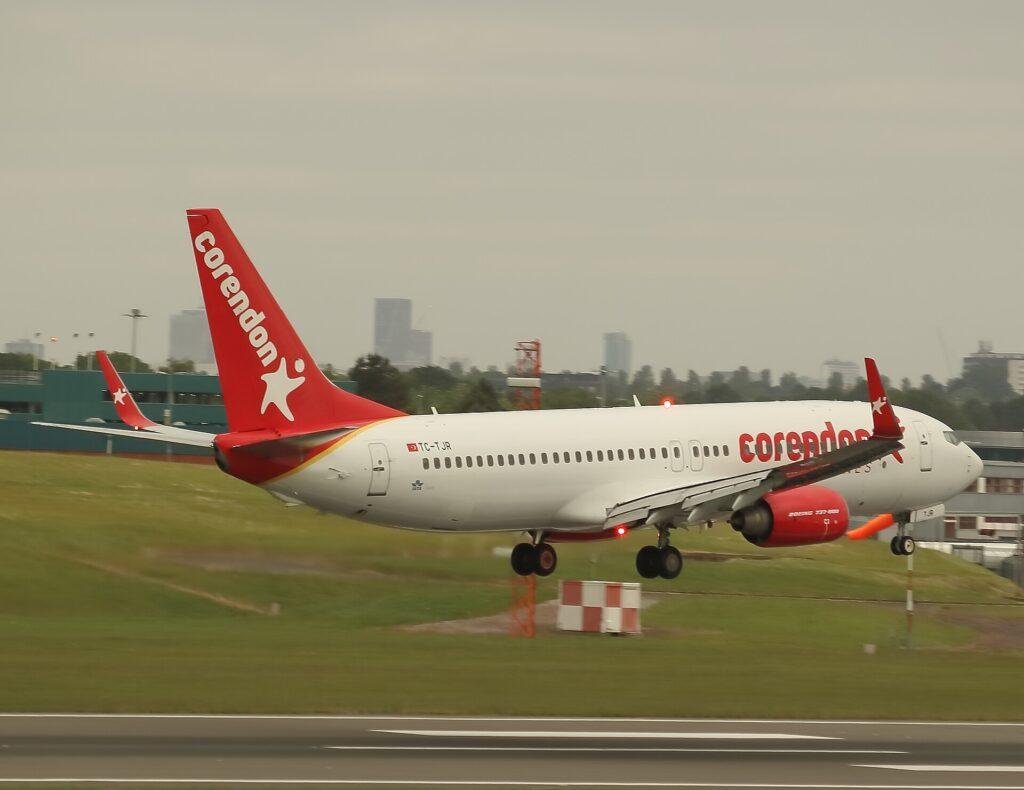
Featured image: Corendon Airlines Boeing 737-800 TC-TJR photographed in May 2023. File photo; this is not verified as the aircraft escorted to Nuremberg. Photo: simon butler. License: CC BY 2.0. Source: Wikimedia Commons image page (license). Image scaled for web without other edits.