ESA satellite interference mitigation has gained a new institutional partner through an agreement signed with the International Astronomical Union’s Centre for the Protection of the Dark and Quiet Sky. The European Space Agency announced the cooperation on October 8.
The memorandum of intent was signed at the International Astronautical Congress, ESA said. It brings together spacecraft engineering expertise and astronomical observers to explore designs that limit reflected light and unwanted radio emissions from satellites.
The agreement does not impose a new universal satellite regulation or prove that existing constellations are already less disruptive. Its immediate result is a framework for technical work and dialogue between scientists, manufacturers and satellite operators.
Table of Contents
How ESA Satellite Interference Affects Astronomy
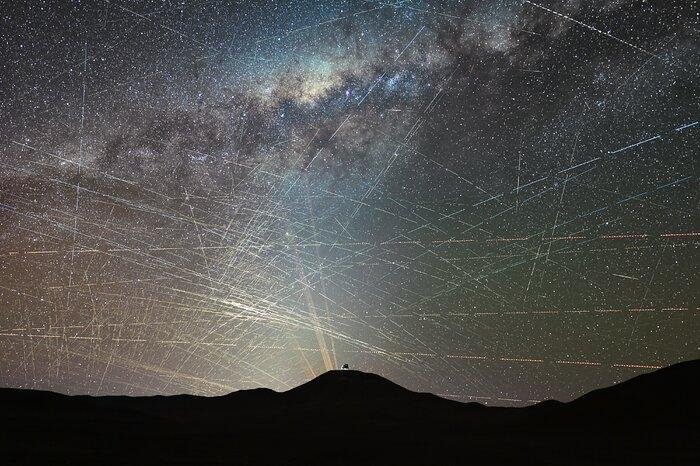
ESA satellite interference research addresses spacecraft that can disrupt optical observations when sunlight reflecting from their surfaces creates bright tracks across long-exposure telescope images. For astronomers studying faint objects, unwanted light can obscure part of a measurement or complicate analysis of the recorded data.
Radio astronomy faces a different but related problem. ESA explained that electronics aboard spacecraft can emit unwanted radio signals that overlap with frequencies of interest to sensitive instruments. Such emissions can disrupt an observation even when a satellite is not visible to the human eye.
Neither challenge is solved simply by moving a spacecraft out of one photograph. The effects depend on satellite design, position, observing conditions and the scientific instrument. ESA’s new cooperation aims to bring spacecraft builders and observers into technical discussions before problems are locked into hardware.
What Engineers Could Change Before Launch
For ESA satellite interference work, the agency highlighted darker spacecraft surfaces as one approach to reducing reflected sunlight. The agency also identified quieter electronic systems that produce less unintended radio interference, along with modelling techniques to estimate how a future spacecraft may appear in ground-based observations.
These are possible engineering measures, not a list of certified changes already adopted by all satellite operators. Any actual reduction in interference would need to be demonstrated through measurements and incorporated into design standards or operational practices as appropriate.
The emphasis on early design decisions matters because an orbiting satellite is more difficult to modify than one still in development. Designers can examine tradeoffs involving surface treatment, onboard electronics and mission requirements while technical options are still available.
What ESA and the IAU Center Agreed to Do
The ESA satellite interference agreement involves an IAU center that connects observatories, researchers, industry and members of the public who are concerned about interference with the night sky. ESA will contribute engineering knowledge and help engage manufacturers and operators on potential mitigations.
The agencies described a goal of sharing best practices, developing new approaches and encouraging dialogue rather than a programme with a disclosed budget or timetable. ESA’s director of operations, Rolf Densing, said the intention is to allow space activities and scientific observing to coexist.
ESA satellite interference work also reaches beyond specialist observatories. ESA noted that the night sky has cultural value and that natural darkness matters to wildlife. Those concerns form context for the effort, although the signed agreement primarily addresses astronomical interference caused by spacecraft.
FAQ: ESA and satellite interference
What is the ESA satellite interference agreement?
ESA announced a memorandum of intent with the IAU dark-and-quiet-sky center to cooperate on mitigation.
How do satellites disrupt astronomy?
Reflected light can streak across telescope images, while unintended electronic emissions can interfere with radio observations.
Does the agreement ban bright satellites?
No. ESA described cooperation and possible engineering approaches, not a binding satellite ban.
Looking Ahead
The useful next milestones will be published engineering guidance, trial results or adopted operator practices from the ESA–IAU effort. No deadlines or quantitative brightness targets were announced, so the impact must be measured through subsequent technical work.
Sources