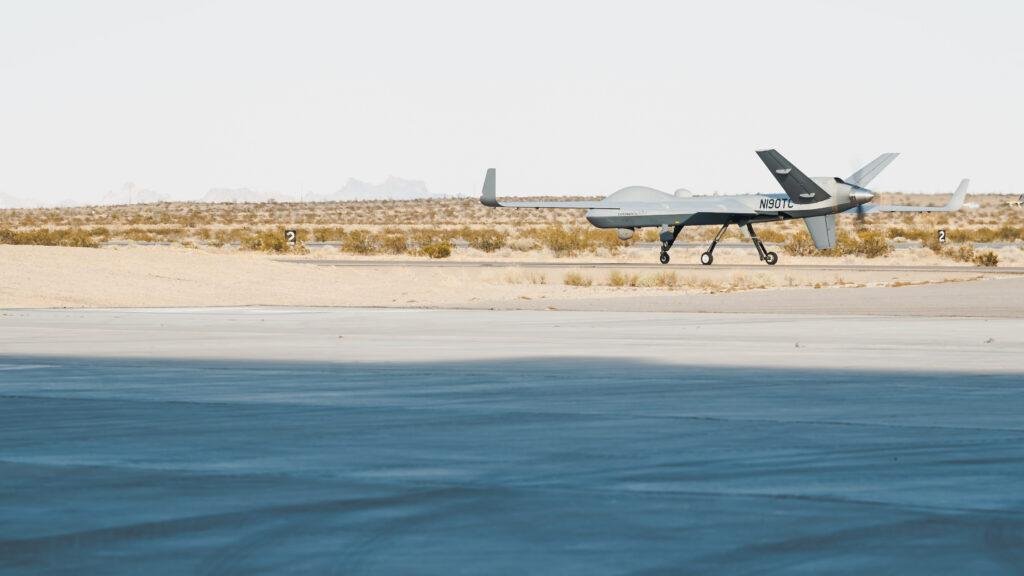
MQ-9B LoyalEye flight tests showed an uncrewed General Atomics aircraft carrying Saab airborne early-warning radar tracking several aircraft and maritime targets, the partners said on Oct. 28, 2026. The flights took place over recent months from General Atomics’ Desert Horizon facility in Southern California.
The companies described simultaneous, long-range tracking of instrumented fighter aircraft, commercial jets and maritime contacts. They did not announce an operational deployment or a signed production order. Their reports describe a development and evaluation milestone for airborne sensing rather than a finished military acquisition.
Table of Contents
MQ-9B LoyalEye Tracks Multiple Targets
General Atomics said the radar equipment flew on an MQ-9B, with Saab’s LoyalEye sensors mounted in external payload pods. During the testing, operators followed multiple targets at once, including aircraft acting as opposing fighters. Saab separately said the trials included target detection, tracking and classification under a representative operational scenario.
The manufacturer’s account confirms that customer interest is being discussed but does not identify a committed buyer. The companies did not disclose radar detection ranges, performance against specific threats, or the exact number of tracked contacts. Those omissions matter when comparing a flight demonstration with an established surveillance system.
Saab said the evaluation began with the configuration’s first flight in May. That places the latest reported result within a continuing test program, not a separate first flight in October. A sequence of flight and sensor demonstrations can establish technical readiness before governments decide whether to place operational orders.
Why Uncrewed Early Warning Matters
Conventional airborne early warning usually depends on large crewed aircraft with radar operators or data links feeding command posts. Moving a sensor to an unmanned platform could let military planners position surveillance assets differently, especially when long endurance or distance from personnel is valuable. The concept does not remove requirements for crews on the ground.
General Atomics also described possible distributed battle management and command-and-control arrangements, with information processed on shore, aboard ships or through other airborne assets. Such architectures depend on dependable communications and coordination. The October announcement did not establish that a particular military command network has completed acceptance of this integration.
The MQ-9B LoyalEye concept is different from the fighter procurement discussed in TAD’s F-35 production coverage. The earlier report concerns combat aircraft procurement; this development concerns collecting information that could help a broader force understand activity in the air and at sea.
What the Partners Have Not Confirmed
The companies said the radar tracked real aircraft and maritime targets during the tests, but they did not publish independent military evaluation results. Public descriptions also omit how the uncrewed system performed under electronic interference, during prolonged deployments or when exchanging data with several competing command networks.
No operational MQ-9B LoyalEye squadron, procurement quantity or service entry date was announced. The firms say they are discussing the capability with prospective customers. That is an indication of market engagement, not evidence that any specific country has selected an unmanned airborne early-warning fleet.
The next distinction for editors and defense planners is between a flown prototype, a fully qualified configuration and fielded service. The October test supports the first of those stages. Endurance, data-link resilience, training and maintenance requirements would still have to be evaluated before operational use.
FAQ: MQ-9B LoyalEye
What did MQ-9B LoyalEye demonstrate?
The companies say the aircraft tracked several air and maritime contacts during flight testing in Southern California.
Has a country bought the new radar-equipped drone?
Neither company identified a confirmed procurement customer or an operational entry-into-service date in its Oct. 28 announcement.
Is LoyalEye the same as a crewed radar aircraft?
No. It is an unmanned airborne early-warning configuration intended to complement existing crewed surveillance and command systems.
Looking Ahead
Additional sensor flights, customer evaluations and any future procurement announcements will determine whether MQ-9B LoyalEye progresses beyond its test configuration. Saab and General Atomics provided no committed delivery date or unit deployment schedule on Oct. 28.
Sources
General Atomics test announcement
Related profiles