Boeing has won the F-15 Eagle Crest contract, a sole-source, indefinite-delivery/indefinite-quantity agreement with a ceiling value of $131.23 billion, the largest F-15 award in the program’s history. The U.S. Department of War announced the contract on August 24, covering production, modernization, and sustainment of the F-15 fleet through 2037.
The award lands the same week Boeing reported its highest quarterly aircraft deliveries since 2018, pushing the company’s overall order backlog to a record $597 billion.
Table of Contents
What the F-15 Eagle Crest Contract Covers
The contract, numbered FA8634-26-D-B001, was awarded through the Air Force Life Cycle Management Center at Wright-Patterson Air Force Base, Ohio. It spans the full F-15 Eagle Weapon System lifecycle, covering:
- New aircraft production
- Systems integration
- Modernization and upgrades
- Retrofits
- Fleet sustainment
Work will be performed in St. Louis, Missouri, supporting F-15 fleets operated by the Air Force, Air National Guard, and other Department of War customers. The initial ordering period runs through August 24, 2031, with an option to extend ordering authority through August 24, 2036. The overall contract is expected to be completed by August 2037.
Ceiling vs. Actual Funding
The headline $131.23 billion figure describes the contract’s ceiling, the maximum amount the Pentagon could spend under this vehicle over its 12-year life, not a guaranteed payout to Boeing. As an IDIQ contract, actual funding is obligated incrementally as individual task and delivery orders are placed.
The contract ceiling represents the maximum potential value of the vehicle and does not guarantee that the full $131.23 billion will be obligated.
At the time of award, the only funds actually obligated were $343,740 in fiscal 2026 research, development, test, and evaluation money, a small fraction of the contract’s ceiling. The gap between the two numbers is normal for large IDIQ vehicles, which exist to give the Pentagon a pre-negotiated framework it can draw against over many years rather than renegotiating terms with each new order.
The Foreign Military Sales Angle
The Eagle Crest contract vehicle also covers potential Foreign Military Sales activity for seven countries: Japan, Israel, Saudi Arabia, South Korea, Singapore, Indonesia, and Poland. Building FMS authority directly into the contract framework gives Boeing and the Air Force a pre-cleared path to fulfill future international F-15 orders without negotiating a separate contract vehicle each time.
Several of the listed countries already operate F-15 variants. Japan, Israel, Saudi Arabia, South Korea, and Singapore have flown F-15s for years, while Indonesia and Poland represent newer or prospective F-15 customers. The contract’s structure suggests continued international demand for the platform even as the U.S. Air Force shifts more of its own fighter investment toward fifth- and sixth-generation programs.
A Fighter Built to Outlast Its Successor
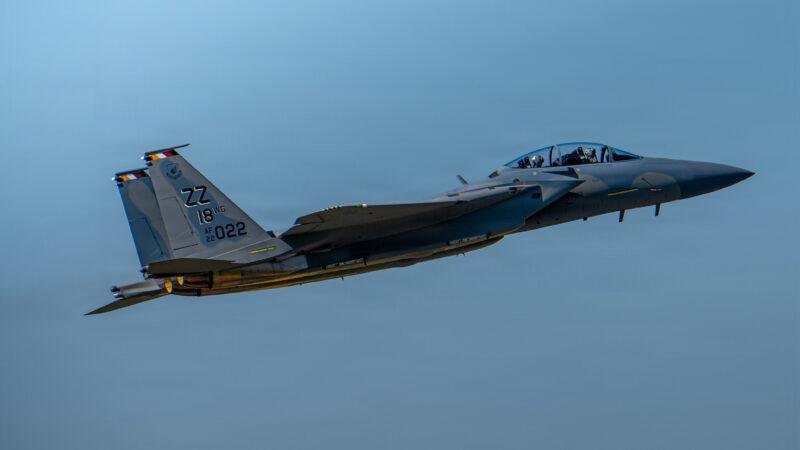
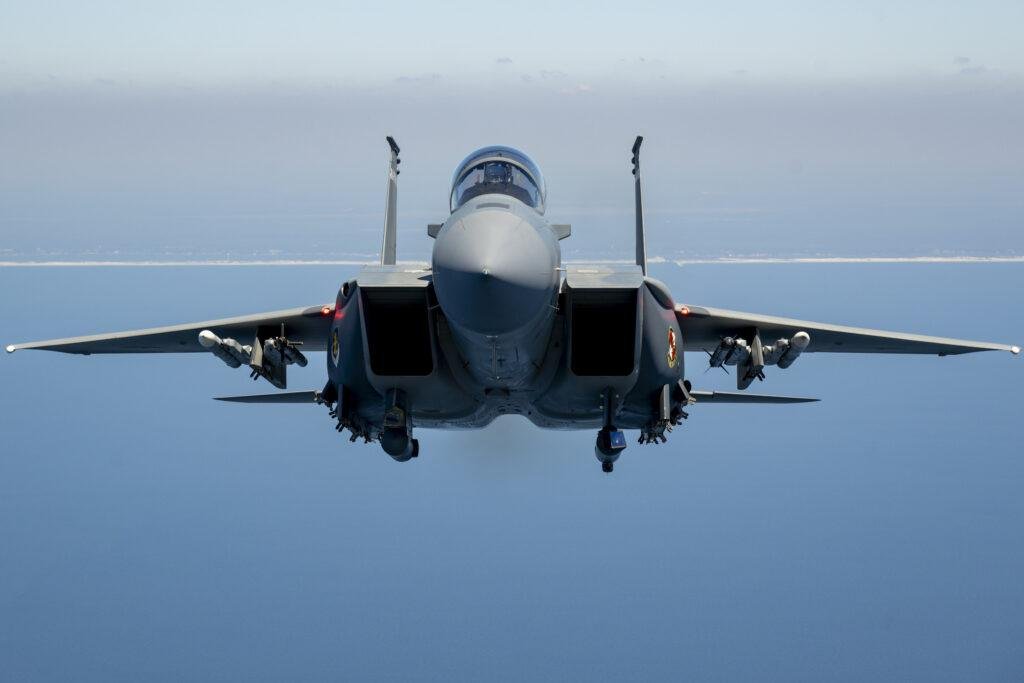
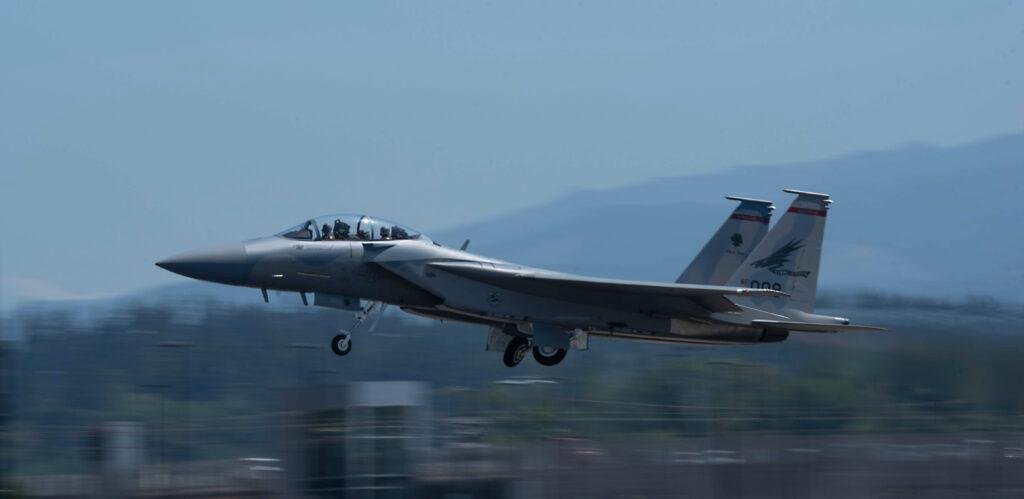
The Eagle Crest award underscores how central the F-15 remains to U.S. and allied airpower even as fifth-generation stealth fighters take on a growing share of the mission set. The current-production F-15EX Eagle II, built for the Air Force and Air National Guard, carries a larger weapons payload and more advanced mission systems than earlier F-15 variants, while retaining the type’s long-standing reputation for speed, range, and weapons capacity.
The 142nd Wing of the Oregon Air National Guard became the first operational unit to field the F-15EX, receiving its first aircraft in June 2024 and formally unveiling it to the public that July.
Market Reaction
Boeing shares ended the regular trading session down 1.75% on the day the contract was disclosed, but climbed 0.41% in after-hours trading once the award became public. The Eagle Crest news arrived alongside Boeing’s disclosure of its strongest quarterly aircraft delivery total since 2018, contributing to a record $597 billion order backlog spanning more than 6,200 aircraft on the commercial side of the business.
Retail investors reacted favorably to the pairing of a long-term, high-ceiling defense contract with strong commercial delivery numbers, with some predicting the stock could open higher in subsequent sessions.
FAQ: F-15 Eagle Crest Contract
How much is the F-15 Eagle Crest contract actually worth?
The contract has a ceiling of $131.23 billion, but that is the maximum the Pentagon could spend over the contract’s life, not a guaranteed payment. Only $343,740 in fiscal 2026 funds were obligated at the time of award.
Which countries are covered by the contract’s Foreign Military Sales provisions?
The contract vehicle covers potential FMS activity for Japan, Israel, Saudi Arabia, South Korea, Singapore, Indonesia, and Poland.
How long does the F-15 Eagle Crest contract last?
The initial ordering period runs through August 24, 2031, with an option to extend through August 24, 2036. The overall contract is expected to be completed by August 2037.
Looking Ahead
The F-15 Eagle Crest contract gives Boeing a stable, long-term framework for F-15 production and sustainment through 2037, spanning both U.S. Air Force and allied fleets. As individual task and delivery orders are placed against the ceiling in the coming years, the real scale of the program will become clearer, but the award itself signals continued confidence in the F-15 platform as a complement to fifth-generation fighters rather than a program headed toward retirement.
The Aviation Diary will continue tracking F-15 program developments, Boeing defense contracts, and Foreign Military Sales activity as they unfold.
Source
- U.S. Department of War — Contract Announcements, August 24, 2026
- St. Louis Post-Dispatch — Boeing awarded $131 billion contract for F-15 work to be done in St. Louis
- Stocktwits — Boeing Wins $131B F-15 Contract From US Air Force