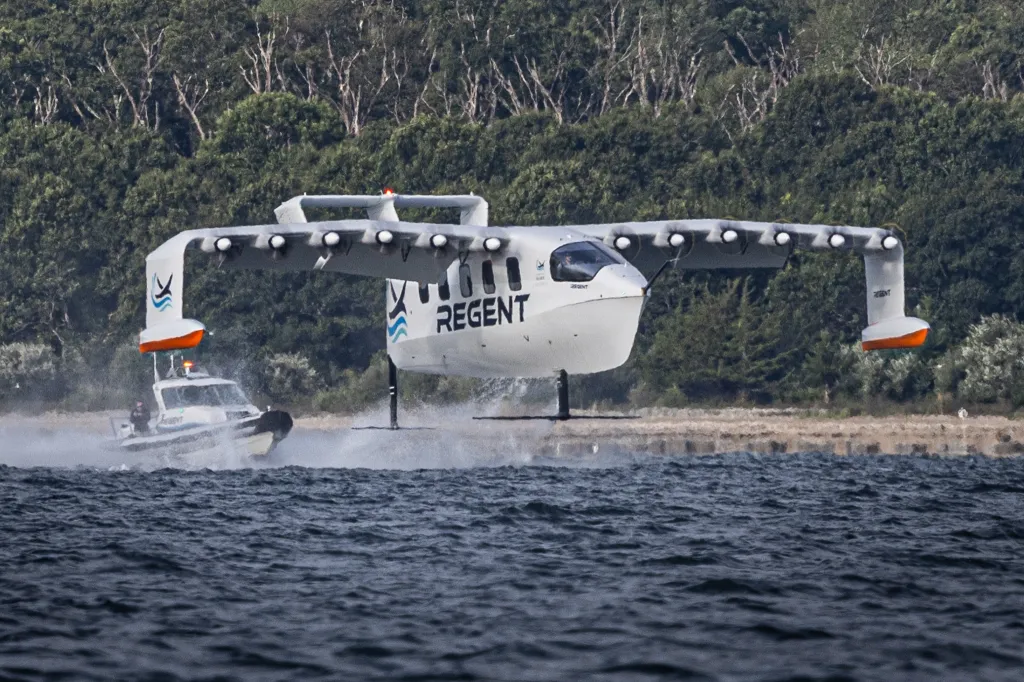
The Seaglider first crewed flight happened September 2 over Narragansett Bay, Rhode Island, when REGENT Craft’s all-electric Viceroy prototype carried two captains 1,956 feet at 33 feet above the water in a 30-second hop. It’s the largest all-electric wing-in-ground effect craft ever to fly with people aboard.
The flight caps five and a half years of development and lands a week after REGENT closed a $240 million Series B round, positioning the Rhode Island company to move from prototype testing into full-scale production of a vehicle that is regulated as a boat but flies like an airplane.
Table of Contents
What Happened Over Narragansett Bay
REGENT’s full-scale Viceroy prototype took off from the company’s North Kingstown, Rhode Island headquarters with two captains aboard, covering 1,956 feet at a height of about 33 feet above the water in roughly 30 seconds. The flight followed a summer of progressively faster hydrofoiling tests on the bay and marks the start of the program’s final stage of sea trials before production.
“This is the moment we have been envisioning and tirelessly pursuing for the past five and a half years: REGENT has successfully proven safe, efficient ground-effect flight. The Viceroy Seaglider flight marks the start of a new era in mobility, unlocking opportunities across passenger travel, defense missions, and cargo transport.”
Billy Thalheimer, co-founder and CEO, REGENT
The company says the milestone makes the Viceroy the largest all-electric wing-in-ground effect (WIG) craft to fly with people aboard. It follows an earlier, uncrewed test flight of REGENT’s smaller Squire Seaglider drone.
What Is a Seaglider, Exactly?
A Seaglider is a hydrofoiling, wing-in-ground effect craft: an all-electric vehicle that operates entirely over water and moves through three distinct modes as it accelerates. It starts by floating on its hull at low speed, rises onto hydrofoils to cut wave drag as it picks up pace, and finally lifts into ground-effect flight within one wingspan of the water’s surface.
- Powered by a dozen electric motors along the wing’s leading edge
- Hydrofoils provide stability and wave tolerance near harbors and coastlines before takeoff
- A triple-redundant digital fly-by-wire system manages pitch, roll, and altitude automatically
- Captains fly it like a boat: left, right, fast, slow, with the automation handling stability
- The production Viceroy is designed to carry 12 passengers plus two crew at up to 180 mph for up to 180 miles
“Completing this flight test validates years of rigorous engineering and operational work and gives us the confidence to move into full-rate production. We showed today that flying a Seaglider is every bit as smooth and safe as we designed it to be.”
Mike Klinker, co-founder and CTO, REGENT
Betting Big on Ground-Effect Flight
The flight comes on the heels of a $240 million Series B round REGENT closed the week prior, aimed at scaling manufacturing of both the passenger-carrying Viceroy and the smaller Squire drone. In June, the company finished building a 255,000-square-foot Seaglider manufacturing facility at its Quonset, Rhode Island headquarters, with waterfront access built in for sea trials.
REGENT says it already has a global order book spanning six continents with multiple years of manufacturing capacity booked. The largest disclosed domestic commitment is from The Twenty Five, a luxury coastal travel operator that agreed earlier this year to be REGENT’s first U.S. delivery and launch partner, with an order for up to 60 Viceroy Seagliders for Northeast and Southeast U.S. routes.
The company is also pursuing defense applications in parallel. REGENT holds a $15 million contract with the U.S. Marine Corps Warfighting Lab and a cooperative research agreement with U.S. Special Operations Command, aimed at contested logistics, medical evacuation, intelligence and surveillance missions, and launched effects.
Who Regulates a Vehicle That Flies Like a Plane?
Despite spending part of every trip airborne, the Viceroy is legally a maritime vessel rather than an aircraft. It’s classified as a Type A wing-in-ground effect craft, regulated in the United States by the U.S. Coast Guard instead of the FAA, and flown by licensed maritime captains who complete a type-rating course rather than a pilot’s certificate.
That regulatory path is a deliberate design choice as much as a legal one. Treating the Seaglider as a boat means it can use existing waterfront and port infrastructure rather than requiring new runways or vertiports, and it sidesteps the multi-year aircraft type-certification process that has slowed other next-generation aviation programs, including electric vertical takeoff and landing air taxis.
FAQ: Seaglider First Crewed Flight
Is a Seaglider an airplane or a boat?
Legally, a boat. The Viceroy is classified as a Type A wing-in-ground effect vessel and regulated by the U.S. Coast Guard, even though it spends part of each trip flying just above the water’s surface.
How fast and how far can the Viceroy Seaglider fly?
REGENT says the production Viceroy is designed to reach speeds up to 180 mph and travel up to 180 miles, carrying 12 passengers and two crew. The September 2 test flight itself covered a much shorter 1,956 feet in 30 seconds, intended only to validate the basic flight characteristics.
When will Seagliders carry paying passengers?
REGENT has not given a specific commercial service date. The company says this flight starts the “final stage” of sea trials, with The Twenty Five holding an order for up to 60 Viceroys for eventual Northeast and Southeast U.S. coastal routes.
Looking Ahead
REGENT says it will keep expanding the Viceroy’s flight envelope through further testing, using this month’s crewed hop to build toward longer flights, higher speeds, and eventually full-rate production at its new Quonset facility. With a global order book and both commercial and defense customers already lined up, the company’s next disclosures worth tracking are longer test flights and any update on a firm commercial service timeline.
Sources