A Solar Orbiter switchback studied by European researchers carries a chemical signature linking the structure to magnetic loops near the Sun, according to findings announced by the European Space Agency on October 8.
The spacecraft passed through a large bend in the solar wind’s magnetic field and measured a distinctive mixture of charged oxygen and carbon particles. Researchers say those particles point to conditions in hot magnetic loops close to the Sun rather than to a random disturbance that formed solely during travel through space.
The result matters because scientists have debated whether these bends originate through magnetic reconnection near the solar surface or through waves and turbulence farther out. The new measurements indicate both processes can contribute at different stages.
Table of Contents
Solar Orbiter Switchback Carries a Chemical Fingerprint
A Solar Orbiter switchback is a section of the solar wind where a magnetic field line temporarily bends back on itself, creating an S-shaped change in direction. ESA previously reported an image-based observation confirming that shape in 2022. The new work moves beyond recognizing the geometry to identifying where the plasma inside one such structure came from.
Scientists used Solar Orbiter’s Solar Wind Analyser, which measures particles passing the spacecraft. ESA says the observed composition included highly charged oxygen and carbon associated with plasma held in hot closed magnetic loops. At the time of the measurement, the spacecraft was approximately halfway between Earth and the Sun.
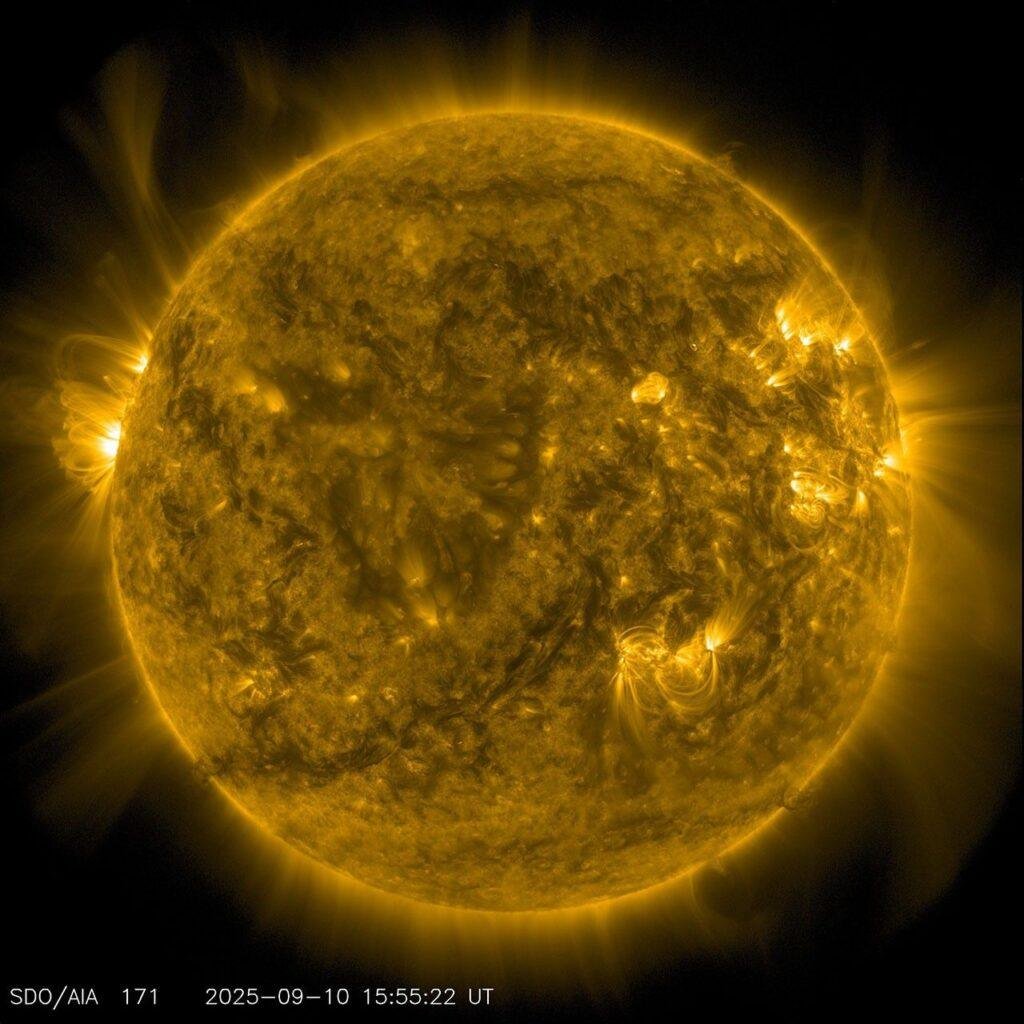
The team compared the local particle measurements with observations of the solar disk and models of solar magnetic fields. The analysis also used NASA Solar Dynamics Observatory data, giving researchers a way to connect what the spacecraft sampled in space with structures on the solar surface.
Magnetic Reconnection and Turbulence Play Different Roles
In the proposed source process, an open magnetic field line intersects a closed loop. When the fields reconnect, plasma that had been confined in the loop can escape outward into the solar wind. The measured ions provide evidence that this kind of interchange reconnection contributed to the observed switchback.
The Solar Orbiter switchback data also revealed indications of wave and turbulence effects after the structure had left the Sun. Rather than declaring the competing explanation wrong, they suggest the two mechanisms act at different points: reconnection helps launch or shape the structure, while turbulence influences its later evolution.
This interpretation comes from analysis of a particular large switchback. ESA did not claim that the mission had settled the formation pathway for every switchback observed throughout the heliosphere, where magnetic conditions can vary sharply with distance and solar activity.
Why the Finding Matters for Space Weather Research
The solar wind is a continual flow of charged particles moving outward from the Sun. Changes in that flow and in the magnetic field embedded within it can affect how energy and disturbances travel through the solar system. Researchers study those changes partly because solar activity can interfere with spacecraft and other technologies.
ESA says the particle signature offers a way to reconstruct aspects of a plasma parcel’s earlier environment even after it has traveled far from the Sun. In other words, chemical and charge-state measurements complement remote images and magnetic-field models rather than replacing them.
The Solar Orbiter switchback results were reported in Nature Astronomy by Jesse T. Coburn and co-authors. The article identifies a physical mechanism and a method of tracing origin; it is not a near-term forecast of a particular geomagnetic storm or a new operational warning system.
FAQ: Solar Orbiter switchback
What is a Solar Orbiter switchback?
It is a temporary S-shaped bend in the solar wind’s magnetic field, detected by spacecraft sampling the flow.
How did scientists find the switchback’s origin?
They measured distinctive oxygen and carbon ions and compared them with observations and models of magnetic loops at the Sun.
Does this solve every solar-wind switchback mystery?
No. The new study supports a combined role for reconnection and later turbulence in one observed structure, not a universal rule for every event.
Looking Ahead
The team’s October publication provides a testable approach for studying other switchbacks. Further in-situ particle measurements, combined with solar images and field models, will show how widely this origin mechanism applies.
Sources
Image credit: NASA/GSFC/Solar Dynamics Observatory (NASA-EDITORIAL; reuse terms). Featured image is an archival or contextual illustration, not the reported event.