The Martian Moons mission led by Japan’s space agency is scheduled to launch in October, beginning an attempt to study Phobos and Deimos and bring samples from the nearer moon back to Earth.
NASA said October 8 that its Martian Moons eXploration contribution will be previewed at an October 15 media briefing. The spacecraft is targeting October 19 in the U.S. Eastern time zone, corresponding to October 20 in Japan, from Tanegashima Space Center.
JAXA plans a multi-year round trip that includes orbital observations, a surface sampling effort and eventual recovery of material on Earth. The launch is an intended milestone, not evidence that the spacecraft has departed or begun collecting samples.
Table of Contents
Martian Moons Mission Will Investigate Phobos and Deimos
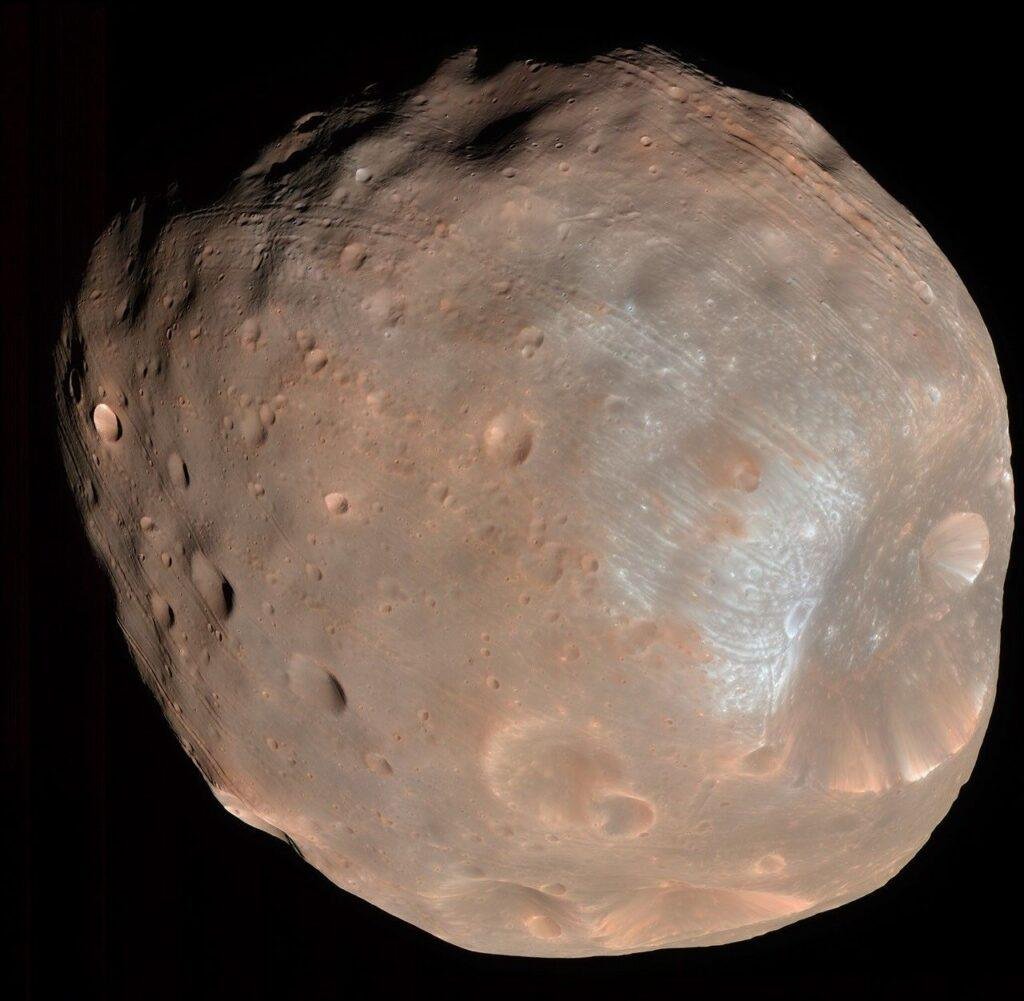
The Martian Moons mission aims to address long-standing questions about their origin. Scientists have considered whether they were captured asteroids or material resulting from a major impact involving Mars. Their surface composition, internal structure and physical environment may help discriminate among competing explanations.
JAXA says MMX will concentrate on Phobos while also observing Deimos. The spacecraft is planned to travel to the Mars system over about a year, then make detailed surveys before attempting to collect material. Mission planners intend to bring more than ten grams of rock and dust back to laboratories on Earth.
The mission’s sample-return objective is distinct from a Mars landing: MMX aims to collect material from a moon of Mars rather than from the Red Planet’s surface. That distinction matters when comparing its engineering with earlier asteroid sample-return missions.
NASA Adds Instruments, Sampling and Deep-Space Support
For the Martian Moons mission, NASA says it is providing the MEGANE gamma-ray and neutron spectrometer, developed by the Johns Hopkins Applied Physics Laboratory. The instrument is designed to study elemental composition by measuring radiation associated with the surface of Phobos, adding remote chemical information to images and later laboratory analysis of returned grains.
NASA is also supporting a pneumatic sampler developed by Honeybee Robotics, a Blue Origin company. The agency lists communications and navigation services through its Deep Space Network, along with funding for U.S. scientists participating in the international science team.
JAXA identifies further international participation, including European partners. Its mission architecture includes an exploration section, propulsion capability and a return component, all of which must support a complex sequence across interplanetary distances before the sample capsule can come back to Earth.
An October Launch Starts a Journey Through 2031
NASA’s Martian Moons mission plan calls for arrival near Mars in August 2027, followed by observation of Phobos and Deimos. The earliest scheduled surface sampling is December 2028, and the agency describes an Earth return in 2031. These are mission-planning dates that depend on launch and flight performance.
JAXA’s mission website describes a rover intended to investigate Phobos before the main sample-collection operation. The reconnaissance is meant to reduce uncertainty about the surface as engineers prepare the encounter and sampling sequence; it is not a guarantee that any particular site has already been selected.
JAXA says the returning capsule is expected to be recovered in Australia. The planned chain of launch, transfer, orbital observation, sampling and re-entry has multiple dependencies, and any later timetable changes should be attributed to the mission agencies rather than inferred from this initial briefing.
FAQ: Martian Moons mission
When will the Martian Moons mission launch?
NASA and JAXA currently target October 20, 2026 in Japan, which falls on October 19 in U.S. Eastern time.
Which moon will MMX collect a sample from?
MMX plans to collect material from Phobos and observe both Phobos and Deimos.
When are the Phobos samples expected back on Earth?
The agencies currently plan a 2031 return, provided the mission reaches its intermediate milestones.
Looking Ahead
NASA will hold its MMX science-contribution briefing October 15 ahead of the targeted Tanegashima launch. The next operational proof will be a successful H3 liftoff and confirmed spacecraft separation, not the publication of the planned mission sequence.
Sources
- NASA — MMX contributions and October launch briefing
- JAXA — MMX mission overview
- JAXA — MMX mission schedule and flight profile
- NASA Science — MMX scientific goals and MEGANE instrument
Image credit: NASA/JPL-Caltech/University of Arizona (NASA-EDITORIAL; reuse terms). Featured image is an archival or contextual illustration, not the reported event.