Burbank Airport terminal operations are scheduled to move to a new passenger building on Tuesday, October 13, marking the next phase of a roughly $1.3 billion infrastructure replacement in Southern California. The airport has planned its first passenger flights at the new facility following a ceremonial opening earlier in the month.
The 355,000-square-foot terminal will keep the airport at 14 gates while replacing older facilities located closer to the runway than current standards permit. The project is intended to improve passenger circulation, security screening, accessibility and operational safety rather than increase the airport’s gate count.
Architect Corgan confirmed the October 13 start in an October 12 announcement, while the airport authority’s Elevate BUR project materials document the project cost, safety rationale and new terminal features. Actual opening-day operations remain subject to the airport and airlines’ procedures.
Table of Contents
Burbank Airport Terminal Replaces Older 14-Gate Complex
The replacement building stands in the airport’s northeast quadrant. Airport planners retained the 14-gate limit, a central point because a larger terminal does not automatically mean permission for more flights or a broader airfield operation. The project instead changes where passengers check in, clear security, collect baggage and reach their aircraft.
Burbank-Glendale-Pasadena Airport Authority materials identify an approximately $1.299 billion overall project estimate, including design, construction, other owner costs and removal of existing facilities. The construction contract’s guaranteed maximum price was approximately $1.11 billion when approved in 2024.
The older terminal complex traces its origins to the airport’s early decades. Relocating the main passenger building gives planners a way to address runway-to-building separation requirements while maintaining a relatively compact passenger experience, a feature long associated with Hollywood Burbank Airport.
Safety, Accessibility and Ground Access Shape the Upgrade
The airport authority says the new facilities respond to federal aviation separation standards, seismic requirements and accessibility needs. Updated baggage screening, passenger screening and ticketing areas are intended to reduce constraints that can occur when older terminals are adapted to modern passenger volumes.
The replacement also includes a new parking structure, on-airport access road and ground-transport arrangements. Passengers used to the old terminals should verify departure instructions, parking directions and pickup locations before traveling, particularly during the transition period.
Corgan says the building preserves ground-level aircraft boarding while adding more space, food and retail facilities and a different layout for arriving and departing travelers. Those features are project descriptions; the airport has not yet published a full assessment of how the terminal performs under everyday flight schedules.
New Airport Design Emphasizes Electric Operations
Corgan describes the replacement terminal as designed for fully electric building operations, including heating, cooling and food-service systems. The plans also include electric-vehicle charging and accommodation for electric ground-support machinery, although individual equipment deployment is a separate operational decision.
Designers drew on the entertainment industry and aviation history of the Burbank area. Public artwork includes references to Lockheed’s former local aircraft activity and Amelia Earhart’s Lockheed Electra, connecting the new structure with an airport that has served the region for nearly a century.
An airport ribbon-cutting and architectural completion announcement are not substitutes for proof of a successful first day of airline operations. The important near-term questions are whether the gate transition proceeds on schedule and whether passengers can navigate the new roadway, screening and baggage systems without disruption.
FAQ: Burbank Airport terminal
When does the Burbank Airport terminal open?
The replacement terminal is scheduled to welcome its first passenger flights on October 13, 2026. Travelers should confirm operational instructions directly with the airport and their airline.
Does the new Burbank terminal add airport gates?
No. The larger 355,000-square-foot building retains 14 gates, matching the existing gate count.
Why was the old terminal replaced?
The airport authority cites safety-separation standards, seismic and accessibility requirements, and outdated passenger facilities as major reasons for relocating and rebuilding the terminal.
Looking Ahead
The immediate test is the October 13 move into passenger service. TAD will watch for any changes in terminal access, the first operating-day experience and an airport-authority assessment once normal traffic is running. This is an opening preview, not confirmation that the new terminal has already handled scheduled flights.
Sources
- Corgan — New Hollywood Burbank Airport terminal (October 12, 2026)
- Burbank-Glendale-Pasadena Airport Authority — Elevate BUR project
- CBS Los Angeles — New terminal ribbon-cutting (October 5, 2026)
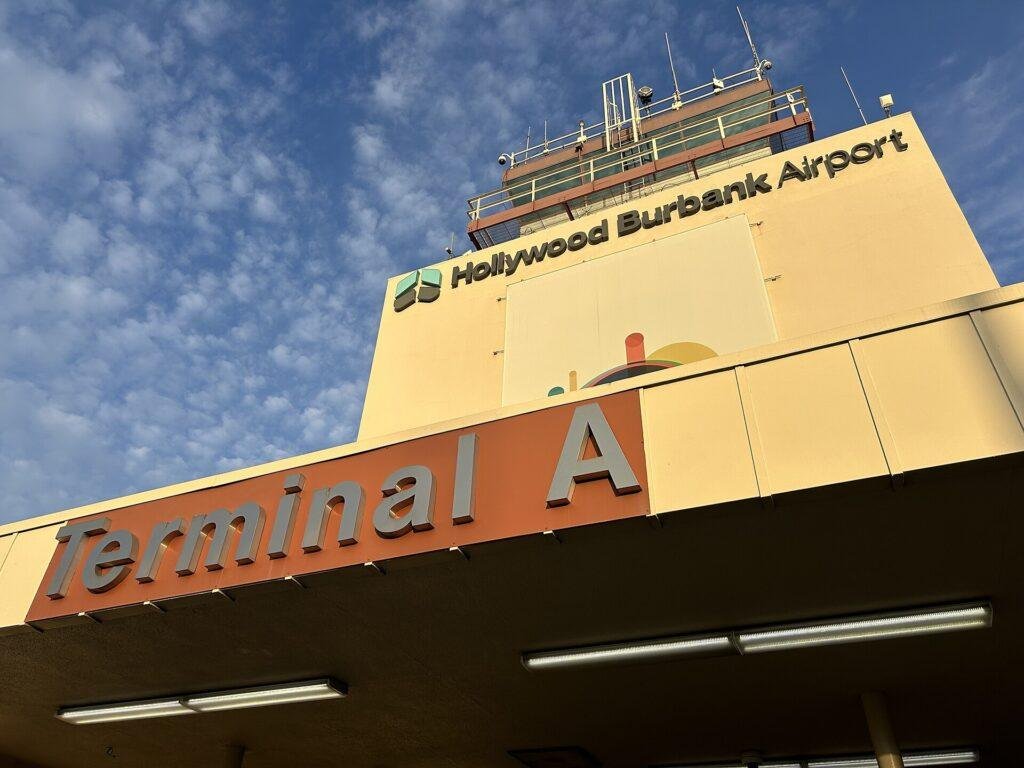
Featured image: Hollywood Burbank Airport’s existing Terminal A pictured in February 2026. This shows the OLD terminal, not the replacement building scheduled to open October 13. Photo: Busition. License: CC BY 4.0. Source: Wikimedia Commons image page (license). Image scaled for web without other edits.