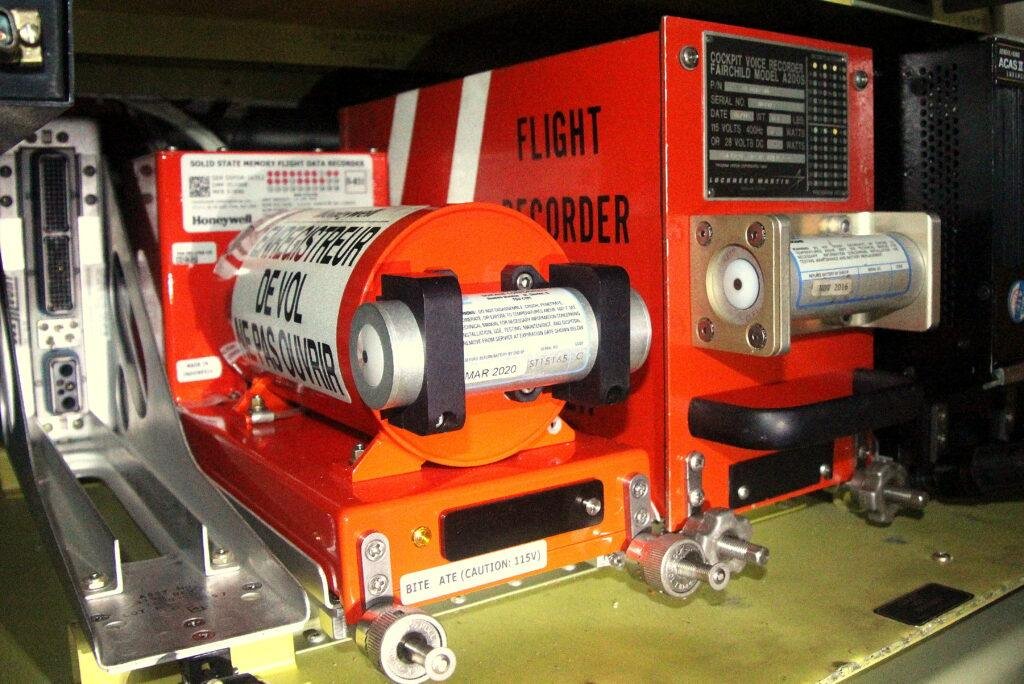
Airplane black boxes are crash-protected recorders that preserve evidence for aviation accident investigations. The familiar nickname refers to two distinct systems: a flight data recorder (FDR), which stores aircraft operating parameters, and a cockpit voice recorder (CVR), which captures flight crew communications and other cockpit sounds.
The National Transportation Safety Board (NTSB) explains that large commercial aircraft and some smaller commercial, corporate, and private aircraft are required to carry both recorders. Their contents help investigators reconstruct events alongside physical evidence, maintenance records, weather information, and other independent sources.
Despite the name, crash-protected flight recorders are generally painted bright orange to make them easier to locate. They do not provide a complete or continuously broadcast account of everything aboard. Their recordings must be recovered, validated, and interpreted before investigators can draw reliable conclusions.
Table of Contents
What Flight Data Recorders Actually Measure
A flight data recorder stores selected measurements from aircraft systems. Depending on the aircraft and installation, these can include altitude, airspeed, heading, aircraft attitude, flight-control positions, and engine or autopilot status. The NTSB notes that some systems capture far more parameters than the regulatory minimum.
Investigators align recorded values with radar tracks, air traffic control communications, and other evidence to develop a timeline. A change in speed, control position, or system status can show what happened at a particular moment. It does not, on its own, establish why a pilot acted or why a component responded in a certain way.
Raw data can require aircraft-specific conversion documents and specialized software before it becomes meaningful. Analysts check time synchronization, parameter definitions, and data quality. The result may support a detailed flight reconstruction, but a dramatic-looking graph posted online should never be mistaken for an official finding of probable cause.
What Cockpit Voice Recorders Capture and Protect
A cockpit voice recorder captures flight crew speech, radio calls, and sounds from cockpit microphones. Investigators may hear warning tones, engine noise, landing gear activity, and conversations that help establish the order of events. These sounds can offer valuable context, but they are compared with flight data and other evidence rather than treated as a complete account.
Cockpit audio raises important privacy concerns. Federal law prohibits the NTSB from publicly releasing any portion of a CVR audio recording. Written transcripts of pertinent portions may be released at a Safety Board public hearing or, if no hearing takes place, when most factual reports become public. A transcript is not the same as access to the original audio.
Recorder capabilities depend on the aircraft, equipment generation, and applicable rules. Recording duration, audio channels, and the amount of recoverable information are not identical in every case. Investigators therefore identify the actual installed equipment and what its data contains instead of assuming every aircraft records the same material.
How Investigators Find and Use Airplane Black Boxes
The protected memory units are engineered to withstand severe impacts, fire, and water pressure. Recorders are often installed toward the rear of an aircraft, where survival prospects may be better. Underwater locator beacons produce acoustic signals after immersion, helping equipped search teams narrow the search area. They are not a guarantee of recovery, particularly in deep or widely scattered wreckage.
Once recovered, recorder components may be taken to a specialist laboratory for inspection and readout. The NTSB processes many U.S. aviation recorders in Washington, D.C. Engineers may need to work around damaged hardware before extracting usable information. Investigators then compare that material with surveillance data, weather records, aircraft examinations, and operational documents.
Recovering a recorder is a major step, not the end of an investigation. Sometimes data is incomplete or requires substantial validation. Initial readout summaries are preliminary and can change as evidence is reconciled. Responsible reporting makes that distinction clear and does not assign blame based on isolated audio, selective data points, or unofficial interpretations.
FAQ: airplane black boxes
Are airplane black boxes actually black?
No. They are typically bright orange so recovery teams can spot them more easily.
What is the difference between FDR and CVR?
The FDR preserves aircraft performance and system data; the CVR preserves cockpit audio, including crew speech, radio calls, and warning sounds.
Can the public hear cockpit voice recordings?
The NTSB cannot publicly release the audio under U.S. law. Relevant written transcripts may be published later in an investigation.
Looking Ahead
Improved recorders may preserve more detail, but no single device can explain every decision or failure. For a developing investigation, readers should distinguish a recovered recorder, a preliminary readout, a factual report, and the NTSB’s eventual findings. Each represents a different stage of what the evidence can establish.
Sources
- NTSB — Cockpit Voice and Flight Data Recorders
- NTSB — Media Resources and Recorder Release Rules
- FAA — Airworthiness and Operational Approval of Digital Flight Data Recorder Systems (AC 20-141B)