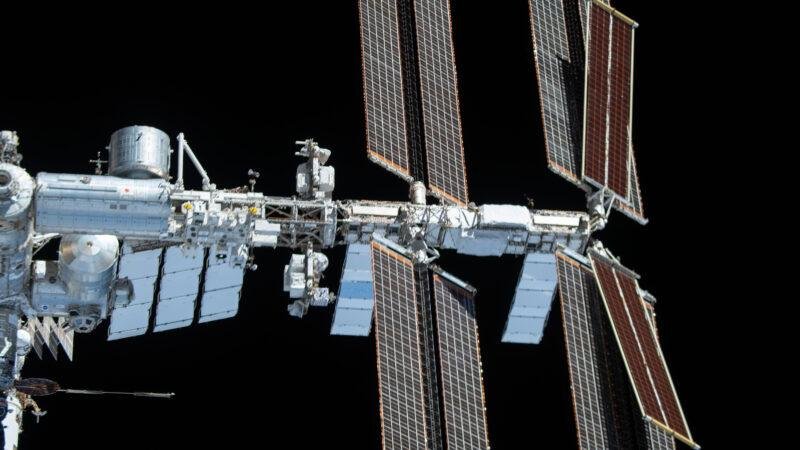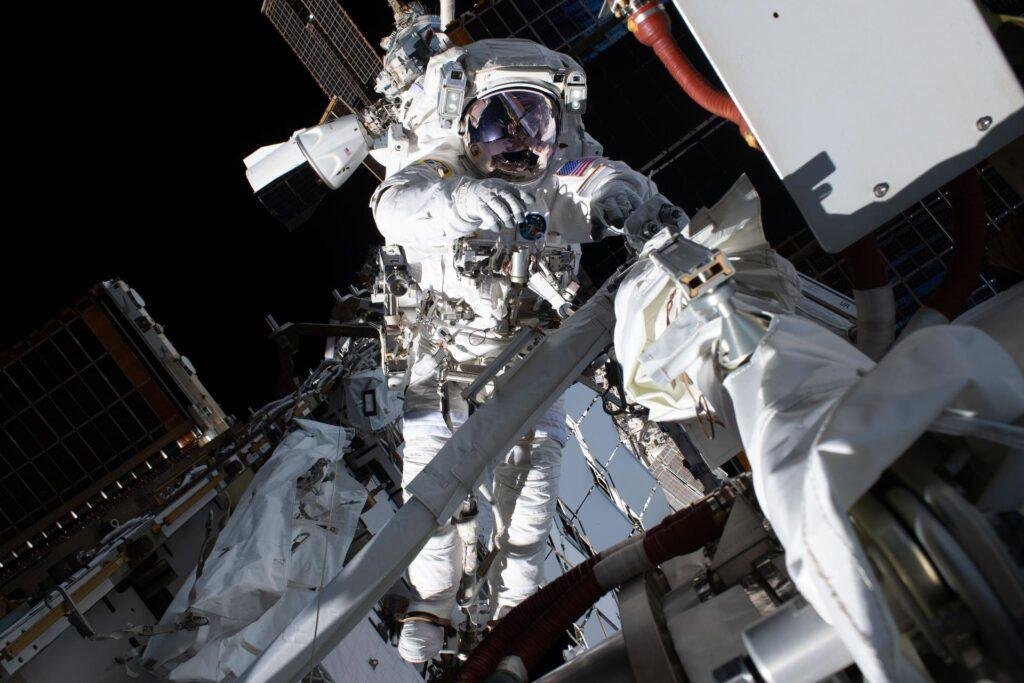
ISS spacewalks planned for Oct. 29 and Nov. 5 will support the next stage of NASA’s International Space Station solar-array upgrades. The two excursions were listed for Oct. 29 and Nov. 5 at the time of the announcement. As with other spacewalk schedules, those dates remain subject to operational decisions and conditions.
NASA astronaut Anil Menon and Canadian Space Agency astronaut Joshua Kutryk are assigned to both operations. Their duties are part of an ongoing effort to supplement the station’s existing solar-power hardware rather than replace its entire electrical system.
Table of Contents
ISS Spacewalks Will Install Arrays Seven and Eight
The Oct. 29 activity, designated U.S. spacewalk 100, is planned to install and deploy the seventh International Space Station Roll-Out Solar Array. NASA assigned it to the station’s 2A power channel, one of the electrical paths that supply onboard systems.
A second excursion, U.S. spacewalk 101, is scheduled for Nov. 5. Menon and Kutryk are to install the eighth and final roll-out array on the 3B channel. Together, the two activities would complete the augmentation work described in NASA’s latest advisory.
The assignments and hardware locations are mission plans, not results. Successful installation will have to be confirmed after the astronauts complete the work. This distinction matters in advance stories, especially where a planned operation can be postponed or rearranged for technical reasons.
What the Power Increase Would Provide
NASA says the full set of eight roll-out arrays is expected to increase the station’s available electricity by as much as 30%. The agency lists a change from approximately 160 kilowatts to about 215 kilowatts of generating capacity when the upgrade is complete.
Power is needed for scientific experiments, communications, thermal control and the daily operation of an inhabited orbital laboratory. Additional generation offers more margin as the station continues its research program and maintains systems needed for safe operations.
NASA also connected the improvements to the station’s eventual controlled deorbit. The upgrades therefore serve current research needs while supporting longer-term operational planning. They do not, by themselves, announce a new date for the station’s retirement or establish how the final disposal mission will be conducted.
The station already has a long history of maintenance work performed outside its pressurized modules. NASA’s own running record documents previous excursions and provides context for why the newly assigned numbers matter. The agency identifies the two planned activities as the 285th and 286th spacewalks in support of station assembly, upkeep and upgrades.
Crew and Coverage Plans
NASA plans to brief reporters at Johnson Space Center in Houston at 2 p.m. Eastern on Tuesday, Oct. 20. Its announcement names operations integration manager Gaurang Patel and spacewalk flight director Garrett Hehn as participants. The agency plans to stream the briefing through its normal online channels.
Menon and Kutryk are scheduled to leave the station through the Quest airlock during each spacewalk. The international crew pairing reflects the station program’s multinational operation, although NASA is the organization releasing the detailed U.S. spacewalk schedule.
For observers, the important near-term questions concern confirmation of the assigned schedule, the readiness of the hardware and whether both installations can be completed as planned. Those operational answers belong to subsequent NASA updates, not assumptions about the announced timetable.
FAQ: ISS Spacewalks
When are the next ISS spacewalks planned?
NASA listed Oct. 29 and Nov. 5, 2026, for the two solar-array installations. The dates remain subject to change.
Who will perform the ISS spacewalks?
NASA astronaut Anil Menon and Canadian Space Agency astronaut Joshua Kutryk were assigned to both excursions in the Oct. 14 advisory.
How much extra power will the arrays add?
NASA estimates that the eight-array project will raise available generating capacity from about 160 to 215 kilowatts, an increase of up to 30%.
Looking Ahead
NASA’s Oct. 20 briefing should provide the next official operational details. The two installation dates follow, with confirmation of successful deployment required before TAD can report the augmentation project complete.
Sources
- NASA, Oct. 14: NASA to Host News Conference Previewing US Spacewalks 100, 101
- NASA: International Space Station Spacewalks