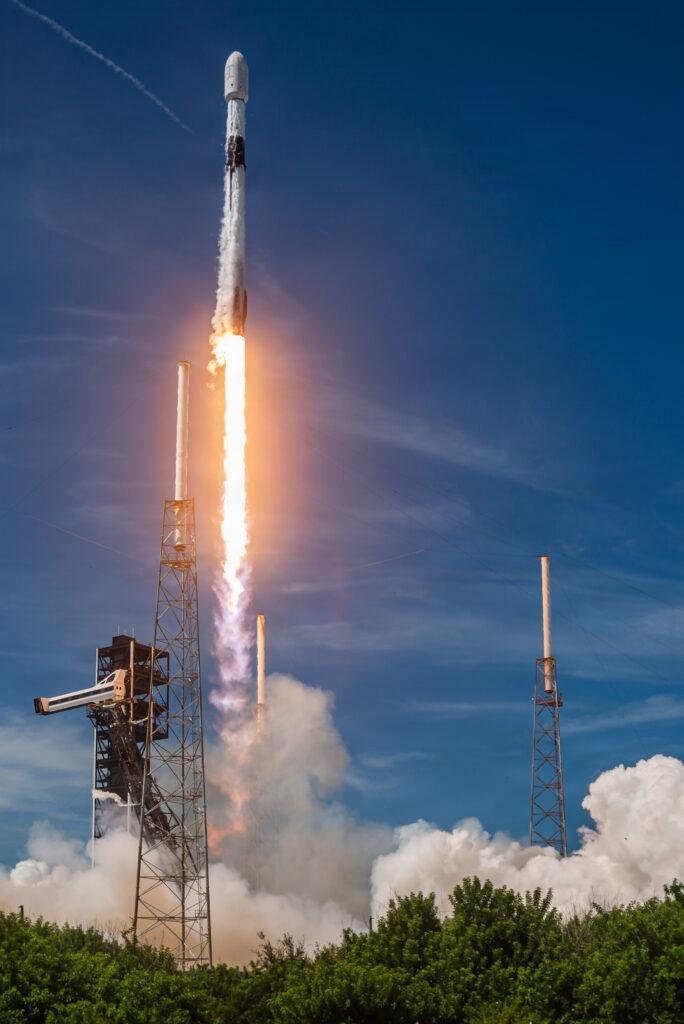
SpaceX Bandwagon launch operations reached orbit Oct. 20 when a Falcon 9 departed Cape Canaveral Space Force Station at 11:04 UTC, or 7:04 a.m. Eastern time, on the company’s fifth Bandwagon rideshare mission. Independent launch tracking recorded a successful flight, and NASA confirmed that two federally funded commercial communications demonstrations were among the payloads carried into low Earth orbit.
The mission followed a shift from an earlier Oct. 19 launch target. SpaceX’s mission page listed a first-stage booster on its 19th flight, with a planned droneship recovery in the Atlantic. The final reported outcome should be separated from the prelaunch plan: NASA confirms launch, and launch trackers classify the mission as successful, while individual payload mission results will take longer to assess.
Table of Contents
What Flew on the SpaceX Bandwagon Launch

Bandwagon is a rideshare service that places multiple spacecraft from different customers on one rocket. The Oct. 20 mission carried a collection of small satellites and other experimental payloads instead of a single dedicated spacecraft. Reporting has described 32 payloads, but published manifests can count satellites, deployment systems and reentry experiments differently. TAD should retain the count only with an attributed source and should not represent it as a final independent inventory.
Falcon 9 launched from Space Launch Complex 40 at Cape Canaveral Space Force Station in Florida. The rocket’s first-stage booster was returning for another mission after previous work supporting crew and satellite launches. Reuse is part of SpaceX’s established operational approach, but a successful booster recovery does not establish that every scientific payload has completed its planned demonstration.
The primary announcement is available at the original source.
NASA’s Two Communications Demonstrations
NASA said two partner satellites launched aboard the mission for tests involving Viasat and SES Space and Defense. Over the coming weeks, the organizations intend to evaluate communications services that could support future science spacecraft. The agency described planned high- and low-rate data demonstrations using commercial relay networks, including elements of SES’s medium-Earth-orbit and geosynchronous systems.
These flights form part of NASA’s Communications Services Project. NASA said it awarded $278.5 million to industry partners in 2022 to help develop commercial communications alternatives for future missions. The long-term goal includes reducing dependence on the aging Tracking and Data Relay Satellite network. A spacecraft reaching orbit is a prerequisite for the tests; it is not evidence those relay demonstrations have already succeeded.
How to Interpret the Launch Outcome
NASA’s Oct. 20 account confirms that the two demonstrations reached low Earth orbit. Independent tracking services recorded the Bandwagon-5 launch as successful, while SpaceX provided the mission plan and booster details. Those sources support a successful launch headline, but readers should not be told that the spacecraft achieved every intended operational objective unless the relevant operators release subsequent results.
This distinction is particularly important for technology demonstrations. Engineers may need weeks to establish ground contact, check systems, commission payloads and conduct controlled communication experiments. Those stages have different dates and levels of success, and combining them into a single claim would overstate what happened on launch day.
Why Rideshare Missions Matter
A shared launch lets customers with smaller spacecraft obtain access to orbit without paying for an entire dedicated rocket. It also requires compatibility with a shared mission profile and its deployment timetable. NASA’s presence on the manifest illustrates how government agencies are testing commercially provided services in addition to using their own space infrastructure.
Bandwagon-5 is also a vehicle for commercial and experimental missions unrelated to NASA. Individual payloads can justify their own articles when they have distinct research or operational outcomes. They should not all be written as separate versions of the same Falcon 9 launch report.
FAQ: SpaceX Bandwagon launch
When did the SpaceX Bandwagon launch occur?
Falcon 9 lifted off Oct. 20, 2026, at 11:04 UTC from Cape Canaveral, according to launch tracking records.
Did NASA have payloads on Bandwagon-5?
Yes. NASA confirmed two commercial communications demonstration satellites involving Viasat and SES Space and Defense.
Have the SpaceX Bandwagon launch satellites completed their experiments?
No such conclusion is supported by the launch report. NASA said the communications demonstrations would unfold over the coming weeks.
Looking Ahead
NASA plans communications experiments after commissioning, with the broader project continuing into 2027. TAD should return to the story when NASA or the spacecraft operators publish actual test results, separating them from the October launch milestone.
For related TAD reporting, see the Japanese MMX spacecraft mission.
Sources