The **NASA MMX mission** contribution will help Japan investigate two of the least understood bodies in the inner solar system when the Japan Aerospace Exploration Agency launches its Martian Moons eXploration spacecraft. NASA detailed its role on Oct. 15, ahead of a launch then targeted for Oct. 20 in Japan.
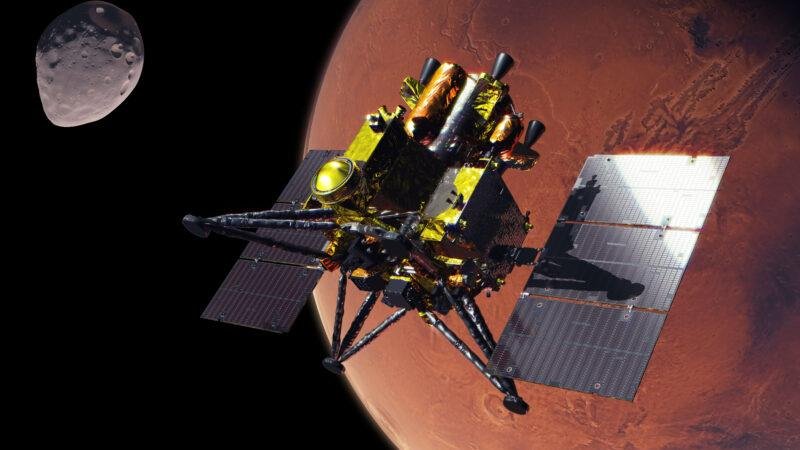
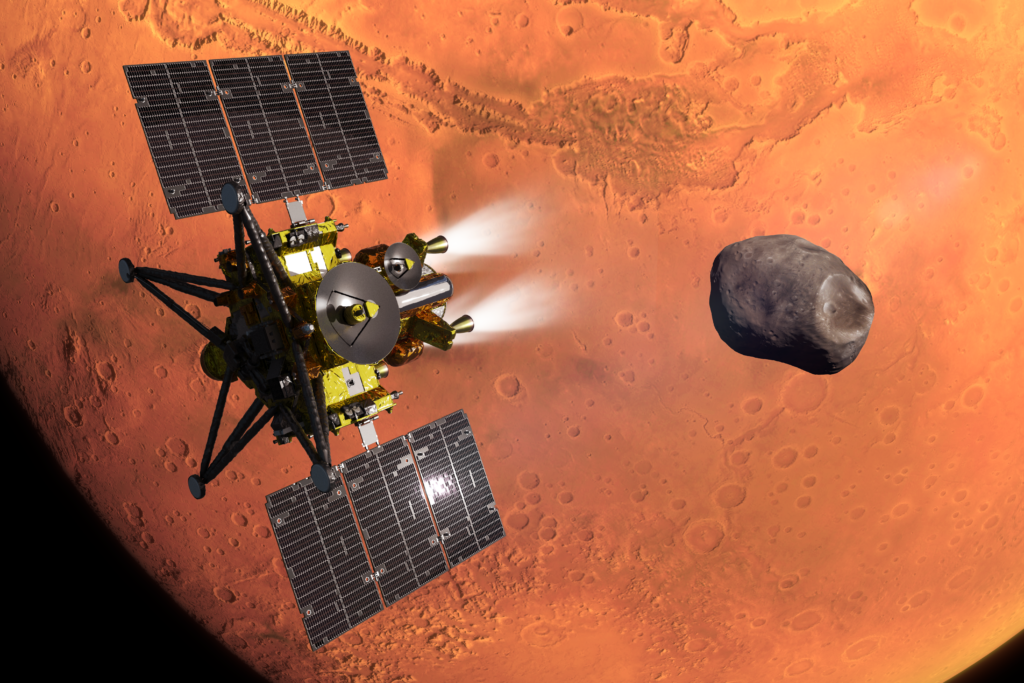
JAXA’s spacecraft is designed to examine both Phobos and Deimos, the small moons of Mars, and bring a sample from Phobos back to Earth. That would allow researchers to study material in laboratories rather than relying only on remote observations. The agency has described a launch target, not a completed flight.
The mission’s questions reach beyond the two moons. Scientists want to determine whether the objects formed from debris associated with Mars or were captured from elsewhere. Their origin would illuminate the Red Planet’s history and the environment in which its satellites developed.
Table of Contents
NASA MMX Mission Brings U.S. Science to Japan’s Probe
NASA is supplying the Mars-moon Exploration with Gamma Ray and Neutrons instrument, known as MEGANE. Its measurements are intended to provide information about the chemical composition of Phobos by examining gamma rays and neutrons associated with its surface. The instrument adds a different line of evidence to observations made by the main spacecraft.
The arrangement is an international scientific partnership, not a NASA-operated launch. JAXA is responsible for the overall MMX spacecraft and campaign, while NASA’s hardware contributes to the investigation. Those roles matter when describing who operates the mission and which organization is responsible for the launch timetable.
NASA said the mission could help answer whether the Martian moons are remnants of a collision or objects captured by the planet. Researchers have not settled that question. An instrument designed to test competing explanations is not evidence that one has already been proven.
Why the Phobos Sample Matters
A returned sample would offer investigators material to characterize directly. Orbital measurements reveal broad patterns, but laboratory instruments can examine mineral, chemical and physical properties in much greater detail. Scientists can then compare results with remote observations to better understand the surface and its history.
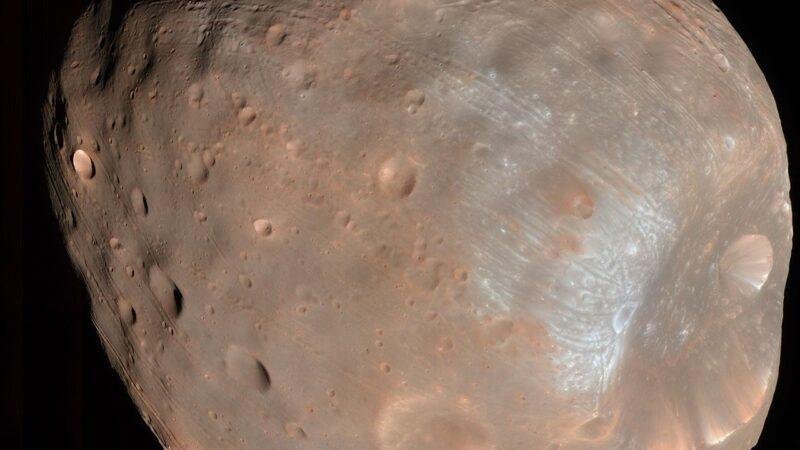
Phobos is especially intriguing because of its irregular shape, small size and close orbit around Mars. Understanding its composition could help test competing accounts of how the moon originated and subsequently changed. Deimos also forms part of the mission’s scientific program, even though the announced sample-return objective focuses on Phobos.
The spacecraft’s planned activities carry several distinct milestones: leaving Earth, traveling to Mars, conducting observations, acquiring a sample and returning that material. Completion of the launch alone would not establish that any later step had succeeded. Each stage will require its own confirmation from mission controllers.
Launch Timing and International Cooperation
NASA’s Oct. 15 announcement listed a planned departure from JAXA’s Tanegashima Space Center at 4:41 a.m. Japan Standard Time on Tuesday, Oct. 20, equivalent to 3:41 p.m. Eastern Daylight Time on Monday, Oct. 19. That timing was a target as of the announcement; launch schedules can change.
The project highlights how planetary exploration missions combine specialized equipment and experience from multiple agencies. NASA’s instrument is part of the science payload, while Japan leads a mission with navigation, sampling and return requirements that go beyond a straightforward flyby.
For readers following wider exploration plans, the key result will be the scientific findings, not simply the launch image. Measurements near Mars and eventual laboratory analysis, if the mission reaches those phases, would determine how much MMX changes scientists’ understanding of the moons.
FAQ: NASA MMX Mission
What is the main goal of the NASA MMX mission contribution?
NASA’s MEGANE instrument is intended to study the elemental composition of Phobos, supporting efforts to explain how the moon originated.
Which Martian moon is MMX expected to sample?
JAXA plans to collect material from Phobos while also investigating Deimos. The sample return remains a future mission objective.
Has the MMX spacecraft already launched?
No launch had been confirmed in NASA’s Oct. 15 announcement. It listed an Oct. 20 Japan-time launch target.
Looking Ahead
The immediate milestone is the planned launch from Tanegashima. After that, the next verified outcomes will depend on JAXA’s mission updates, and TAD should distinguish achieved flight events from projected sampling and return phases.
Sources
- NASA, Oct. 15: NASA to Help Unlock Mysteries of Mars’ Moons in Upcoming Mission
- NASA Science: MMX mission overview