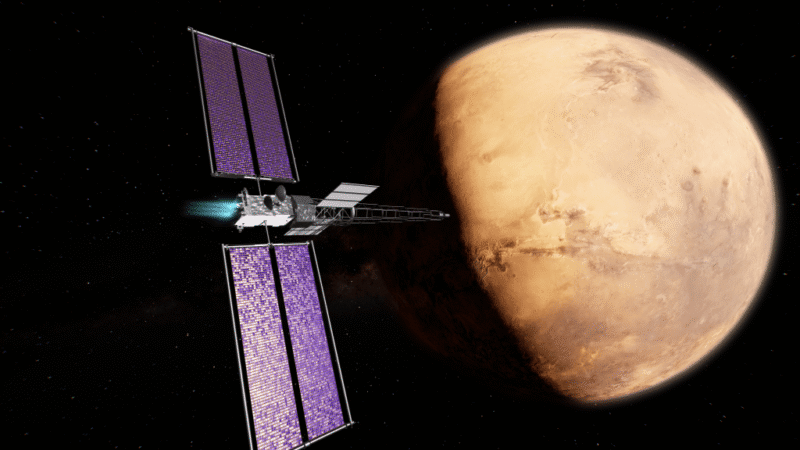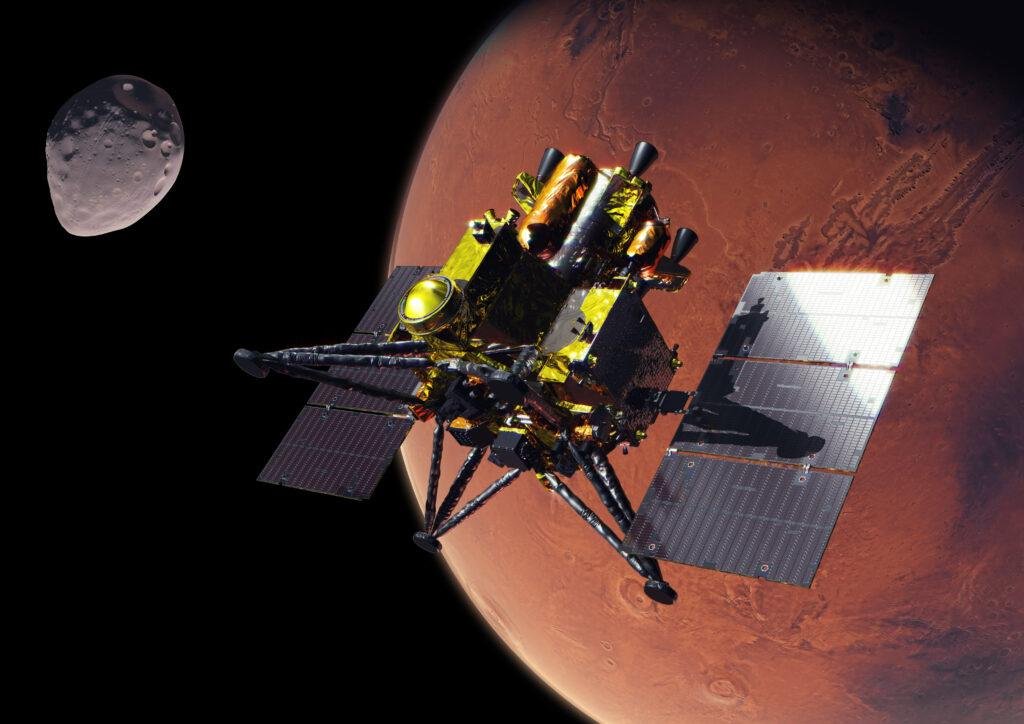
JAXA MMX launch operations succeeded on Oct. 20 when Japan’s H3 rocket carried the Martian Moons eXploration spacecraft away from Tanegashima Space Center, according to the Japan Aerospace Exploration Agency. Liftoff occurred at 4:41:03 a.m. Japan Standard Time, corresponding to the afternoon of Oct. 19 in the eastern United States. The agency later confirmed that the spacecraft separated normally and entered its planned orbit.
This is a distinct development from earlier mission previews: the H3 has flown, and the spacecraft has separated. It is not confirmation that MMX has arrived at Mars, landed on Phobos or obtained a sample. Those are planned steps in a multiyear exploration program, each of which will require its own evidence and mission update.
Table of Contents
JAXA MMX Launch Timeline and Confirmed Outcome
JAXA said the H3 rocket’s tenth flight departed Tanegashima at the published launch time and proceeded in accordance with its planned sequence. Approximately one hour, 11 minutes and 13 seconds after liftoff, the rocket released MMX. The agency confirmed the normal separation and insertion into the prescribed orbit in a formal October 20 statement.
That is a meaningful launch result, particularly because the mission will operate far beyond Earth orbit. However, separation establishes only the first major phase. Engineers must monitor spacecraft health, establish and maintain communications, conduct trajectory maneuvers and check instruments long before any attempt to study the Martian moons at close range. The launch announcement should not be expanded into an unsupported claim of end-to-end mission success.
The primary announcement is available at the original source.
Why Japan Is Sending a Spacecraft to Phobos
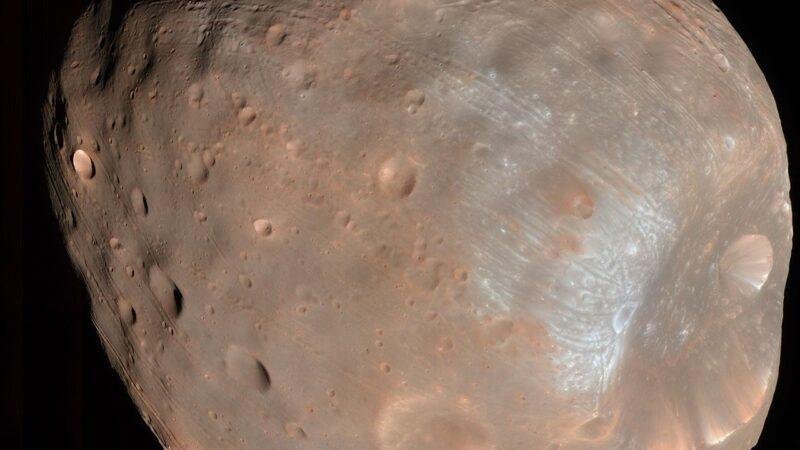
MMX is designed to investigate the origin and development of Phobos and Deimos, the two small moons orbiting Mars. Researchers want to determine whether material in these bodies may be associated with Mars or with objects captured from elsewhere in the solar system. Observations and physical samples could help distinguish between competing formation scenarios.
The mission plan calls for detailed examination of Phobos and an effort to collect at least 10 grams of surface material for return to Earth. That target is an objective, not an amount already obtained. JAXA also intends observations of Deimos and the Martian environment. Measurements from orbit and on the surface should give scientists context for laboratory analysis of any returned material.
International Instruments and Planned Surface Work
MMX involves contributions from international partners as well as JAXA’s own mission team. Among them is a rover developed with European participation that is intended to investigate the Phobos surface and conditions relevant to future spacecraft operations. NASA is also contributing scientific expertise and instrumentation to the wider mission.
Those contributions broaden the range of measurements planned, but an instrument’s inclusion on a spacecraft is not proof that it has been deployed or completed scientific observations. Mission stages such as instrument checkouts, Mars approach and landing-site assessment occur on separate timelines. Each carries technical uncertainty, including navigation challenges and the low-gravity environment around Phobos.
How MMX Fits Japan’s Sample-Return Experience
Japan has previous experience returning extraterrestrial material through the Hayabusa asteroid missions. MMX builds on that national capability while posing a different engineering problem. Phobos orbits a planet, its gravity is weak, and the spacecraft must operate over a much longer and more complex trajectory than a brief Earth-orbit mission.
Successful analysis of material from Phobos could improve scientific understanding of the early solar system. It would not, by itself, prove a particular origin theory before laboratories examine the material. The present achievement is narrower and firmly documented: Japan launched MMX and confirmed separation. Claims about the eventual samples will have to wait for the return mission.
FAQ: JAXA MMX launch
When did the JAXA MMX launch occur?
The H3 rocket lifted off from Tanegashima at 4:41:03 a.m. Japan time on Oct. 20, 2026, according to JAXA.
Did the spacecraft separate from the rocket?
Yes. JAXA confirmed normal spacecraft separation approximately 71 minutes after liftoff and insertion into the planned orbit.
Has MMX already collected a sample from Phobos?
No. Sampling is a future objective requiring the spacecraft to reach the Mars system and complete subsequent mission phases.
Looking Ahead
JAXA’s mission plan targets arrival in the Mars system in 2027 and ultimately the collection and return of Phobos material to Earth. The dates and final results remain dependent on spacecraft operations. The next newsworthy updates will be verified health checks, trajectory maneuvers and science milestones, not a repetition of the launch preview.
For related TAD reporting, see TAD’s previous MMX mission preview.
Sources