Mars helicopter blades developed through NASA-supported research could allow future rotorcraft to fly substantially farther than Ingenuity did, according to an agency report released Oct. 20. Engineers used simulations and wind-tunnel tests to study an optimized airfoil called roamx-0201. Under modeled conditions, researchers estimated that future aircraft could extend uninterrupted flights from an Ingenuity comparison of 0.7 kilometers to as much as 18.7 kilometers.
That long-range figure is a research projection, not a Mars flight record. The new blade profile has not completed a mission on the Red Planet, and the work remains experimental. NASA published the article to explain how its teams are developing aerodynamic tools for later helicopters rather than reporting the result of a new spacecraft launch.
Table of Contents
How Mars Helicopter Blades Differ From Earth Designs
Mars has a very thin atmosphere, making it difficult for rotorcraft to generate enough lift to carry a useful science payload. Engineers must balance speed, blade shape, efficiency and structural loads under unusual environmental conditions. Ingenuity proved controlled powered flight was possible, but it was a technology demonstrator with modest payload capacity and relatively short flights.
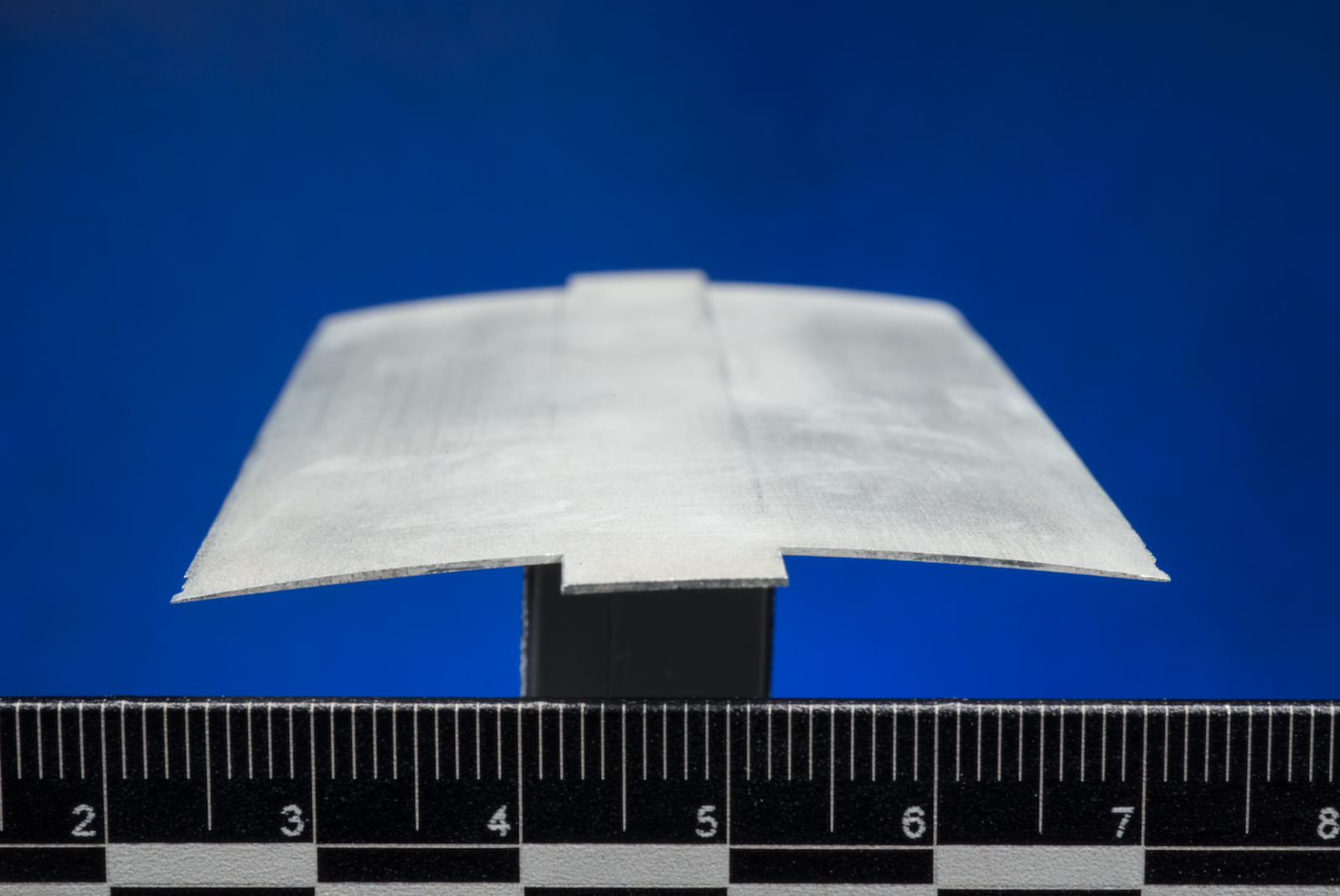
The roamx-0201 design uses a thinner, asymmetrical airfoil instead of the more rounded cross-section associated with Ingenuity’s blades. NASA says the research team optimized the shape with computer methods tailored to Martian flight conditions, then investigated it in wind tunnels. These test conditions help researchers compare concepts, although they cannot reproduce every aspect of flying on Mars.
The primary announcement is available at the original source.
What the Aerodynamic Studies Found
NASA says the new profile delayed a sharp loss of aerodynamic efficiency as rotor speed increased, a phenomenon called drag divergence. Blade tips on Mars approach challenging compressibility conditions because the speed of sound there is lower than on Earth. Improving performance in that regime could help a future helicopter generate lift while traveling faster and carrying more instruments.
Researchers also reported improved behavior near aerodynamic stall. NASA described how the shape deliberately influences airflow near the leading edge, creating a lift mechanism that differs from conventional assumptions about a smooth boundary layer. Better stall behavior in a controlled test can widen the design space, but it should not be reported as proof that a future Mars aircraft cannot stall.
The Difference Between Simulations and a Mars Flight
The high-end range estimate of 18.7 kilometers comes from analysis of possible aircraft performance using the new airfoil, not from a completed flight. NASA says more work is needed to reconcile some computational predictions with physical test results. The research was discussed in a technical paper released in September and highlighted by the agency in its Oct. 20 public update.
Ground testing helps engineers reject poor designs and improve promising ones before the expense and risk of a space mission. It cannot establish how a rotorcraft will respond to the full combination of Martian winds, dust, temperature changes, navigation challenges and operational constraints. Those questions would require progressively more realistic tests and, ultimately, flight experience.
How the Work Relates to Future Missions
NASA has described the planned SkyFall mission, involving three helicopters targeted for delivery to Mars through the SR-1 Freedom program. The October blade research is part of a wider effort to advance aerial exploration, not proof that roamx-0201 is already the flight-ready rotor for those helicopters. No such equipment assignment should be inferred without a specific program statement.
More capable rotorcraft could eventually carry scientific instruments across terrain that is difficult for wheeled vehicles to traverse. That benefit remains a long-term objective. Today’s confirmed achievement is the development and testing of a promising rotor profile in laboratory and simulated environments.
FAQ: Mars helicopter blades
What did NASA find about Mars helicopter blades?
Simulations and wind-tunnel tests identified improved aerodynamic performance for an optimized profile called roamx-0201.
Has a helicopter flown 18.7 kilometers on Mars?
No. That distance is a modeled potential for a future design, not an achieved flight.
Will these Mars helicopter blades be used on SkyFall?
NASA’s Oct. 20 report does not confirm that roamx-0201 is the selected flight blade for SkyFall.
Looking Ahead
Researchers plan additional design and test work to address remaining differences between models and experiments. Any announcement of a flight-qualified blade or demonstrated range improvement will require separate mission evidence, not extrapolation from the current studies.
For related TAD reporting, see NASA MMX Mars exploration.
Sources