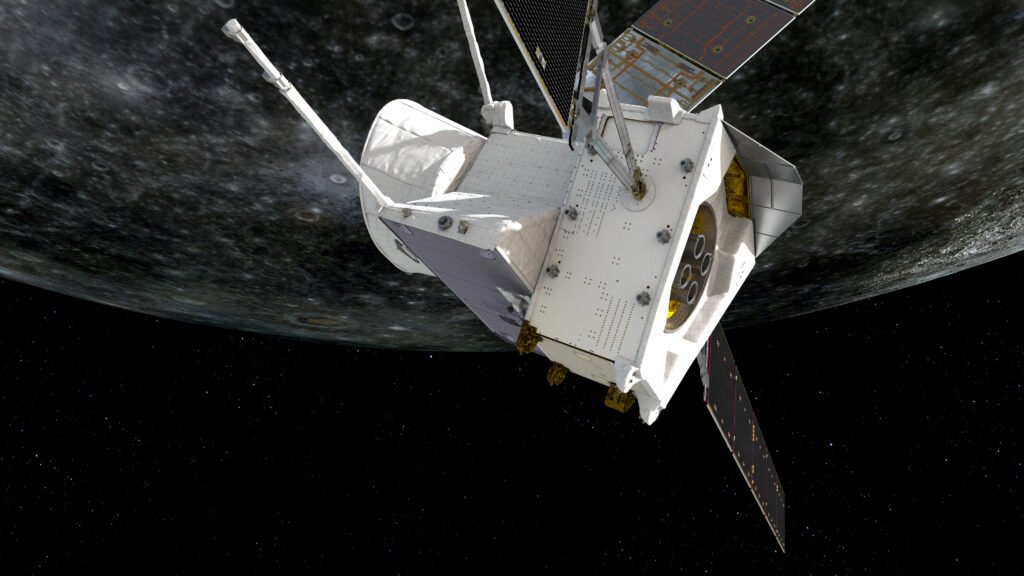
The BepiColombo Mercury mission reached orbit on November 21 after an eight-year journey through the inner solar system, the Associated Press reported. Europe’s Mercury Planetary Orbiter and Japan’s Mio spacecraft arrived together and are due to separate in December.
The milestone moves the European Space Agency and Japan Aerospace Exploration Agency mission from interplanetary cruise into its arrival phase. ESA’s timeline calls for scientific operations to begin in April 2027, after the two spacecraft separate and settle into their working orbits.
Table of Contents
How the BepiColombo Mercury mission got there
BepiColombo launched in 2018. Its route included one flyby of Earth, two of Venus and six of Mercury. Each encounter changed the spacecraft’s path around the Sun, preparing it to approach Mercury under conditions that would allow it to enter orbit. Passing Mercury during the cruise gave the team earlier glimpses of the planet, but the encounters were brief.
Getting to an inner planet means shedding enough orbital energy to match its motion around the Sun. A spacecraft traveling inward can pick up speed as it falls deeper into the Sun’s gravitational field. BepiColombo used its transfer module and planetary flybys to alter its trajectory over the course of the trip. ESA confirmed that the transfer module separated in September, before the final approach.
Two spacecraft will observe different parts of the system
ESA’s Mercury Planetary Orbiter is designed to study the surface, interior and immediate environment of Mercury. The questions it will help address include how the planet formed and how its terrain and composition vary. JAXA’s Mio focuses on Mercury’s magnetic environment and its interaction with the solar wind, the flow of charged particles from the Sun.
Running the two investigations at the same time gives scientists a way to compare what each spacecraft sees. For example, observations of a change in the magnetic environment can be compared with measurements taken closer to the planet during the same period. After repeated passes, researchers can begin to distinguish persistent features from conditions that change as Mercury moves around the Sun.
Mercury gets its first orbiter since MESSENGER
NASA’s MESSENGER entered Mercury orbit in 2011 and ended its mission in 2015. The earlier mission mapped the planet and established a baseline for later investigations. BepiColombo adds a second observing platform, allowing the teams to study the rocky planet and its surrounding environment in parallel.
The orbit insertion answers whether the spacecraft could reach Mercury and stay there. The next milestones concern whether each orbiter can take up its assigned position and begin sending the planned measurements back to Earth. ESA’s timetable lists several steps between arrival and the April start of science operations.
FAQ: BepiColombo Mercury mission
When did the BepiColombo Mercury mission reach orbit?
The Associated Press reported that the spacecraft entered Mercury orbit on November 21, 2026.
Which spacecraft are traveling together?
The mission pairs ESA’s Mercury Planetary Orbiter with JAXA’s Mercury Magnetospheric Orbiter, also called Mio.
When will the two orbiters separate?
ESA schedules their separation for December 9–10. The agency expects science operations to start in April 2027.
Looking Ahead
Watch for ESA and JAXA to confirm the December separation and publish any changes to the commissioning schedule. That will establish when each spacecraft can begin work in its own orbit.
Sources
- Associated Press report on the Mercury arrival
- ESA arrival timeline and mission updates
- NASA BepiColombo mission background
- Featured image — ESA, with acknowledgement to ATG Europe (CC BY-SA 3.0 IGO).
- Featured image reuse terms