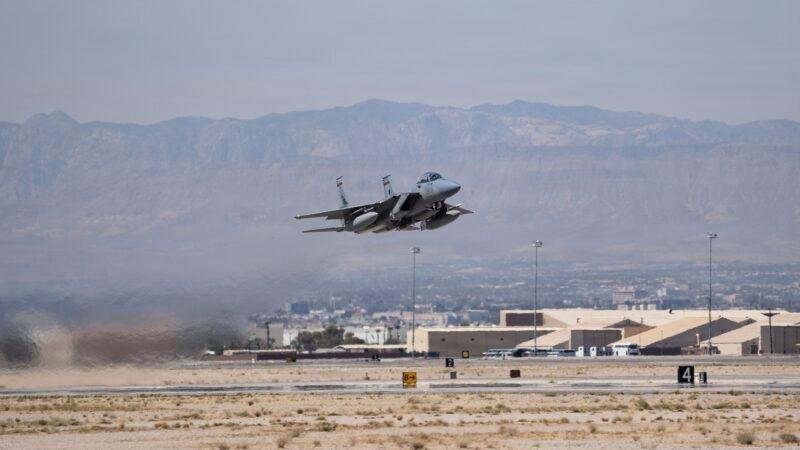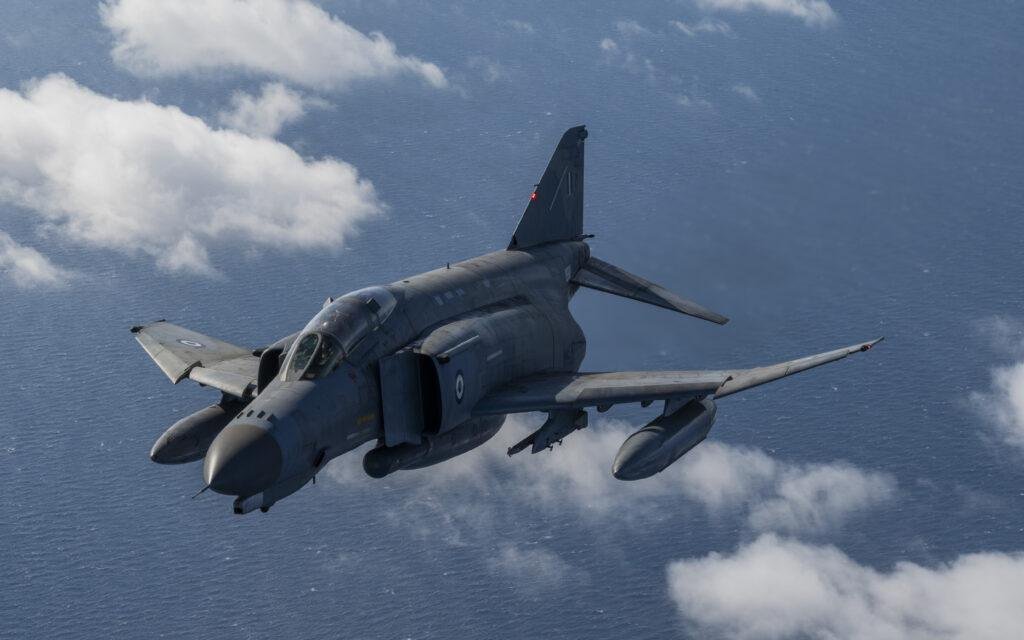
The Athens Flying Week crash killed both crew members of a Hellenic Air Force F-4E AUP Phantom II during a flying display at one of the largest airshows in southeastern Europe. The twin-seat jet went down at approximately 14:55 local time on Saturday, September 5, roughly three nautical miles southeast of the airfield at Tanagra Air Base, north of Athens, in front of thousands of spectators.
Neither crew member ejected. The Hellenic Air Force has declared three days of mourning and appointed a board of inquiry to determine the cause.
Table of Contents
What Happened at Tanagra Air Base
The Hellenic Air Force General Staff said the F-4E AUP Phantom II, serial number 01504 and assigned to the 338th “Ares” Squadron of the 117th Combat Wing, was roughly two minutes into its display when it struck the ground and caught fire. Spectator video showed the aircraft performing a low right turn before it descended behind trees and disappeared from view, followed by a fireball and a column of black smoke.
Athens Flying Week 2026 was scheduled to run September 5 and 6 at Tanagra, and organizers canceled the remainder of the event after the crash. No injuries were reported among the thousands of spectators who had gathered to watch the display.
The fire that followed the crash spread into nearby vegetation. The Associated Press reported that 11 water-dropping planes and helicopters assisted 85 firefighters in containing the blaze, which stayed a distance from the viewing area, and that the fire prompted an evacuation order for the surrounding area.
The Pilots Who Were Killed
The Hellenic Air Force identified the crew as Squadron Leader Ioannis Blesias, 40, and Flight Lieutenant Dimitrios Petrou, 37. Both were experienced officers of the 338th Squadron. Their bodies were recovered from the crash site later on Saturday.
Greek Prime Minister Kyriakos Mitsotakis addressed the loss publicly the same day.
“The sense of grief is widespread, and our thoughts are with the families of the two pilots we lost. It is a reminder of the daily danger faced by Greece’s aviators, who remain on constant standby to protect Greece’s skies.”
Kyriakos Mitsotakis, Prime Minister of Greece
The Hellenic Air Force has declared three days of official mourning for the crew.
Investigation and Response
A Hellenic Air Force board of inquiry has been appointed to determine what caused the crash. Wreckage is being recovered from the site and moved to a secure location so investigators can examine it. Greek authorities have said there is no indication that either ejection seat was activated, but they have not identified a cause, and an investigation of this kind typically takes months rather than days.
The Hellenic Air Force has not released additional detail on what the pilots were attempting during the maneuver that preceded the crash, and The Aviation Diary has not independently verified unofficial claims circulating about a possible mechanical failure.
One of the World’s Last Operational Phantoms
Greece is the last operator of the F-4 Phantom II in Europe, and one of only a small number remaining worldwide. The Hellenic Air Force has flown the type since 1974, when it acquired its first examples under the Peace Icarus program, later adding more aircraft including former U.S. Air Force and German airframes.
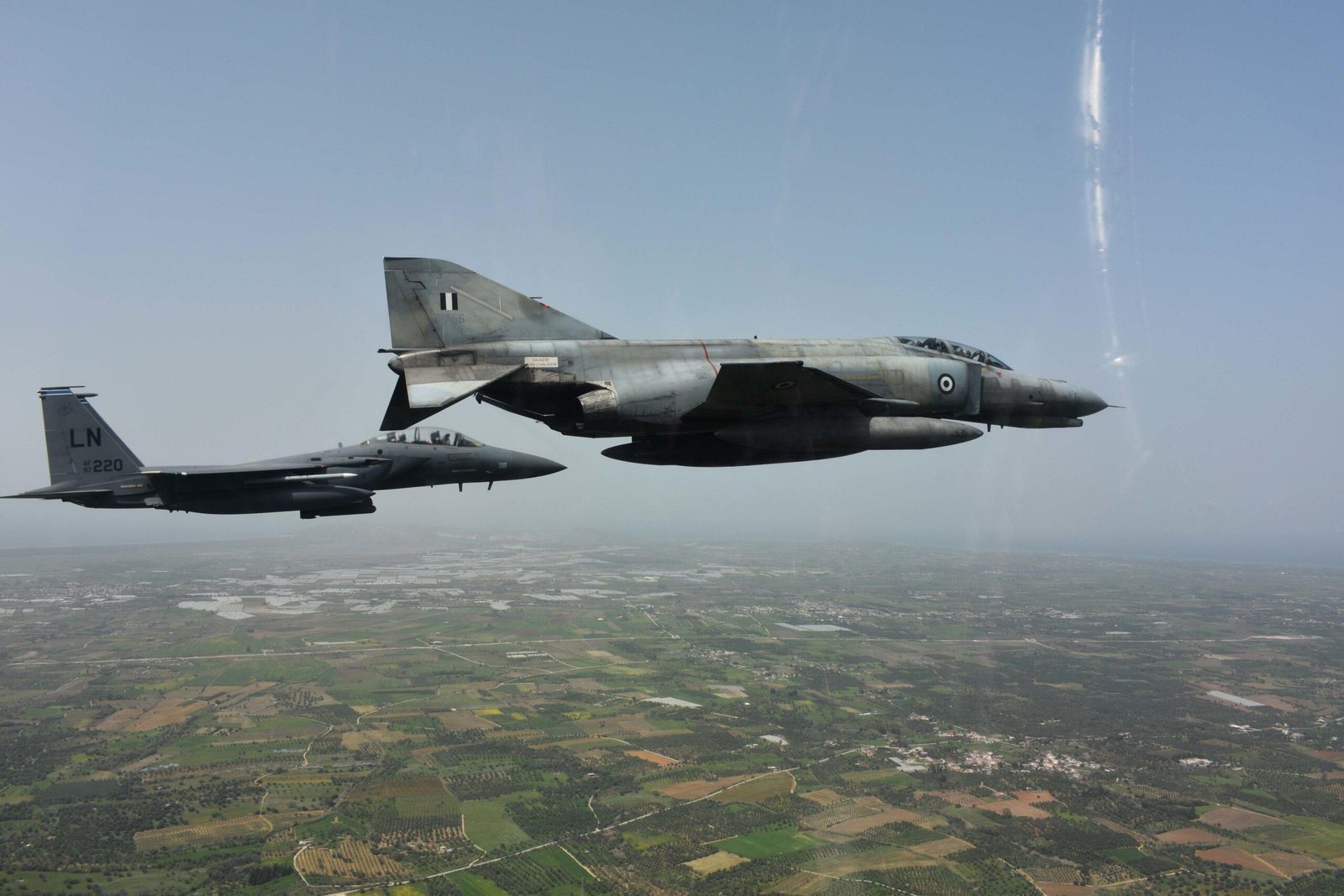
The surviving fleet underwent the Peace Icarus 2000 avionics upgrade, which extended the aircraft’s operational life with:
- Updated radar and navigation systems
- A MIL-STD-1553 digital databus
- New color cockpit displays
Even with the upgrade, the F-4’s airframe design dates to the 1960s, and Greece’s remaining Phantoms are expected to be retired from service by the end of the decade. Athens Flying Week organizers had promoted this year’s F-4 display as one of the type’s last public appearances before it leaves Hellenic Air Force service.
A Fleet With a Troubled Recent History
Saturday’s crash was not the first fatal accident involving a Hellenic Air Force F-4E in recent years. On January 30, 2023, another 338th Squadron Phantom crashed into the Ionian Sea roughly 25 nautical miles south of Andravida Air Base during a low-altitude training flight, killing both crew members: Weapons Systems Officer First Lieutenant Marios Michail Touroutsikas, 29, and pilot Captain Efstathios Tsitlakidis, 31. As with Saturday’s crash, officials said the crew did not eject.
Both accidents involved aircraft from the same squadron. The Athens Flying Week crash, coming less than three years after the Ionian Sea loss, has renewed attention on the safety margins of flying a fifty-year-old airframe at low altitude, whether in training or in front of an airshow crowd.
FAQ: F-4 Phantom Crash at Athens Flying Week
Was this the first fatal accident at Athens Flying Week?
Organizers have said no previous accident had occurred in the show’s history. The Aviation Diary has not independently confirmed this against an official Athens Flying Week safety record.
Why does Greece still fly the F-4 Phantom?
Greece is the last European operator of the type, having flown it since 1974 and upgraded the surviving fleet under the Peace Icarus 2000 program. The remaining aircraft are expected to be retired by the end of the decade.
Has this happened before with a Greek F-4?
Yes. A Hellenic Air Force F-4E from the same squadron crashed into the Ionian Sea in January 2023 during a training flight, killing both crew members.
Looking Ahead
The Hellenic Air Force’s board of inquiry is expected to take months to determine a cause, and The Aviation Diary will update this story as investigators release findings. The Athens Flying Week crash is also likely to sharpen debate over how much longer Greece’s Phantom fleet should keep flying, particularly in low-altitude display work, as the type approaches its already-planned retirement later this decade.
Sources
- Associated Press, via KSL — “Greek air force jet crashes at an annual aerial show, killing 2 pilots”: crash details, firefighting response and Prime Minister Kyriakos Mitsotakis’s statement.
- The Aviationist — “Greek F-4 Phantom Crashes During Airshow Near Athens”
- MiGFlug — “F-4 Phantom Crash at Athens Flying Week Kills Two Pilots”
- Neos Kosmos — official Hellenic Air Force General Staff statement identifying the crew.
- AirDataNews — squadron and aircraft-history background
- Militär Aktuell — on-scene reporting and Greece’s status as Europe’s last Phantom operator
- TO VIMA — on the F-4 fleet’s planned retirement by the end of the decade
- The Aviationist — “Greek F-4E Phantom II Crashed in the Sea Near Andravida” (January 2023)
- Scramble Magazine — “EPA Phantom Crash in Ionian Sea” (January 2023)
- Key.aero — “Greek F-4E Phantom II Crashes Ionian Sea” (January 2023)