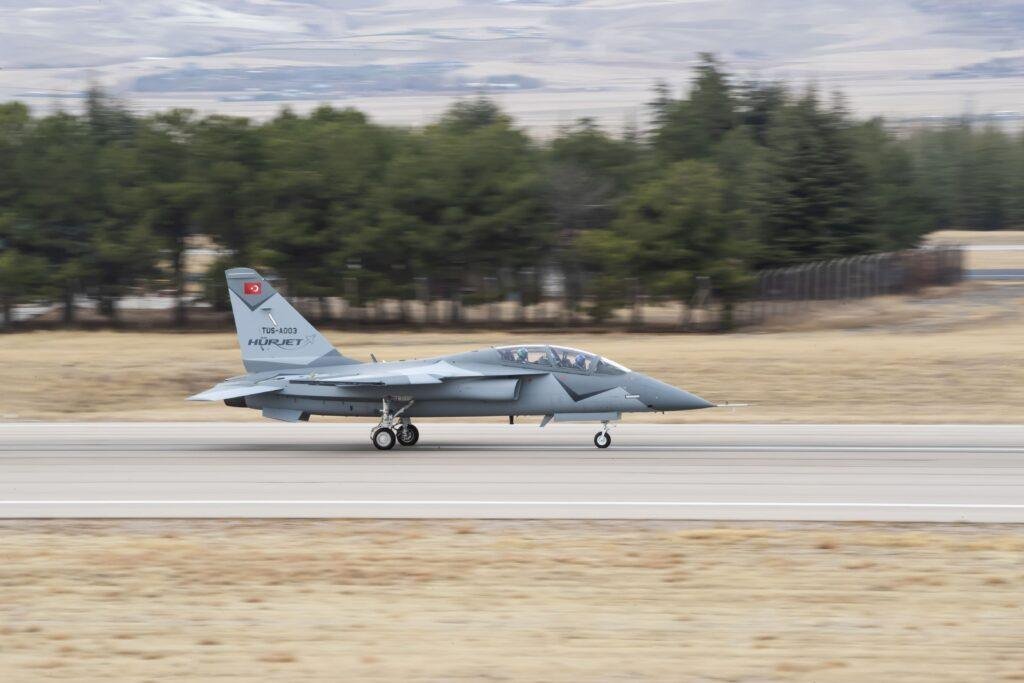
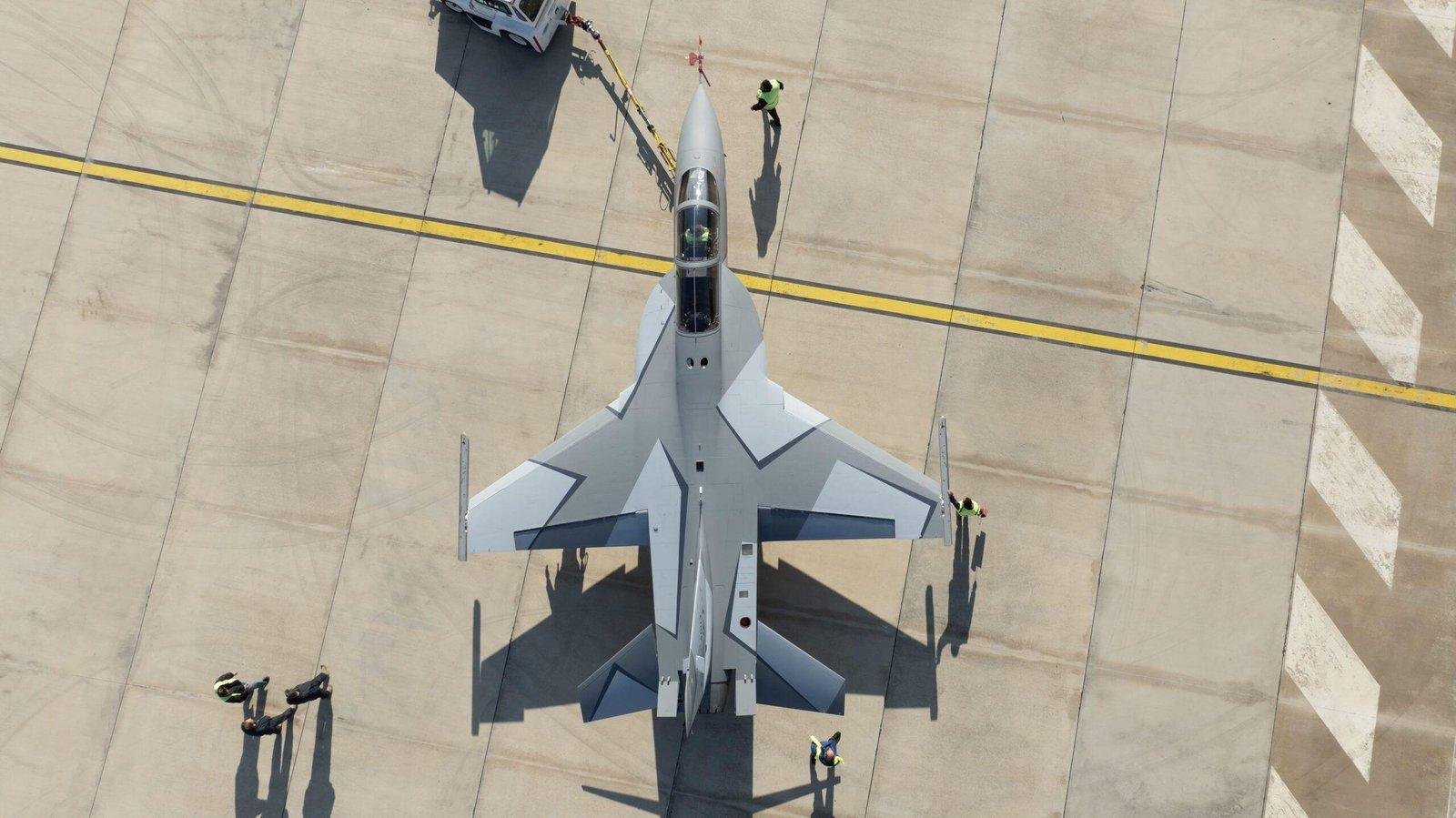
The Hurjet first flight on August 30, 2026 was not the program’s first, but it was the first for an aircraft the Turkish Air Force will actually keep. Turkish Aerospace flew the initial production-configuration HÜRJET advanced jet trainer on an 18-minute sortie accompanied by one of the program’s development prototypes. The distinction matters more than the flight time suggests, because it moves a program that has been airborne since 2023 out of the prototype phase and into the far harder business of building, testing and delivering repeatable aircraft.
Türkiye’s Presidency of Defense Industries (SSB) confirmed the flight, which followed final assembly, ground testing and taxi trials at Turkish Aerospace’s Ankara facility. Air Data News identified the aircraft as TUS-A020; Turkish Aerospace has not published a serial designation for it.
Table of Contents
Why This Hurjet First Flight Is Different
Aviation headlines about maiden flights usually mean one thing: an aircraft that has never flown before has left the ground for the first time. That is not what happened here, and the difference is worth understanding before the significance of the milestone makes sense.
The Hurjet has been flying for more than three years. Its first prototype, P1, lifted off on April 25, 2023. A second prototype followed on November 13, 2024, staying airborne for 26 minutes and reaching 10,000 feet on that initial sortie. Between them, according to Turkish Aerospace, the two prototypes have logged over 500 test flights, exceeded 45,000 feet and broken the sound barrier.
The aircraft that flew on August 30 belongs to a different category. It is not a hand-built test article assembled to prove the design works. It came off the production effort for aircraft intended to enter the Turkish Air Force inventory, built in the configuration the service will actually operate. This Hurjet first flight therefore validated something the prototype campaign never could: that the production process, the tooling and the assembly standard behind a serial aircraft produce something that flies as designed.
Plenty of aerospace programs have flown impressive prototypes and then stalled on exactly this transition. Getting from a demonstrator to a delivered fleet involves production engineering, supply chain maturity, acceptance testing and sustainment planning, none of which a prototype campaign proves.
Victory Day Timing Was Not an Accident
August 30 is Zafer Bayramı, Victory Day, marking the decisive 1922 engagement that ended the Turkish War of Independence. The 2026 flight fell on the 104th anniversary.
Türkiye schedules defense milestones around the date deliberately, and SSB President Haluk Görgün framed the announcement in exactly those terms, describing the aircraft as evidence that the resolve which carried the country to independence continues to drive its national aviation industry today. He thanked the Turkish Air Force, the Turkish Aerospace team, and the engineers and technicians behind the program.
For readers outside Türkiye, the symbolism explains why a comparatively short 18-minute sortie generated the coverage it did. A domestically designed supersonic jet flying a production-standard airframe on the national military holiday is a deliberate statement about indigenous capability, and the Hurjet first flight was staged with that audience in mind.
From a 2017 Program Launch to a Production Line
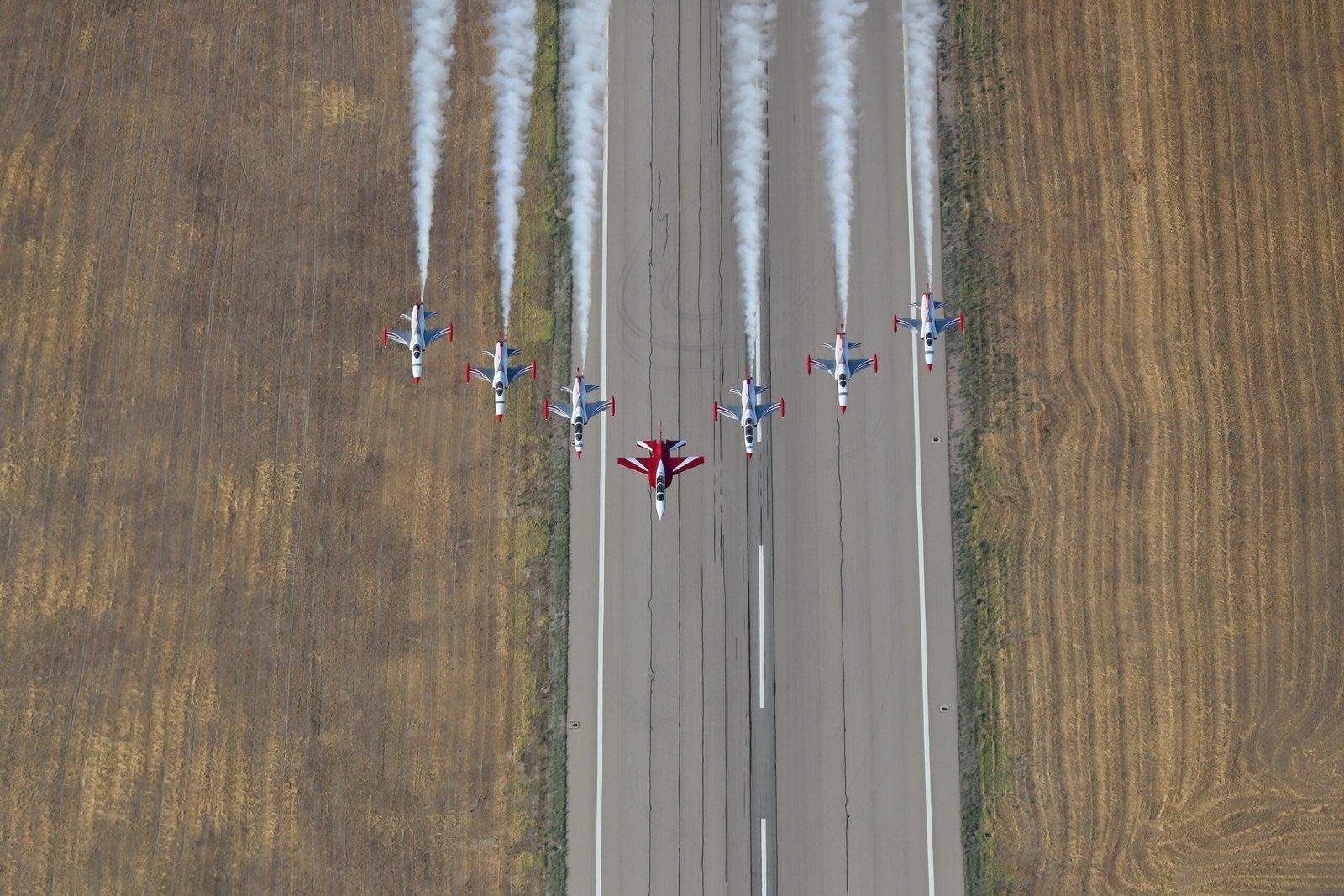
Turkish Aerospace launched the Hurjet program in 2017, aiming to replace two aging fleets at once: the Northrop T-38 Talons used for advanced jet training, of which the Turkish Air Force still operates roughly 68, and the Northrop F-5 derivatives flown by the Turkish Stars aerobatic demonstration team. Both types have been in Turkish service for decades, and both are increasingly expensive to sustain.
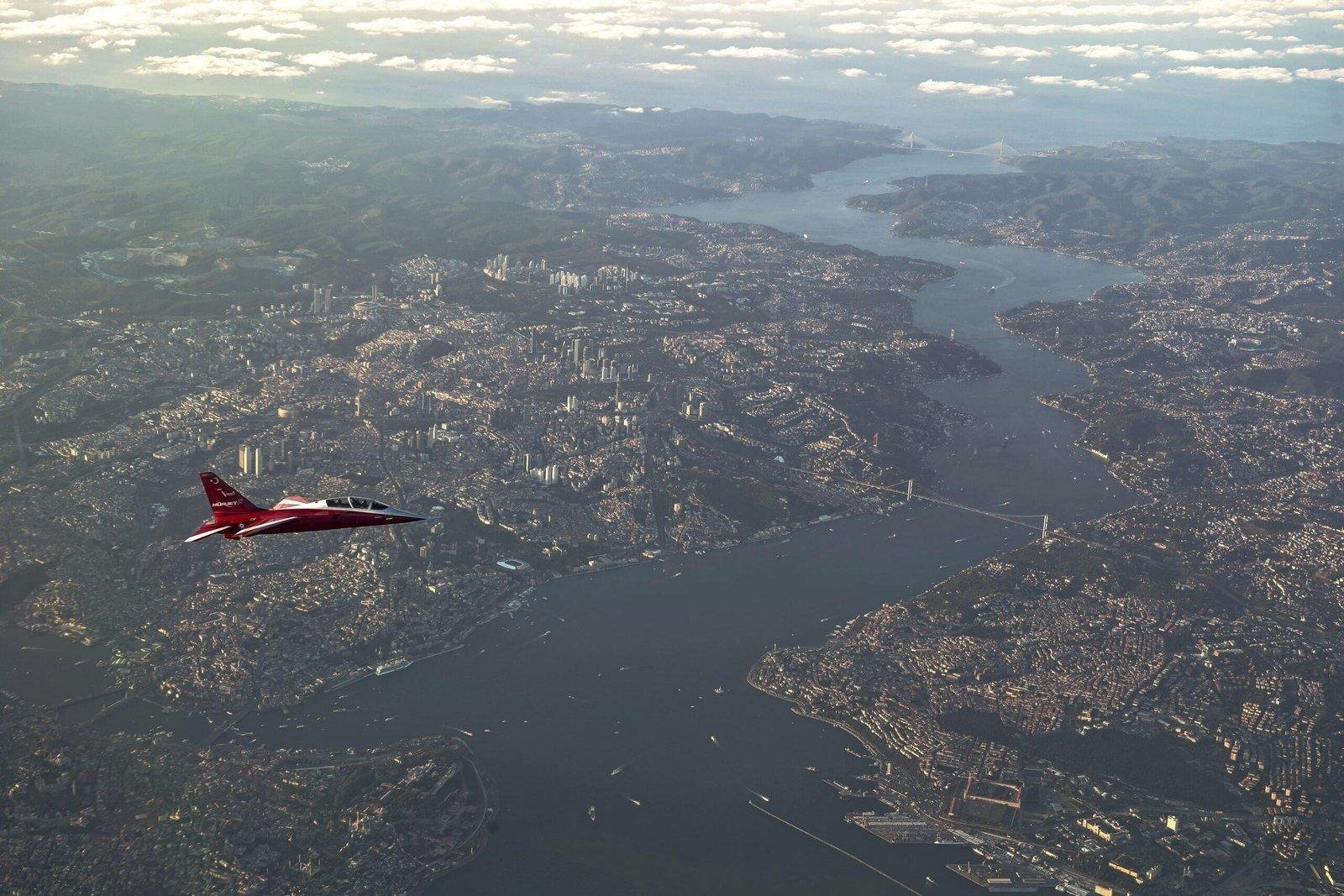
The development campaign moved steadily. P1 alone completed more than 150 test activities, crossed the Mediterranean for an overseas appearance at the Egypt International Aviation and Space Fair, and flew a demonstration over the Giza Pyramids. Supersonic flight came during the prototype phase, with Turkish Aerospace publicising a Mach 1.2 milestone before the aircraft’s Mach 1.4 design ceiling was approached.
The Turkish Air Force has contracted for 12 aircraft, with six to be produced in the first phase. Turkish Aerospace has said it intends to scale the line toward roughly two aircraft per month once serial manufacturing is fully running, and production and assembly of further delivery-configuration airframes is proceeding in parallel with the ongoing prototype test campaign.
What the Hurjet Is Built to Do
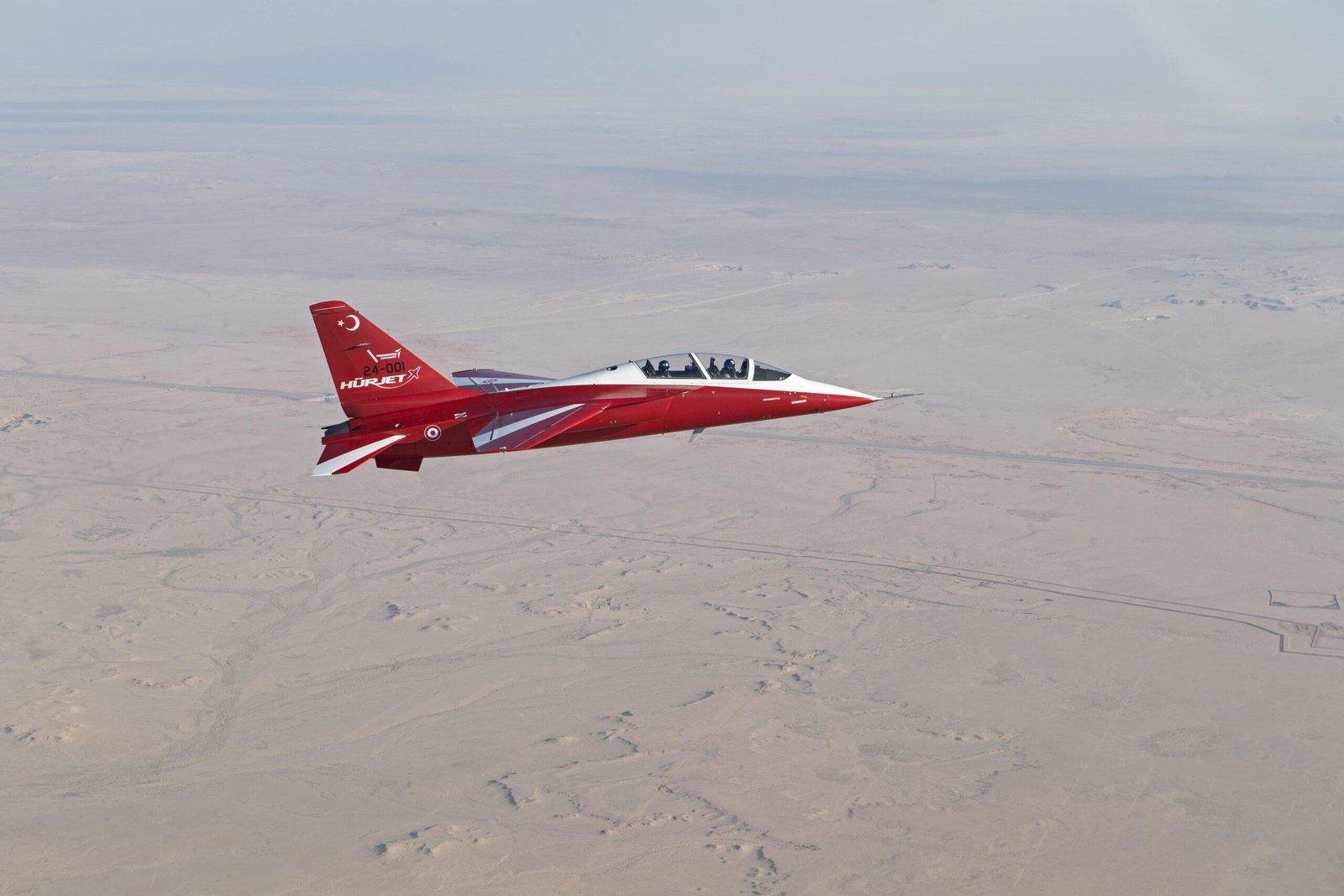
The Hurjet is a single-engine, tandem-seat supersonic advanced jet trainer and light attack aircraft. Its job is to close the gap between basic jet training and the front line, and that gap has widened considerably as combat aircraft have become sensor-driven rather than simply fast.
A student moving toward the F-16, the Eurofighter Typhoon or an eventual fifth-generation type needs more than handling experience in a fast jet. Modern lead-in fighter trainers are expected to reproduce cockpit workload, sensor fusion, datalink behaviour and mission management, so that expensive frontline flight hours are spent on tactics rather than familiarisation. Turkish Aerospace built the aircraft around a modern avionics suite and a fighter-style human-machine interface for that reason, supported by an embedded and ground-based training architecture the company markets as Hurjet Training 360.
Turkish Aerospace lists four intended roles: advanced jet training, introduction to fighter fundamentals, red air or aggressor work, and aerobatic team operations. The light attack side is developing visibly. In May 2026, the second prototype was photographed in flight carrying four underwing weapon pylons, two per side, and Turkish defense outlets have reported planned integration of MURAD-family AESA radar and the Gökdoğan and Bozdoğan air-to-air missiles. Turkish Aerospace has not commented publicly on the pylons, and the company’s own material still presents the aircraft primarily as a trainer family rather than publishing an operational weapons catalogue.
Hurjet Specifications
Figures below are as published by Turkish Aerospace:
- Length: 13.6 m (44.9 ft)
- Wingspan: 9.5 m (31.2 ft)
- Height: 4.1 m (13.5 ft)
- Wing area: 25 m² (270 ft²)
- Maximum speed: Mach 1.4
- Service ceiling: 45,000 ft
- Range: 1,060 nm
- Rate of climb: 48,500 fpm
- Maximum sustained G: 6.3 G at 15,000 ft
- G limits: +8g / -3g
- Payload capacity: 7,500 lb
- Powerplant: GE Aerospace F404 afterburning turbofan, 17,700 lb thrust
One note on the engine designation. Turkish Aerospace’s own technical data lists the powerplant as the GE-F-404-104, while GE Aerospace’s engine family documentation and most independent references identify the Hurjet’s engine as the F404-GE-102, the same variant that powers the KAI T-50 Golden Eagle. Both figures point to the same 17,700-pound afterburning rating, and GE Aerospace and Turkish Aerospace signed an F404 supply agreement covering the program in May 2026.
Those numbers place the Hurjet against the KAI T-50 and the Leonardo M-346 in the advanced trainer market. The M-346 is subsonic, which gives the Hurjet a genuine performance differentiator when air forces evaluate lead-in fighter training packages.
Spain Has Already Bought In
The Hurjet’s most consequential development may have happened outside Türkiye entirely. Spain selected an Airbus-led training package built around the aircraft for its Integrated Combat Training System, intended to replace the Spanish Air and Space Force’s remaining F-5 advanced trainers. The Spanish variant is designated SAETA II.
The program covers 30 aircraft, with Airbus as prime contractor and Turkish Aerospace supplying the platform. Spanish aircraft will not be Turkish jets in different markings: Airbus and Spanish industry are integrating national avionics, mission systems and training infrastructure as part of a broader combat pilot training system. Deliveries to Spain are currently targeted from 2028.
Turkish Aerospace chief executive Mehmet Demiroğlu has separately indicated that a final supply contract covering a larger quantity, in the region of 45 aircraft and valued at roughly $3.6 billion, is expected. That figure has not been formally confirmed by Airbus or the Spanish Ministry of Defense, so the 30-aircraft ITS-C program remains the firm number for now.
Either way, the significance is the same. Türkiye has secured a jet trainer export to a fellow NATO member before the aircraft has entered squadron service at home, which is something most new military aircraft programs never manage.
What Comes Next
The Hurjet first flight put a production airframe in the air, and that aircraft now enters a flight test and verification campaign of its own. Production airframes require acceptance testing against the customer’s requirements, a process distinct from the development flying already completed by the two prototypes, and the Turkish Air Force will need to formally accept the aircraft before it enters service.
Delivery timing is where the picture gets less certain. Turkish Aerospace continues to list 2026 as the target for the start of Turkish Air Force deliveries, but Turkish defense reporting points to regular deliveries beginning in 2027. A first flight at the end of August leaves a narrow window for acceptance work inside the calendar year, so the two positions may not be as far apart as they look.
Beyond that, the milestones to watch are production rate, the first physical handover, and execution on the Spanish program. Whether the 2026 date holds is the question the Hurjet first flight does not answer. What it does establish is that the program has something to deliver.
FAQ: Hurjet and the Turkish Air Force
If the Hurjet flew in 2023, why is this called a first flight?
The 2023 flight was the first for prototype P1. The Hurjet first flight on August 30, 2026 was the first for a production-configuration aircraft built for delivery to the Turkish Air Force rather than for the development test campaign. Each individual airframe has its own maiden flight.
How many Hurjets has the Turkish Air Force ordered?
Twelve aircraft under the current contract, with six produced in the first phase.
What engine does the Hurjet use?
A single GE Aerospace F404 afterburning turbofan rated at 17,700 pounds of thrust. Turkish Aerospace lists it as the GE-F-404-104; other references cite the F404-GE-102, the variant used in the KAI T-50.
Which aircraft will the Hurjet replace?
The Northrop T-38 Talon in the advanced jet training role, and the Northrop F-5 derivatives flown by the Turkish Stars aerobatic demonstration team.
Is the Hurjet supersonic?
Yes. It is designed for Mach 1.4 and has exceeded the sound barrier during prototype testing, which distinguishes it from the subsonic Leonardo M-346 in the same market segment.
Has any country ordered the Hurjet?
Spain selected the aircraft for its Integrated Combat Training System, covering 30 aircraft designated SAETA II, with Airbus as prime contractor and deliveries targeted from 2028.
Sources
- Turkish Aerospace — HÜRJET program page and technical data
- Anadolu Agency — first inventory HÜRJET maiden flight report
- GE Aerospace — F404 engine agreement for the HÜRJET program
- Airbus — Spain’s new combat training system
- The Aviationist — first production-representative HÜRJET maiden flight