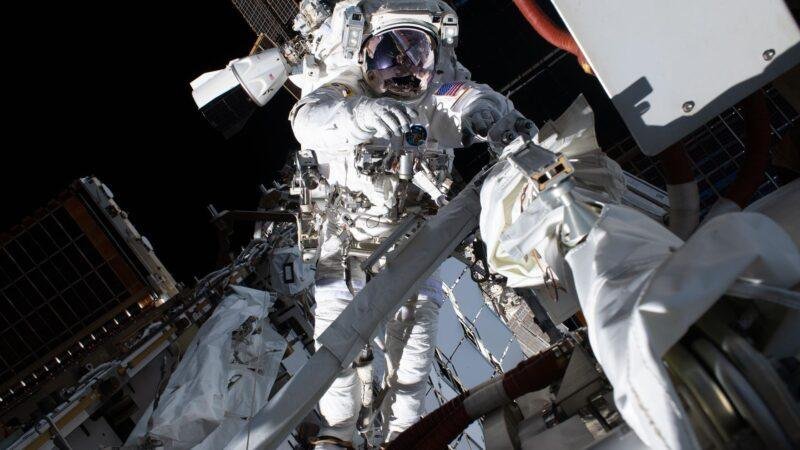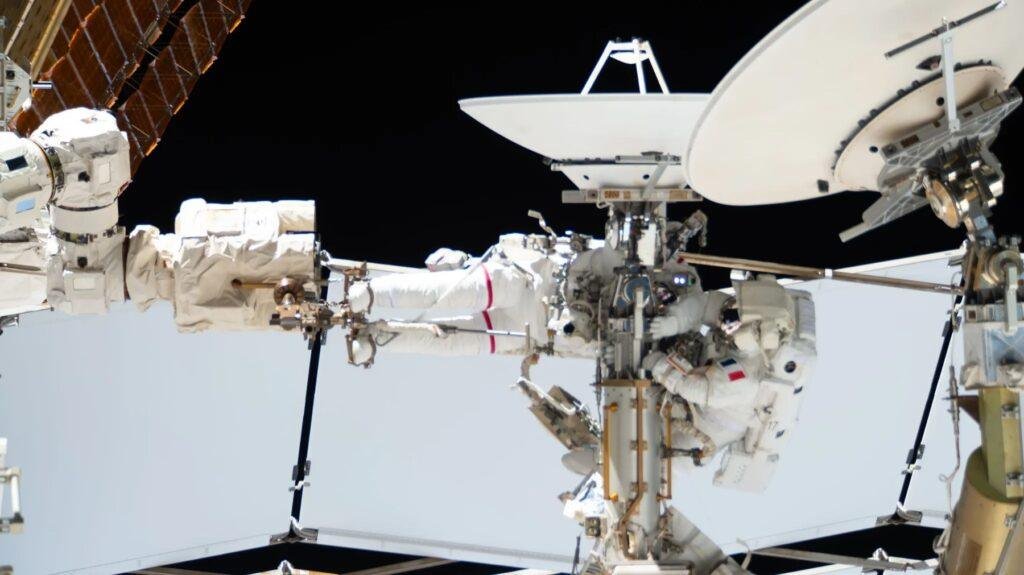
ISS spacewalk teams completed another stage of the International Space Station’s electrical-power upgrade on October 29, when NASA astronaut Anil Menon and Canadian Space Agency astronaut Joshua Kutryk installed the seventh roll-out solar array. NASA said the work concluded after seven hours and eleven minutes outside the orbital laboratory.
The astronauts installed and deployed an International Space Station Roll-Out Solar Array on the station’s 2A electrical power channel. They also completed preparatory tasks for the next planned spacewalk, which would add the eighth and final array on November 5 if the mission proceeds as scheduled.
Table of Contents
ISS Spacewalk Adds Power on the 2A Channel
NASA said Menon and Kutryk concluded the excursion at 3:08 p.m. Eastern time. During the outing, the astronauts worked on the port-side truss structure, with robotic support visible in NASA’s account. The new solar array is intended to increase the power available to station operations as existing infrastructure ages.
The roll-out arrays supplement the station’s older solar wings rather than representing a completely new station. NASA has installed them incrementally through a series of spacewalks. Each new array requires careful preparation, attachment and deployment work that must be completed while astronauts operate in spacesuits outside a pressurized vehicle.
NASA said this was U.S. spacewalk 100, Menon’s fourth spacewalk and Kutryk’s first. The outing was also the 285th spacewalk supporting assembly, maintenance and upgrades on the station. Those totals describe mission history and do not indicate that all planned power upgrades are finished.
The original announcement and its qualification details can be read in the primary source.
What the Eighth Array Would Change
The next installation is intended for the 3B power channel on November 5. NASA said the October 29 crew carried out get-ahead tasks that help prepare the station for that later work. The plan still depends on operational readiness, mission conditions and the results of each stage of preparation.
When all eight roll-out solar arrays are installed, NASA estimates the station’s available power will increase by up to thirty percent, from about 160 kilowatts to roughly 215 kilowatts. These are agency projections for the fully augmented configuration, not a measurement of total output immediately after the seventh array.
Additional electrical capacity helps the station support scientific work, environmental control, vehicle visits and critical systems. NASA also cited the need for power during a future safe and controlled deorbit. The precise deorbit sequence is a separate program matter and cannot be inferred from an individual solar-array spacewalk.
For related reporting, see TAD’s earlier article, ISS Spacewalks to Complete Solar Array Upgrades in 2026. That separate development provides context and should not be confused with the announcement reported here.
A Multinational Station Maintenance Campaign
The operation brought together a U.S. astronaut and a Canadian astronaut aboard an international laboratory that has required continuous maintenance and technical upgrades over decades. Kutryk’s participation is also a reminder that the space station program relies on partner agencies as well as NASA.
Spacewalk work is planned around limited crew time, robotics, tools, suit endurance and power-system configurations. Ground teams assess the sequence of tasks before and after each excursion. Completing the planned array installation is therefore both an engineering milestone and a contribution to continuing day-to-day operations.
The current result is more specific than the earlier announcement of the October spacewalk schedule. With the seventh array deployed, NASA has reported a completed piece of work; the eighth installation remains a future objective. That distinction matters for accurate reporting of milestones that occur over several crewed excursions.
FAQ: ISS spacewalk
What did the ISS spacewalk accomplish?
Menon and Kutryk installed and deployed the seventh station roll-out solar array on the 2A power channel.
How long did the spacewalk last?
NASA reported a duration of seven hours and eleven minutes, ending at 3:08 p.m. Eastern on October 29.
When is the next array installation planned?
NASA scheduled the eighth and final installation for November 5, subject to normal mission planning and readiness.
Looking Ahead
NASA plans to provide live coverage of the November 5 spacewalk, with coverage beginning at 6:45 a.m. Eastern. The agency has not reported completion of the eighth array as of this article’s news peg.
Sources