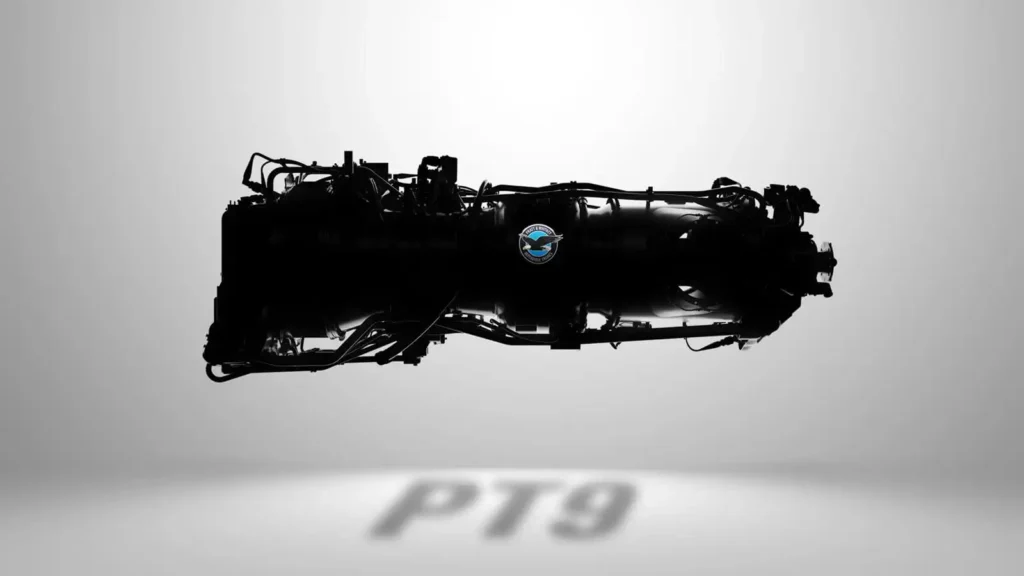
Pratt Whitney PT9 is a newly certified turboprop engine that Pratt & Whitney Canada unveiled on Oct. 21 during a Las Vegas aviation-industry event. Parent company RTX said the design had recently received Transport Canada certification after more than 14,000 development hours, moving the program beyond its development-only status.
The manufacturer claims the engine provides 33% more power at altitude and uses 20% less fuel than previous-generation engines. These are company-stated comparisons, not results of a public head-to-head evaluation reviewed independently by The Aviation Diary. RTX did not identify a specific launch aircraft or delivery customer in the announcement.
Table of Contents
Pratt Whitney PT9 Certification and Performance Claims
Certification is a regulatory milestone for the engine design, but it should not be confused with an aircraft manufacturer receiving approval to install the engine on every possible airplane. Aircraft integration, installation approvals and operator introduction require their own processes. The release identifies Transport Canada as the certifying authority and describes the type as a new turboprop centerline. The original announcement provides the source figures and status.
RTX quantified the program’s development effort at more than 14,000 hours without breaking the total down into flight testing, ground running, design work or other activity. The figure is useful as an indication of the program’s scope, but it does not reveal how much testing an individual customer’s installation might still require. Read also: TAD analysis of aircraft certification requirements.
The 33% improvement is specifically described as additional power at altitude, rather than a blanket 33% performance gain in every flight condition. The 20% fuel-use comparison is likewise against a previous generation. RTX did not provide the exact baseline model, aircraft configuration or measurement conditions in this announcement.
Modular Design and Future Aircraft Applications
Pratt & Whitney Canada described modular construction intended to make the new engine adaptable across different aircraft types. In practical terms, the company is emphasizing an engine architecture that can be developed for more than one installation rather than announcing a fully defined fleet of aircraft that will use it immediately.
The announcement also points to advanced digital capabilities and possible future hybrid thermal-electric applications. That does not mean the certified PT9 announced on Oct. 21 is itself a certified hybrid-electric propulsion system. Such a configuration would require an additional aircraft and propulsion integration effort before commercial operation.
Turboprop aircraft serve missions where runway access, sector length and operating economics can favor propeller propulsion. Manufacturers must balance power, aircraft weight, maintenance, dispatch reliability and acquisition cost. RTX described flexibility and efficiency goals for the PT9, but did not disclose pricing, maintenance intervals or a guaranteed operator cost saving.
Manufacturing in Canada and What Remains Open
RTX said PT9 production would take place in Lethbridge, Alberta, a location it also identifies as a center of excellence for its established PT6 turboprop family. The company linked the new program to its existing industrial base rather than announcing an additional assembly site. No start-of-deliveries date was given in the October statement.
The PT6 family is familiar in general aviation and regional aviation, but the PT9 should not be presented as a mere renaming of an existing PT6 variant. RTX describes it as a new engine centerline with performance and future-integration ambitions. The published specifications do not establish that existing PT6-powered aircraft could install it without redesign.
The next operational evidence will come from named airframe applications, installation approvals and reports of aircraft performance in actual service. Until such information appears, the meaningful completed milestones are the company’s unveiling and its statement that Transport Canada certification has been received.
FAQ: Pratt Whitney PT9
Who certified Pratt Whitney PT9?
RTX states that Transport Canada recently certified the PT9 engine ahead of the Oct. 21 announcement.
How much testing was reported?
The company reported more than 14,000 development hours but did not provide a full category-by-category breakdown.
Is the new turboprop already flying with airline customers?
The announcement did not identify an airline installation, entry-into-service date or customer delivery.
Looking Ahead
Pratt & Whitney Canada has not announced a PT9 launch airframe or delivery schedule in the release reviewed. Airframe selection and evidence from operational installations are the next milestones to watch.
Sources