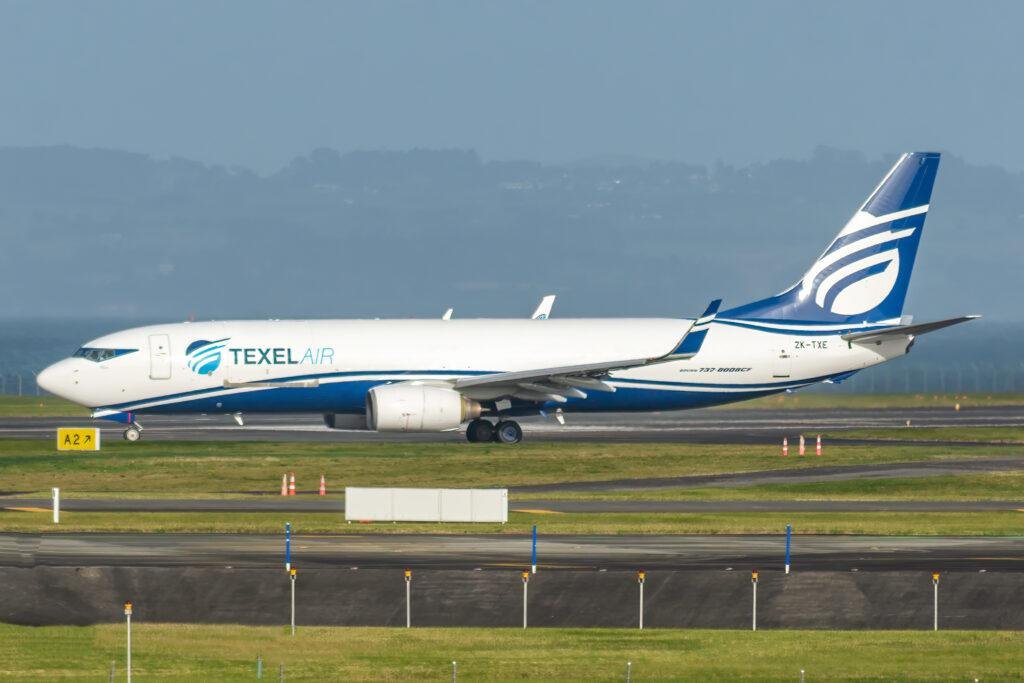
Texel Air freighter capacity is expanding in Australasia after the cargo operator introduced another Boeing 737-800 converted freighter, according to an October report by Air Cargo News. The aircraft forms part of the operator’s efforts to build a jet-cargo network in a region where geography and supply-chain schedules make dependable airfreight links significant.
The airplane is a Boeing 737-800 passenger airframe converted for freight use. The suffix BCF refers to Boeing Converted Freighter, a program that changes the aircraft’s interior and cargo-handling configuration. It is a converted aircraft rather than a factory-built new-generation passenger jet or an entirely new aircraft model.
Industry reporting identified the aircraft with New Zealand registration ZK-TXH. The reported delivery increases the local operator’s freighter inventory, but an aircraft’s arrival should not be mistaken for proof of a fixed number of new routes or guaranteed extra weekly flights.
Table of Contents
Texel Air Freighter Arrives Following Conversion
Air Cargo News described the airplane’s addition to Texel Air Australasia’s operation and placed it within the wider Boeing 737-800BCF conversion program. Conversion typically creates a main-deck cargo compartment, cargo-loading access and systems suited to freight operations, while the aircraft remains subject to maintenance and airworthiness rules.
The 737-800BCF is designed for short- and medium-haul freight sectors where an operator can use a narrowbody aircraft’s capacity without the cost structure of a large widebody freighter. Actual mission economics depend on distance, load, fuel prices, handling arrangements and airport operating constraints.
Introducing a converted freighter can extend an aircraft’s commercial life after passenger service. However, the conversion does not reset the age of the original airframe or remove the need for maintenance. Operators must manage the aircraft in line with its approved modification and continuing-airworthiness requirements.
The aircraft was associated in trade reporting with a milestone in Boeing’s conversion program. Such a production-program milestone is separate from the number of aircraft Texel Air itself owns or operates, and the two figures should not be combined.
Why More Narrowbody Cargo Capacity Matters
Air cargo moves goods for which time, reliability or access to remote markets matters. In Australasia, islands and long distances between economic centers can make a dedicated freighter useful even where passenger airlines also carry goods in belly holds.
A dedicated freighter provides flexibility in loading schedules and the range of cargo that can be accepted within certification and safety limitations. Whether it delivers more freight overall depends on utilization, customer agreements and network deployment, none of which is established by the arrival announcement alone.
The Boeing 737-800 conversion market has attracted operators seeking to replace older narrowbody freighters. Newer-generation passenger fleets can release suitable airframes for conversion, while the availability of slots, airframes and financing affects the overall pipeline.
Fleet expansion can also create requirements for maintenance technicians, spare engines, ground handling and training. Those associated investments are possibilities linked to operating an added airplane, not contracts confirmed by the specific Texel announcement.
The company participates in a broader air-cargo market covered by The Aviation Diary’s commercial aviation section.
Delivery Does Not Establish New Route Frequency
The available report confirms the fleet development but does not provide independently checked schedules for every planned new operation. A freighter may be used for existing customer missions, replace an aircraft undergoing maintenance or enable additional frequency as demand evolves.
It is therefore inaccurate to describe the delivery as launching a particular city pair unless the carrier publishes that specific route information. Nor does the news prove that freight rates will fall or that delivery times will improve across an entire national market.
Air cargo businesses also have to manage volatile demand. Aircraft that provide useful seasonal capacity can have different utilization patterns at other times. Future statements about network performance should be backed by operational disclosures, not simply extrapolated from fleet size.
FAQ: Texel Air freighter
What type of aircraft joined the Texel Air freighter fleet?
The reported aircraft is a Boeing 737-800BCF, a passenger jet modified for dedicated cargo operations.
Where is the added Texel Air freighter operating?
The aircraft was reported as part of Texel Air Australasia’s New Zealand-related operation; individual routes require current schedule confirmation.
Is the Boeing 737-800BCF a new passenger aircraft?
No. It is a previously manufactured 737-800 converted for freight use under an approved conversion program.
Looking Ahead
The next measurable development would be Texel Air’s publication of specific route assignments, utilization or additional fleet commitments. Until those details are announced, the confirmed event remains the addition of another converted 737 freighter.
Sources