Philippines drone aid from Japan will include unmanned aircraft intended for military monitoring and surveillance under a 4.3 billion yen security-assistance agreement signed in Manila on Nov. 9. Japan said the same program will provide a coastal radar system to the Philippine Navy.
The Japanese Foreign Ministry’s announcement describes this as the first transfer of defense equipment under Tokyo’s Official Security Assistance, or OSA, framework. The ministry identifies the Philippine Air Force as the recipient of the surveillance UAVs but does not name the aircraft models or specify a delivery date.
The agreement therefore establishes a funded assistance project and a planned equipment transfer, not proof that the radars or drones are already operating with Philippine units.
Table of Contents
Philippines drone aid agreement signed in Manila
Japanese Ambassador Katsuro Kitagawa and Philippine Foreign Secretary Maria Theresa Lazaro signed and exchanged notes on Nov. 9. The announced amount is 4.3 billion yen for the Japanese fiscal 2026 OSA project, a government-to-government assistance arrangement rather than a commercial aircraft purchase by Manila.
The grant will support two distinct capabilities. The Philippine Navy is to receive a coastal surveillance radar system, while the Philippine Air Force is slated to receive UAVs for monitoring and surveillance. Japan’s release does not assign a public quantity or model to the drones, or a technical range to the radar. Those details should not be inferred from other aircraft currently operating in the region.
The Philippine News Agency also reported the signing and identified the proposed recipients. Neither official account reviewed by TAD establishes that a contract for a particular UAV manufacturer has been awarded or that the first aircraft has been handed over.
Coastal radar and UAVs support maritime awareness
Japan’s announcement links the assistance to the Philippines’ position near the South China Sea and Luzon Strait, two important maritime corridors. Its stated objective is to improve the Philippine armed forces’ ability to monitor activity and gain a more complete picture of the surrounding maritime environment.
A coastal radar can provide observations from land-based sites, while aerial surveillance may extend the area examined when aircraft are available and authorized to fly. The announcement does not describe how the radar and UAV feeds will be integrated, whether they will operate simultaneously, or what operational areas the Philippine Air Force will assign them. It would be premature to describe a functioning shared network.
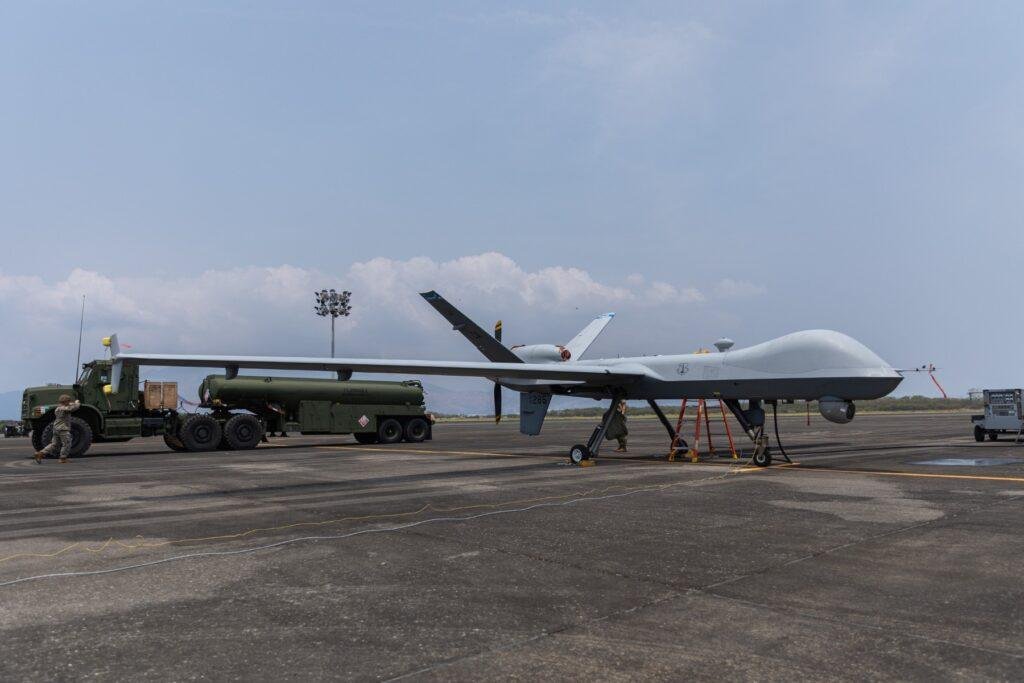
The development sits alongside other reported unmanned-aircraft activities in the country. In an unrelated story, TAD covered a reported U.S. Marine MQ-9A detachment in Palawan. That American operation is separate from Japan’s new assistance package; the U.S. aircraft shown in TAD’s archival photo is not a type identified for the Japanese transfer.
Japan expands security-assistance equipment transfers
OSA is a grant-aid program through which Japan provides equipment, supplies and assistance to partner-country armed forces and related organizations. According to the Foreign Ministry, the November package is a new step because it includes defense equipment, rather than only the broader support commonly associated with the framework.
The distinction matters for descriptions of the agreement. Japan has committed funding for a project and specified recipients and equipment categories. It has not announced complete procurement specifications, a delivery timetable or the start of operational service. Those later developments would each be newsworthy, but they are not established by this signing alone.
Japan describes the Philippines as a comprehensive strategic partner and says the assistance is intended to strengthen maritime domain awareness and regional security cooperation. The countries’ political characterization is attributable to the Japanese government, not a conclusion that any immediate operational change has occurred in disputed waters.
FAQ: Philippines drone aid
Which Philippine service receives the Philippines drone aid?
The Philippine Air Force is designated to receive monitoring and surveillance UAVs. The Philippine Navy is identified as the recipient of a coastal radar system.
How much is Japan providing under the agreement?
Japan announced 4.3 billion yen for its fiscal 2026 Official Security Assistance project in the Philippines.
Has Japan named the drones or their delivery schedule?
No. The ministry’s Nov. 9 release does not identify the UAV model, number of airframes or expected delivery date.
Looking Ahead
The next verifiable steps will be procurement particulars, delivery announcements and confirmation of receiving units or operational acceptance. No timetable for those steps was included in Japan’s announcement. TAD will distinguish any later equipment handover from the agreement announced on Nov. 9.
Sources
- Japan Ministry of Foreign Affairs: Nov. 9 OSA signing and exchange of notes
- Philippine News Agency: Japan radar and drone grant report