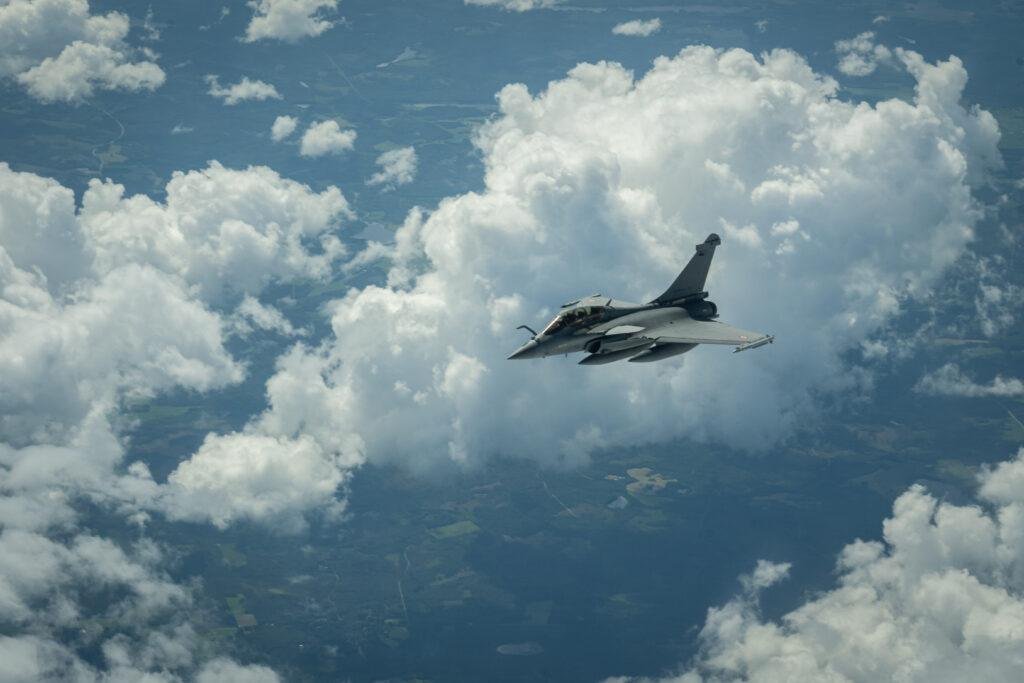
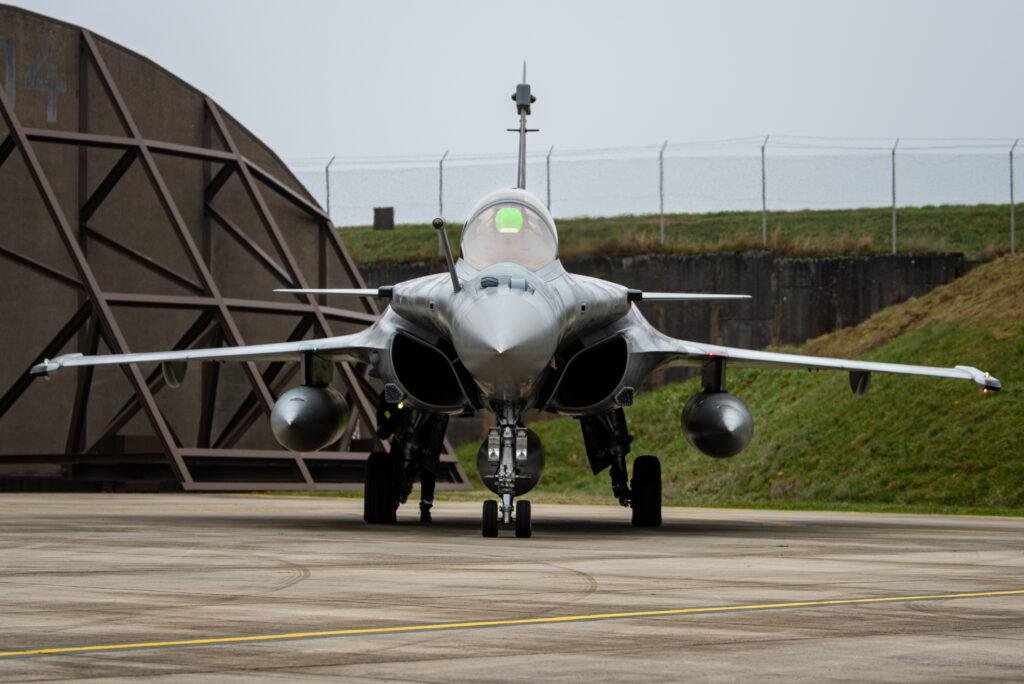
France has begun laying the industrial groundwork for the Rafale F5, awarding preliminary development contracts to Dassault Aviation, Thales, MBDA and Safran ahead of the full realization phase expected to launch by the end of 2026. France’s defense procurement agency, the Direction générale de l’armement (DGA), describes F5 as a deep mid-life overhaul of the Rafale, with qualification targeted around 2033 before the standard enters service with the French Air and Space Force and later the French Navy.
The scale of the upgrade reaches well beyond a routine software refresh. France is preparing a new radar, a substantially revised electronic-warfare suite, new connectivity and navigation systems, more capable propulsion and integration of the future ASN4G nuclear missile. At the same time, Dassault is developing a stealth uncrewed combat aircraft designed to operate alongside the Rafale, turning F5 into the crewed centerpiece of a wider collaborative combat system.
Table of Contents
What France Has Actually Ordered for Rafale F5
The contracts announced by the DGA are preparatory development awards rather than the full Rafale F5 realization contract. They were placed during the summer to reduce technical risk and advance equipment that must be ready before France launches the complete F5 development phase, which the DGA says is planned for the end of 2026.
Dassault Aviation remains responsible for the aircraft and overall integration, while Thales, MBDA and Safran are developing major elements of the future configuration. The work covers areas including inertial navigation, radar, electronic warfare, communications and propulsion. The DGA says the standard is intended to strengthen collaborative combat and France’s ability to conduct “first-entry” missions in heavily defended airspace.
F5 is also central to the future of France’s airborne nuclear deterrent. The standard is planned to integrate the ASN4G, the next-generation air-launched nuclear missile being developed to replace the current ASMPA-R in the 2030s.
New Radar, Electronic Warfare and More Engine Thrust
One of the biggest changes planned for the Rafale F5 is the Thales RBE2-XG radar. The next-generation active electronically scanned array is expected to use gallium-nitride technology to increase available power and detection performance while improving the aircraft’s ability to identify very-low-observable targets. Additional computing capacity is also being designed into the radar for collaborative sensing and future artificial-intelligence functions.
The aircraft’s SPECTRA self-protection system is undergoing an equally substantial change. Thales confirmed that the DGA placed orders for development of the next-generation SPECTRA electronic-warfare suite and new connectivity as part of F5 work. The future system is being developed with MBDA and is intended to move toward a more fully digital architecture able to cope with denser and more complex electromagnetic threats.
Connectivity is another major part of the configuration. A new Inter-Vehicle Data Link is intended to provide a high-speed, discreet and jamming-resistant connection between aircraft and other nodes in the combat network, a requirement that becomes especially important once Rafales begin coordinating with uncrewed combat aircraft.
Safran is also advancing the M88 T-REX, a higher-thrust evolution of the Rafale’s existing engine. Safran says the T-REX is designed to reach 9 metric tons of thrust with afterburner, roughly 20 percent more than the current M88, while retaining the engine family’s compact dimensions and modular architecture. Qualification of the T-REX is being aligned with the planned Rafale F5 timeline.
Rafale F5 Will Fight With a Stealth Combat Drone
The uncrewed part of the program is not an optional side project. Dassault Aviation launched development of a new uncrewed combat air vehicle in October 2024 specifically to complement the future F5 standard. The company says the aircraft will incorporate stealth technology, autonomous control with a human kept in the decision loop, and internal payload carriage.
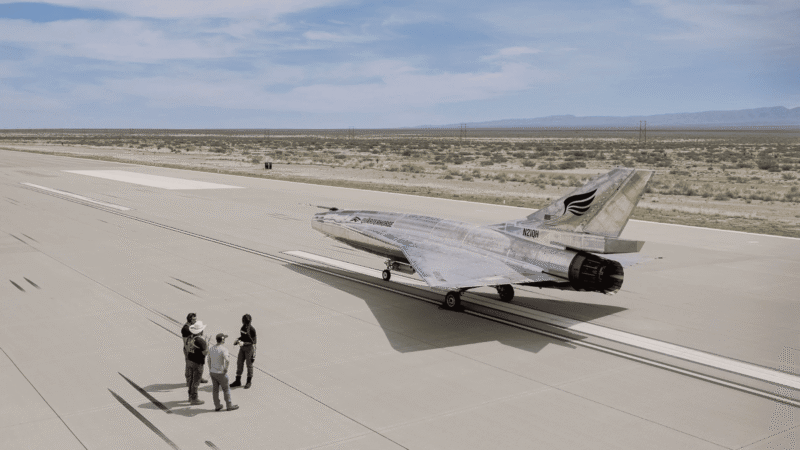
The new drone will draw heavily on the experience gained from Dassault’s nEUROn demonstrator, which first flew in 2012 and has been used to mature European stealth-UCAV technologies. The French defense ministry has described a much broader operational role for the follow-on system, including first-entry missions, air-to-air combat, air-to-surface missions and suppression of enemy air defenses in contested environments.
Rather than requiring a Rafale pilot to manually fly a second aircraft, the concept centers on collaborative combat. The crewed fighter would remain the human-controlled command node while automation and onboard autonomy handle more of the drone’s flight and mission execution. That approach mirrors a wider shift toward crewed-uncrewed teaming, including programs such as Saab’s A3-001 Collaborative Combat Aircraft in Sweden.
Why Rafale F5 Now Matters More to France
The timing of the F5 acceleration gives the program additional strategic weight. France had expected the Rafale to bridge toward a new crewed combat aircraft developed with Germany under the Future Combat Air System effort, but the Franco-German New Generation Fighter arrangement has fractured in its original form. That leaves Paris with a stronger incentive to keep the Rafale viable against high-end threats well into the 2030s and beyond.
F5 does not turn the Rafale itself into a low-observable fifth- or sixth-generation fighter. The underlying airframe remains an evolution of a design that predates modern all-aspect stealth. France’s answer is instead to improve the fighter’s sensors, electronic warfare, networking and propulsion while shifting some of the highest-risk penetration tasks to a stealthier uncrewed partner.
That combination could allow France to field many of the distributed-combat concepts originally associated with a future next-generation fighter system without waiting for an entirely new crewed aircraft to enter service. It also gives Dassault, Thales, MBDA and Safran a sovereign French path for advancing technologies that could feed whatever combat-air system follows the Rafale in the longer term.
FAQ: Rafale F5 and Its Drone Wingman
What is the Rafale F5?
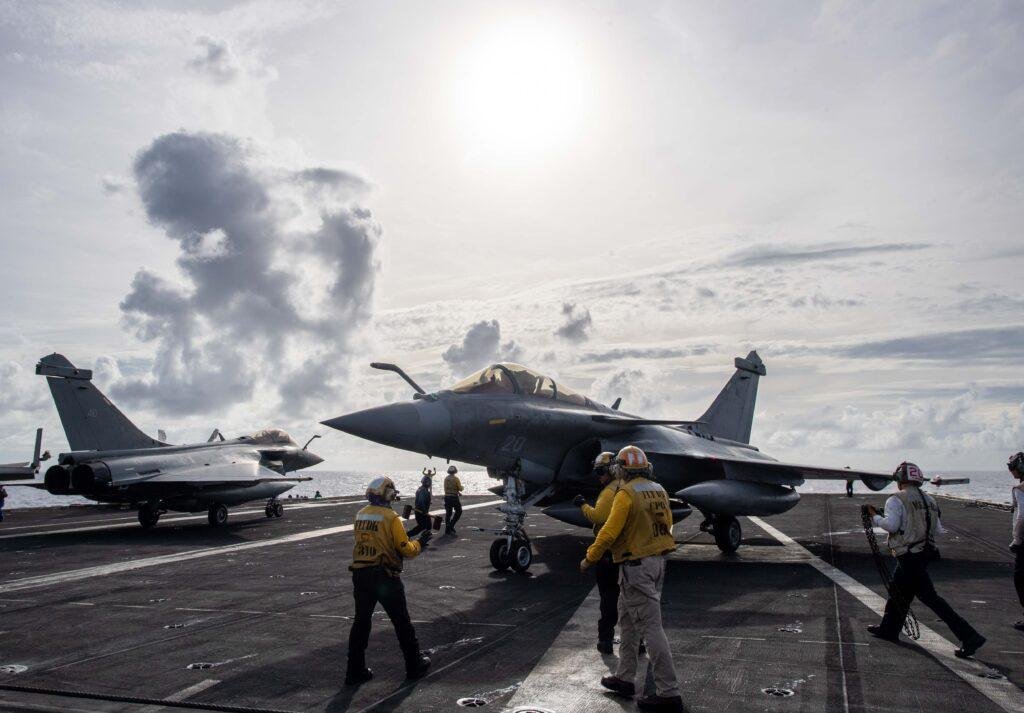
Rafale F5 is the next major standard of France’s Dassault Rafale fighter. The DGA describes it as a deep mid-life modernization that will introduce new sensors, electronic warfare, connectivity, navigation and propulsion while integrating new weapons and collaborative combat with a stealth uncrewed aircraft.
When will Rafale F5 enter service?
France is targeting qualification of the F5 standard around 2033. The DGA says it is expected to enter service first with the French Air and Space Force and later with the French Navy.
Is the Rafale F5 drone wingman the nEUROn?
No. nEUROn is a stealth UCAV technology demonstrator that first flew in 2012. Dassault is developing a new combat drone for the Rafale F5 that will use experience and technologies matured through the nEUROn program rather than simply placing the existing demonstrator into operational service.
Is Rafale F5 a fifth-generation fighter?
No. “F5” is the designation of the Rafale’s future configuration standard, not a claim that the aircraft becomes a fifth-generation stealth fighter. The upgrade is intended to improve survivability and combat effectiveness through better sensors, electronic warfare, networking, weapons and cooperation with a stealth uncrewed partner.
Looking Ahead
The next major program milestone is the planned launch of the full Rafale F5 realization phase by the end of 2026. From there, France will have to bring the new radar, electronic-warfare suite, connectivity, propulsion, weapons and uncrewed combat aircraft into a single operational system ahead of the target qualification around 2033. The Aviation Diary will track the F5 development contract, subsystem testing and the first major milestones for Dassault’s stealth combat drone.
Sources
- French Defense Procurement Agency (DGA) — September 2026 Rafale F5 development announcement
- French Ministry of the Armed Forces — Rafale F5 and stealth combat-drone development
- Dassault Aviation — Unmanned combat aerial vehicle program for Rafale F5
- Safran — M88 T-REX higher-thrust engine for future Rafale upgrades
- Thales — 2026 orders for Rafale F5 SPECTRA and next-generation connectivity
- MBDA — SPECTRA integrated self-protection system
- The War Zone — France accelerates Rafale F5 upgrade after breakdown of the original Franco-German fighter effort