Anduril will bring its Lattice mission-autonomy software to Hermeus’ Quarterhorse Anduril autonomy program, the two companies announced September 3, 2026 — the first time Anduril has integrated Lattice onto a third-party aircraft outside its own Fury combat drone. The deal targets a first mission-autonomy flight on Hermeus’ Quarterhorse Mk 2 in 2027.
The partnership pairs two of the more closely watched U.S. defense-tech startups: Hermeus, building toward sustained high-Mach flight through a rapid, iterative aircraft-development program, and Anduril, whose autonomy software already flies its own Fury Collaborative Combat Aircraft and is competing for the Air Force’s broader CCA program.
Table of Contents
What the Deal Actually Covers
Under the agreement, Anduril will integrate its Lattice for Mission Autonomy software as the core software engine for mission planning and execution on Quarterhorse Mk 2. Lattice already covers operational analysis, threat modeling, training, mission planning, execution and post-mission debriefing for Anduril’s own aircraft; Hermeus is licensing the same stack commercially rather than building a bespoke system in-house.
Operators will interact with Quarterhorse through Anduril’s Menace-T C4 system, giving the aircraft a common human-machine interface rather than a one-off control setup built specifically for this airframe.
Why Quarterhorse Needed a Partner
Every Quarterhorse flight to date has been remotely piloted by a human operator rather than flown autonomously. Hermeus CEO Zach Shore told Breaking Defense the company had reached the point where that approach no longer scales.
“We now need to automate a lot of those flight controls,” Shore said. “I want to be able to push a button, have the aircraft spin up, have the aircraft auto takeoff, all those basic features that allow one person to manage multiple platforms.”
Rather than build that automation layer from scratch, Hermeus evaluated existing autonomy providers and settled on Anduril. Brett Darcey, Anduril’s general manager and vice president for mission autonomy in air dominance and strike, described the offering as an end-to-end stack rather than a narrow flight-control add-on.
“We really want to emphasize the fullness of the stack,” Darcey said. “This isn’t just a mission autonomy science project. This is really readying the Quarterhorse for live operations.”
How the Handoff to Autonomy Will Actually Work
The first mission-autonomy flight, planned for 2027, won’t hand full control to software on day one. Quarterhorse will take off under human control with autonomy switched off, activate mission autonomy once airborne, fly a mission segment under Lattice, then return to human control for landing. Each subsequent test is expected to extend how much of the flight autonomy handles and increase the difficulty of the missions being flown, building toward a point where an operator could, in principle, launch, execute and recover a mission with a single command.
Anduril has described the Quarterhorse Anduril autonomy partnership as open-ended, with no fixed end date, and said it expects to remain Quarterhorse’s autonomy partner going forward — though any eventual government customer acquiring Quarterhorse as a fielded weapon system would retain the ability to select a different autonomy vendor if it chose to.
The Aircraft Behind the Deal
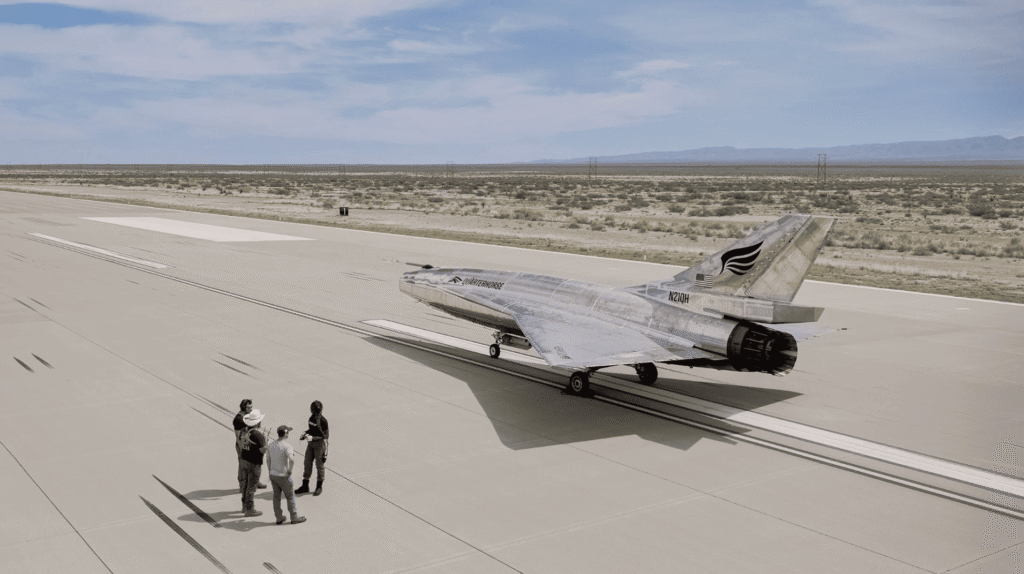
Quarterhorse Mk 2 is roughly F-16-sized and powered by a Pratt & Whitney F100 engine. Its immediate predecessor, Mk 2.1, became the first privately developed, uncrewed aircraft to fly supersonic in the U.S. when it reached Mach 1.21 over White Sands Missile Range on its third test flight in May 2026 — just 364 days after the smaller Mk 1’s first flight at Edwards Air Force Base. Hermeus is targeting Mach 3 with its next demonstrator.

The program is funded in part by the Pentagon’s Defense Innovation Unit, which separately awarded Hermeus a $159 million contract expansion — bringing its total DIU award to $219 million — to demonstrate high-Mach flight combined with in-flight payload release, working directly with the Air Force and Navy.
FAQ: Quarterhorse Anduril Autonomy
Has Anduril put Lattice on another company’s aircraft before?
No. Lattice for Mission Autonomy has flown Anduril’s own Fury Collaborative Combat Aircraft, but the Quarterhorse deal marks the first time Anduril has commercially licensed the software to a third-party Group 5 aircraft.
Is Quarterhorse a Collaborative Combat Aircraft?
Not formally. Quarterhorse is a Hermeus-owned high-Mach test aircraft, not part of the Air Force’s official CCA program. But the autonomy architecture it’s adopting is designed for compatibility with the Air Force’s Autonomy Government Reference Architecture, the same framework meant to let autonomy software transfer between different aircraft rather than being built separately for each one.
When will Quarterhorse fly fully autonomously?
No date has been set. The first Quarterhorse Anduril autonomy flight, planned for 2027, will still begin and end under human control, with autonomy handling only a portion of the mission; full autonomy is expected to be built up incrementally across subsequent tests.
Looking Ahead
Neither company has released a detailed timeline for the integration work ahead of the planned 2027 first flight. The Aviation Diary will continue tracking the Quarterhorse Anduril autonomy partnership as integration testing proceeds and as Hermeus advances its broader high-Mach flight program.
Sources
- Anduril — Hermeus Selects Anduril to Bring Mission Autonomy to High-Mach Flight
- Breaking Defense — Hermeus Picks Anduril Autonomy for Quarterhorse Drone
- Defense Daily — Hermeus Selects Anduril’s Mission Autonomy Platform for Unmanned Supersonic Aircraft
- Hermeus — Hermeus Achieves Its First Unmanned Supersonic Flight
- The Debrief — DIU-Funded Hermeus Says Autonomous, High-Mach Payload Release Test Flights to Begin
- Securities.io — Hermeus Taps Anduril Mission Autonomy for Quarterhorse Mk 2
- Interesting Engineering — Hermeus and Anduril Team Up to Boost Supersonic Aircraft Autonomy
- Tectonic Defense — Hermeus Taps Anduril for Mission Autonomy
- Aviation Week — Hermeus Cruises Beyond Supersonic Speed in U.S. Industry First