Hermeus Northrop Grumman cooperation announced Nov. 12, 2026, aims to integrate military mission equipment into future reusable, unmanned high-speed aircraft. The companies said their strategic teaming agreement would combine Hermeus’ aircraft development work with Northrop Grumman’s experience in sensors, communications, navigation and command-and-control technology.
The agreement is a development partnership, not a disclosed procurement contract for a fleet of operational drones. Neither company identified a firm aircraft quantity, initial deployment date or signed military purchase award in the public announcement.
Table of Contents
What the Hermeus Northrop Grumman agreement covers
Northrop Grumman is expected to contribute design, integration and sustainment work involving mission systems for future Hermeus platforms. That includes capabilities needed to sense the environment, communicate with other systems, navigate and support command decisions. A high-speed airframe needs those functions before it can become a useful operational platform.
Hermeus described its development objective as reusable unmanned aircraft capable of flying at high Mach numbers. Speed alone is not a full mission capability. Sensors, onboard processing and reliable communications must work together under the flight conditions and operational environments for which a vehicle is designed.
The role of an open modular mission system
Hermeus said its aircraft architecture uses a mission management system intended to separate flight-critical functions from mission-specific equipment. That design principle can allow new sensors or software to be tested without requiring the same changes to the systems that control basic flight. The companies cited government open-system interface standards in describing their approach.
A modular architecture is a development strategy, not a certified demonstration that integration can always be completed quickly. The announcement expressed a goal of making upgrades easier, but provided no independent flight-test outcome or military qualification result for the combined hardware at this stage.
Why a high-Mach drone needs more than propulsion
Military users evaluating a fast unmanned aircraft must consider how it receives mission instructions, shares information with friendly systems and collects useful sensor data. An airframe that can fly quickly but cannot integrate with existing networks may be limited in what commanders can employ it to do.
Northrop Grumman brings experience building mission electronics and larger defense systems, while Hermeus has been developing experimental high-speed aircraft. The proposed combination is intended to address the gap between demonstrating an aircraft and making it useful in military operations. The announcement does not demonstrate that gap has already been closed.
What is already known about Hermeus development
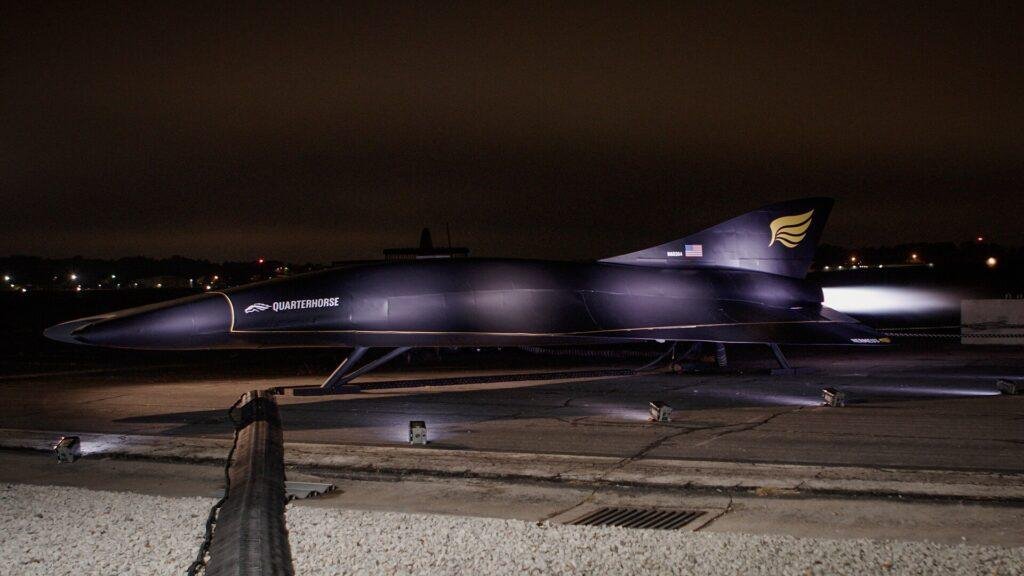
Hermeus has previously announced work on its Quarterhorse test series and related high-speed technologies. Those efforts are part of the broader development history, but the file photograph accompanying this article is of a prototype rather than an operational aircraft fitted with the newly proposed Northrop Grumman systems.
TAD has previously covered the Hürjet military aircraft program. Both involve aircraft development, but the Turkish trainer and the future unmanned high-Mach platform have different missions. The partnership with Northrop Grumman should be assessed on its own test milestones and confirmed contracts.
The companies specifically referenced the U.S. Government’s Agile Mission Suite and Autonomy Government Reference Architectures and Open Mission Systems interfaces. Those labels describe intended standards for interoperability. Their inclusion gives more substance to the announcement than a general promise to collaborate, but it is still an architecture commitment, not a published demonstration of a fully qualified aircraft and payload together.
The manufacturers have identified military applications as a direction for further work, not as an announced procurement award. Public disclosures do not establish an appropriated budget, a military customer order, an acceptance test or a delivery schedule. Those distinctions are consequential when assessing how close a technology demonstrator is to operational service.
FAQ: Hermeus Northrop Grumman
Did the Hermeus Northrop Grumman agreement include a drone order?
No firm aircraft quantity or confirmed procurement award was disclosed. The announcement describes a strategic teaming arrangement.
What systems is Northrop Grumman expected to integrate?
The companies cited sensing, communications, navigation and command-and-control capabilities for future unmanned high-speed aircraft.
Have the partners shown an operational high-Mach military drone?
The announcement did not report an operational deployment or flight test of the integrated mission-system configuration.
Looking Ahead
Future test announcements or government awards will establish how the partnership progresses beyond planning. Until then, statements about speed, integration and operational usefulness remain development objectives rather than verified field performance.
Sources