The EU Space Threat Response Architecture has been strengthened through a new Council decision that broadens the threats it can address and adds faster response mechanisms.
The Council adopted Decision 2026/2195 on Sept. 28, replacing the earlier 2021 framework. The measure expands the architecture beyond threats to EU space programs so it can also address threats to member states, including their territory, space systems and services.
The decision does not identify a specific current attacker or incident. Instead, it creates a standing process for monitoring, alerting and mobilizing foreign-policy tools when the EU determines that urgent action is required.
Table of Contents
EU Space Threat Response Scope Expands Beyond EU Programs
The Council says the strengthened architecture covers threats connected with the EU Space Programme and Secure Connectivity Programme as well as threats to the security of one or more member states. That can include space systems and services used at national level.
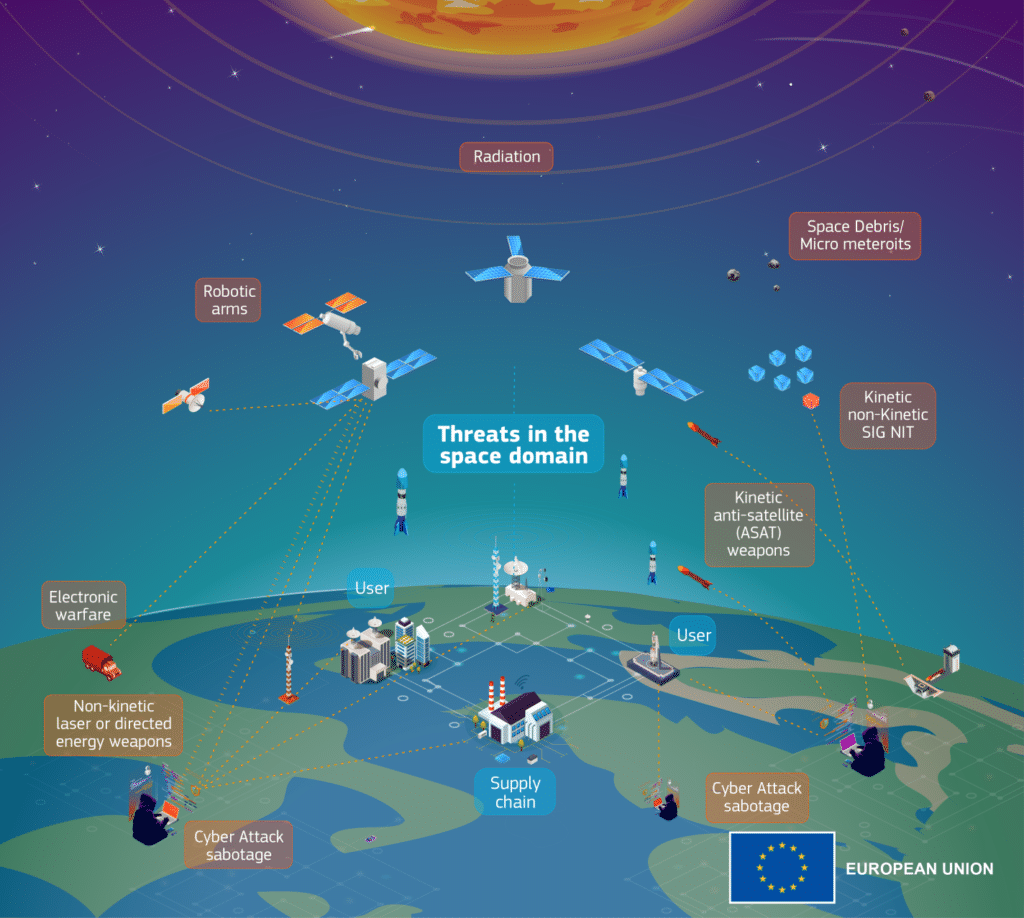
The underlying legal decision also considers threats caused by space systems operated by third states or commercial companies and threats to essential space services delivered within the Union. It recognizes that a space system includes more than an orbiting satellite.
The decision specifically points to spacecraft, ground and launch infrastructure, radio-frequency links, user terminals and cyber elements as parts of the wider system that may matter when assessing a threat.
New EU Space Threat Response Tools Allow Faster Action
When urgent action is required, the EU High Representative can adopt a provisional response. The Council must then confirm, modify or revoke that provisional action as soon as possible and no later than four weeks after it is adopted.
The strengthened framework also creates a space-security toolbox. The Council says that toolbox includes the possibility for the High Representative to propose targeted restrictive measures, giving sanctions policy a defined place among the available responses.
The decision also calls for a yearly exercise to test implementation. That creates a recurring mechanism for member states and EU institutions to practice how the response process would work before a real crisis.
What the EU Space Threat Response Decision Does Not Establish
The architecture is a policy and response framework, not a declaration that any specific spacecraft or operator is hostile. Any future response would still depend on the facts and intelligence surrounding a particular event.
The legal text says a classified Space Threat Landscape Analysis will serve as a reference for identifying threat types. Near-real-time space-domain-awareness information can also be provided voluntarily by member-state space commands and EU security monitoring centers.
Because the detailed threat analysis is classified, the public decision does not provide a list of current targets or scenarios. The practical test will come when the EU uses the architecture during a real event or publishes the results of an implementation exercise.

FAQ: EU Space Threat Response Architecture
What is the EU Space Threat Response Architecture?
It is the EU framework for coordinating political and security responses to threats in the space domain.
Can the EU Space Threat Response Architecture lead to sanctions?
Yes. The new space-security toolbox allows the High Representative to propose targeted restrictive measures.
How quickly can the EU act in an urgent space threat?
The High Representative can adopt a provisional response, which the Council must confirm, modify or revoke within four weeks.
Looking Ahead
The next public milestones are implementation of the new decision and the yearly exercise required by the framework. A future real-world invocation would show how the provisional-response and restrictive-measures tools operate in practice.
Sources
- Council of the EU — Council strengthens EU space threat response architecture
- EUR-Lex — Council Decision (CFSP) 2026/2195