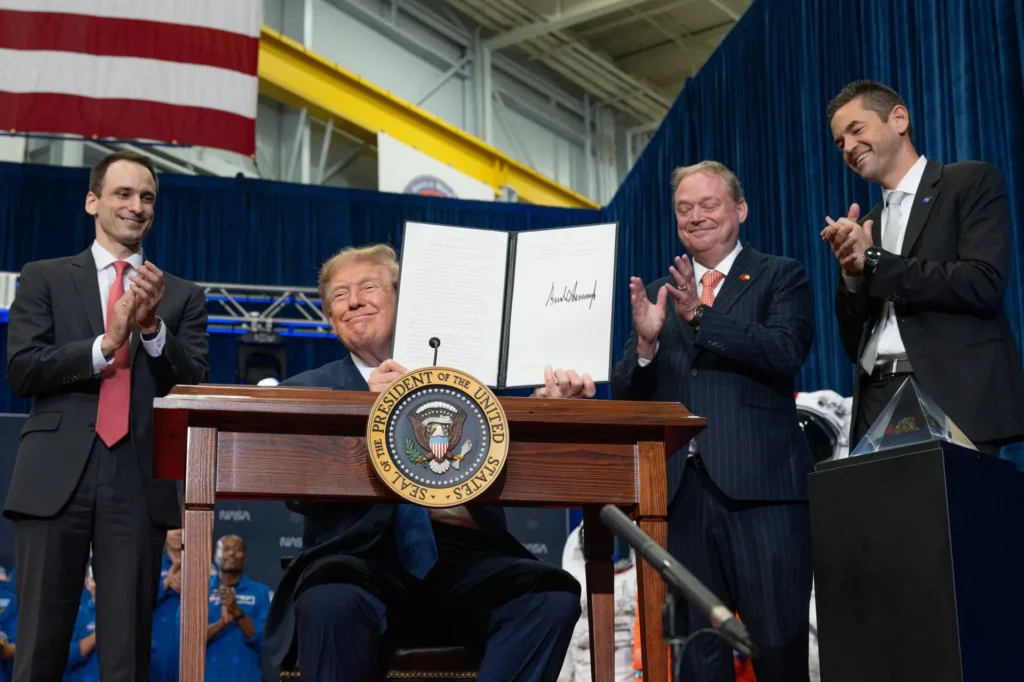
Trump signed a U.S. Space Academy executive order on August 30, 2026 — but the order doesn’t create a school. It creates a commission to figure out what the school should be. President Trump signed “Establishing the United States Space Academy” on Friday, August 28, at NASA’s Johnson Space Center in Houston, during the same ceremony where he presented the Congressional Space Medal of Honor to the Artemis II crew. The order launches a 120-day study, not a campus, and the difference matters more than the headlines about it suggested.
A viral graphic circulating on social media has shown the Space Academy as a completed sixth entry alongside West Point, the Naval Academy, the Air Force Academy, the Coast Guard Academy and the Merchant Marine Academy — implying an operating institution with its own insignia. No such school exists yet, and the order does not establish one. What it establishes is a process for deciding what it should become.
Table of Contents
What the Executive Order Actually Does
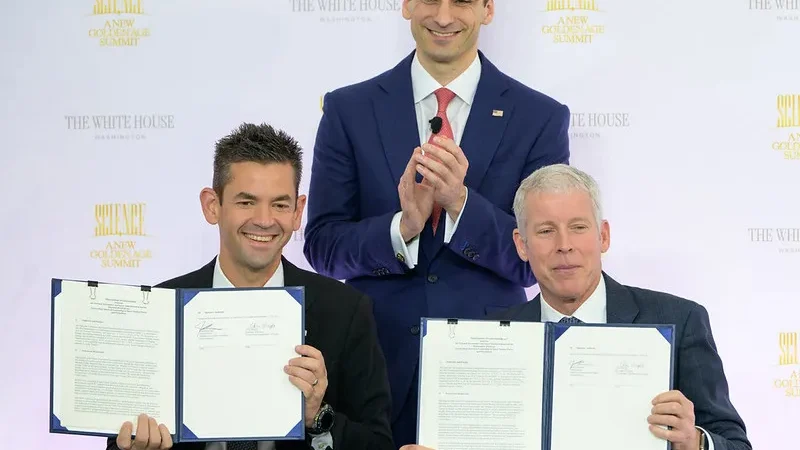
The order establishes a Presidential Commission on the United States Space Academy and gives it 120 days to report back to the President. NASA Administrator Jared Isaacman chairs the commission, with NASA Deputy Administrator Matt Anderson serving as executive director. Vice chairs are Michael Kratsios, Assistant to the President for Science and Technology, and Kevin Hassett, Assistant to the President for Economic Policy. Defense Secretary Pete Hegseth and White House Chief of Staff Susie Wiles also sit on the commission, alongside other representatives from the White House and federal agencies.
That report has to address five things: a governance framework for the academy, the service obligation graduates would owe in exchange for their education, the academy’s physical location, what legislative changes would be needed versus what can be done under existing executive authority, and rough cost. The order is explicit that implementation depends on future appropriations from Congress, which is a separate step from signing an executive order.
In short: the order names who studies the question and sets a deadline for their answer. It does not name a location, set an opening date, fund construction or admit a single student.
Announced at an Artemis II Medal Ceremony
The Space Academy executive order signing took place at NASA’s Johnson Space Center in Houston, where Trump also presented the Congressional Space Medal of Honor to the four-member Artemis II crew: NASA astronauts Reid Wiseman, Victor Glover and Christina Koch, and Canadian Space Agency astronaut Jeremy Hansen. Artemis II carried the crew on a lunar flyby in April, the first crewed mission to travel around the Moon in more than fifty years, and Friday’s ceremony was only the second time NASA has awarded the medal to any crew.
Trump framed the academy as a natural extension of the day’s other announcement, telling the audience that “the rapid growth of the U.S. Space Force and commercial space industry, and the expansion of our ambitions to the Moon and far beyond the Moon” made a dedicated training pipeline necessary. Isaacman, in NASA’s own release, called the order “a transformational step to educate the engineers, scientists, technicians, operators and even the astronauts who will be necessary” for NASA’s Artemis and lunar exploration plans.
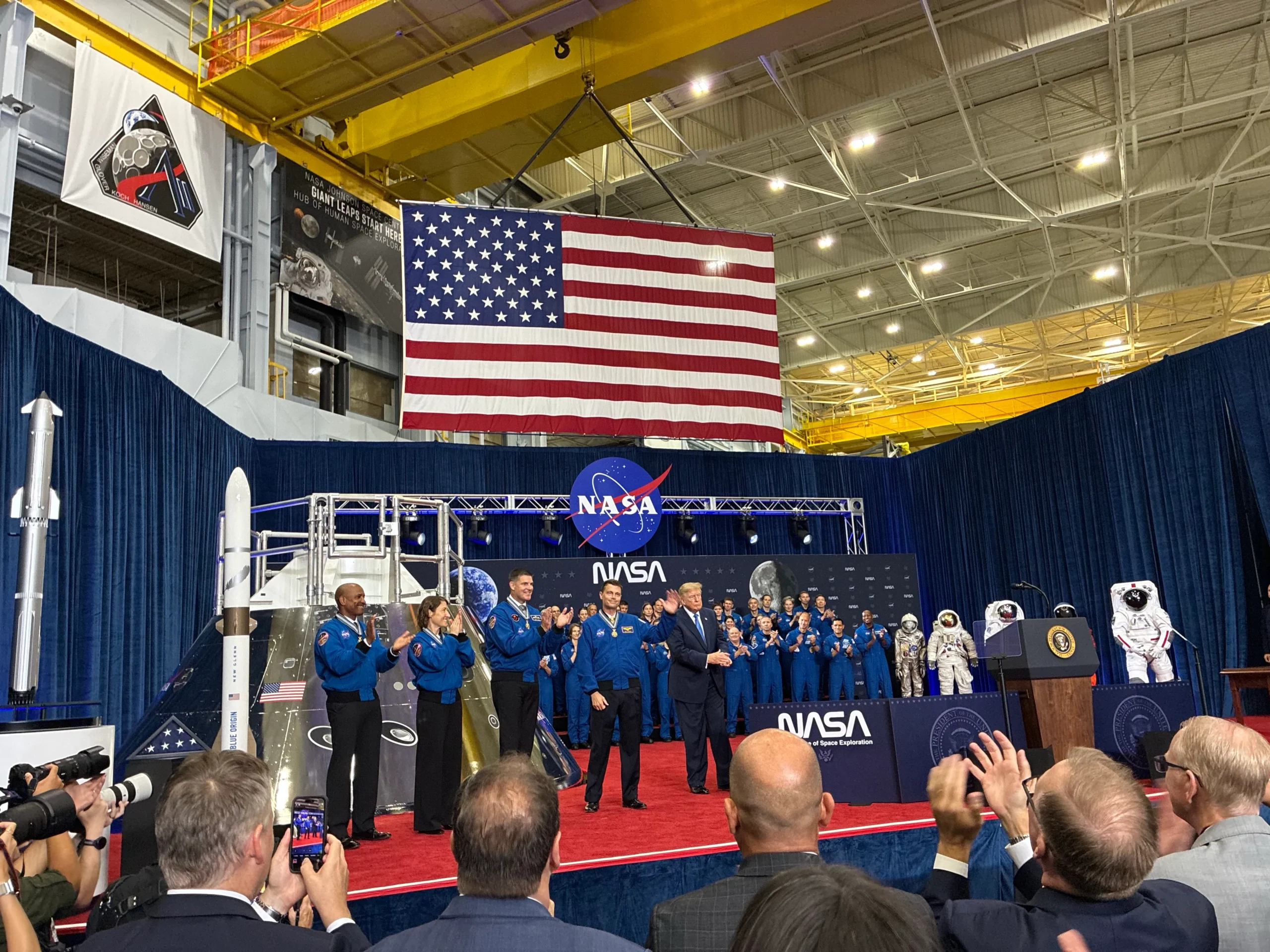
The two announcements sharing a stage explains some of the confusion in how this story spread. A ceremony genuinely honoring four astronauts, paired with a genuinely signed executive order, produced coverage that often collapsed the distinction between “an order was signed” and “an academy was created.”
Not Quite West Point: The Kings Point Model
The Space Academy executive order itself uses more measured language than Trump’s own remarks, which compared the proposed academy to West Point, Annapolis, the Air Force Academy and the Coast Guard Academy. But the order describes something with a narrower military role than any of those. It calls for a “NASA-led Federal academy dedicated to combining rigorous technical education with leadership development, discipline, and a durable commitment to public service,” intended to graduate a “professional corps of civically grounded leaders” for the space domain, not exclusively military officers.
NASA Deputy Administrator Matt Anderson, who will run the commission day to day, told the Houston Chronicle that the working vision is a taxpayer-funded, full-scholarship program in which graduates incur a service commitment. Most graduates, he said, are expected to move into civilian federal service, with only some following a pathway into the Space Force. That would make the institution closer in structure to the U.S. Merchant Marine Academy at Kings Point, which commissions some graduates but sends most into the maritime industry under a service obligation, than to West Point, Annapolis or Colorado Springs, all of which commission virtually every graduating cadet directly into their respective services.
Whether the commission’s 120-day report keeps that framing, and whether graduates entering the Space Force receive commissions the same way graduates of the existing service academies do, is one of the open questions the order specifically assigns the commission to resolve.
How the Space Force Trains Officers Today
The Space Force, established as the sixth branch of the U.S. armed forces in December 2019, has never had a dedicated service academy. Its officers currently commission the same way officers in the other services without their own academy do: through ROTC programs at partner universities, through Officer Training School, or as graduates of the existing service academies, chiefly the Air Force Academy in Colorado Springs, who choose to commission into Space Force rather than the Air Force.
That arrangement has worked at the Space Force’s current size, a few thousand Guardians. The rationale behind the proposed academy is that the pipeline needs to widen as the service grows and as the commercial space industry, NASA’s lunar and Mars ambitions, and national security space missions all compete for the same pool of technically trained personnel. Whether a new standalone academy is the right way to widen that pipeline, versus expanding existing programs, is itself a live policy question the commission will need to weigh, since building any new academy from scratch is a multi-year, multi-billion-dollar undertaking regardless of its eventual structure.
What Still Has to Be Decided
The commission’s report is due to the President within 120 days of the August 28 signing, putting a deadline in late December 2026. Location is entirely open. Trump said during the signing that he would be choosing a site “very shortly,” and Texas Senator Ted Cruz has publicly lobbied for the academy to be built in his state, but no city or facility has been named.
Cost and funding are unresolved. The order separates what can be accomplished under existing executive branch authority from what would require new legislation and a congressional appropriation, and it does not commit any specific dollar figure. Admissions criteria, degree programs, campus size and the commissioning question for Space Force-track graduates are all listed as items the commission still has to work out.
None of that makes the announcement meaningless. A presidential commission with a hard deadline and senior administration officials, including the Defense Secretary and the White House Chief of Staff, sitting on it is a real policy commitment. It is simply a commitment to produce a plan, not a commitment that has already produced a school.
FAQ: The U.S. Space Academy Executive Order
Does the U.S. Space Academy exist yet?
No. The Trump Space Academy executive order creates a commission to study and recommend how the academy should be structured, funded and located. No campus, admissions process or degree program currently exists.
Who is on the Presidential Commission on the United States Space Academy?
NASA Administrator Jared Isaacman chairs it, with NASA Deputy Administrator Matt Anderson as executive director. Vice chairs are Michael Kratsios and Kevin Hassett. Defense Secretary Pete Hegseth and White House Chief of Staff Susie Wiles are also members, along with other administration and interagency representatives.
Will the Space Academy be a military academy like West Point?
That is not yet settled. NASA’s deputy administrator has described the likely model as a taxpayer-funded scholarship program with a service obligation, where most graduates go into civilian federal service rather than commissioning as officers, which would make it structurally closer to the Merchant Marine Academy at Kings Point than to West Point, Annapolis or Colorado Springs.
When will the Space Academy open?
No opening date has been set under the Space Academy executive order. The commission has 120 days from the August 28, 2026 signing to deliver its recommendations, and any construction or program launch would follow that report and depend on congressional funding.
Where will the Space Academy be located?
No location has been chosen. Texas Senator Ted Cruz has lobbied for the academy to be sited in Texas, and Trump said he would announce a location “very shortly,” but the commission’s report is expected to address the site question.
Sources
- NASA — President Trump Signs Executive Order to Create US Space Academy
- The White House — Establishing the United States Space Academy (full order text)
- Houston Public Media — Trump signs order calling for Space Academy during Houston stop
- SpacePolicyOnline — Trump Honors Artemis II Crew, Signs Executive Order to Establish a U.S. Space Academy
- Military.com — Trump Signs Order to Establish US Space Academy for Space Force, NASA