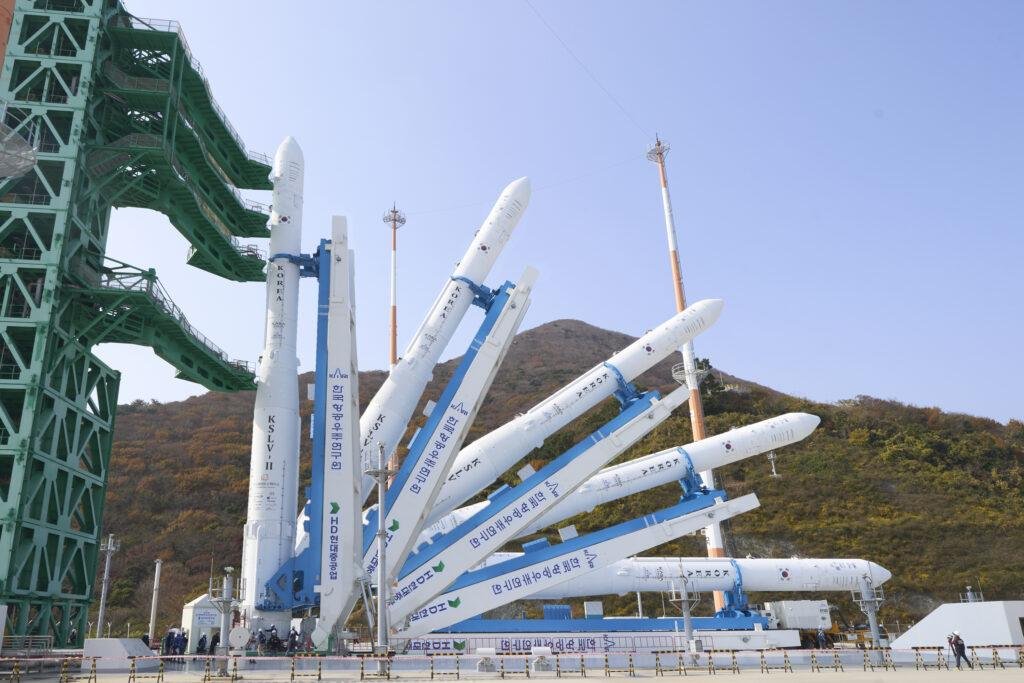
The Nuri rocket launch successfully deployed 14 of its 15 planned satellite payloads on October 7, according to South Korea’s space agency. All five primary Earth-observation satellites separated, but one smaller secondary spacecraft remained attached.
The three-stage vehicle lifted off from the Naro Space Center at 12:25 p.m. local time, Yonhap News Agency reported. Korea AeroSpace Administration officials said the principal mission placed five NEONSAT microsatellites into orbit as planned.
The result is a substantial test of deploying a constellation on a single flight, rather than a clean sweep of every payload. South Korean reporting identified the secondary spacecraft that did not separate, and the agency’s later updates described successful initial contacts with the five primary satellites.
Table of Contents
Which Payloads the Nuri Rocket Launch Released
The Nuri rocket launch carried five New-space Earth Observation Satellite Constellation for National Safety spacecraft, also called NEONSATs, and ten CubeSat rideshare payloads. Yonhap reported that the main spacecraft separated individually at intervals of roughly 35 to 40 seconds as the upper stage changed its orientation between releases.
KASA said nine CubeSats were deployed, while PERSAT-02, developed by South Korean company Quaternion, did not separate from the rocket. Describing the mission as delivering all 15 would therefore overstate the confirmed result. The unseparated satellite was a secondary payload, not one of the five primary observation spacecraft.
Yonhap’s updated October 7 dispatch said the five NEONSATs had made initial contact with the King Sejong Station in Antarctica by the evening. Initial radio contact is one verification step; it does not itself prove that every camera or spacecraft subsystem has completed on-orbit commissioning.
Why South Korea Is Building the NEONSAT Constellation
The Nuri rocket launch satellites are intended to observe the Korean Peninsula and nearby areas for security and disaster-response needs, Yonhap reported. Each primary spacecraft weighs less than 100 kilograms and carries an electro-optical camera, making the group a coordinated observation network rather than unrelated experimental satellites.
Yonhap said the cameras were designed to resolve features as small as one meter in monochrome imagery and four meters in color. These specifications describe intended imaging capability, not a demonstrated result from the first hours after separation.
South Korea ultimately plans a 10-satellite NEONSAT constellation. KASA’s administrator said a further five were planned for Nuri’s sixth flight in the second half of 2027. The intended system would provide more frequent coverage than a single satellite because its spacecraft can revisit the area on different orbital passes.
What the Fifth Nuri Mission Demonstrated
The Nuri rocket launch was the vehicle’s fifth flight overall, after its initial mission failed in 2021 and later flights achieved their main objectives. Yonhap described October’s mission as the rocket’s fourth consecutive successful launch, while also noting the single failed CubeSat separation.
Following the Nuri rocket launch releases, the upper stage conducted a maneuver designed to reduce the risk of collisions with its payloads and discharged remaining propellant, according to Yonhap’s account of the mission. These steps are part of managing the vehicle after deployment rather than another satellite launch.
The important technical achievement was controlled release of multiple primary satellites destined for a common constellation. The remaining shortfall highlights that mission success must be described separately at the rocket, primary payload and rideshare levels.
FAQ: South Korea’s Nuri rocket
How many satellites did the Nuri rocket launch deploy?
KASA said 14 of the 15 planned satellites separated successfully, including all five primary NEONSATs.
Which satellite did not separate from Nuri?
Yonhap identified the secondary CubeSat as PERSAT-02, built by Quaternion.
When is the next Nuri mission planned?
KASA’s administrator said another NEONSAT batch was planned for a sixth launch in the second half of 2027.
Looking Ahead
Spacecraft commissioning and confirmed performance of the observation payloads are the next milestones. KASA must also establish what prevented PERSAT-02 from separating, while the planned sixth mission would carry the remainder of the constellation if the schedule holds.
Sources
- Yonhap — Seventh update on fifth Nuri launch
- KASA — Scheduled fifth Nuri mission and payload manifest
- SBS News — Fourteen satellites after fifth launch