LISA test telescope development advanced on October 8, 2026, when NASA announced that L3Harris Technologies will design, assemble and integrate a new engineering unit for the European Space Agency’s gravitational-wave observatory.
The unit is meant to test the mission’s precision optical hardware before production of telescopes intended for flight. NASA called the Engineering Test Unit the last pre-flight step in its telescope development effort.
LISA, short for Laser Interferometer Space Antenna, is planned for launch in the mid-2030s. The announcement marks a hardware-development milestone, not the launch of a spacecraft or the operational detection of a gravitational wave.
Table of Contents
Why the LISA Test Telescope Uses Specialized Glass
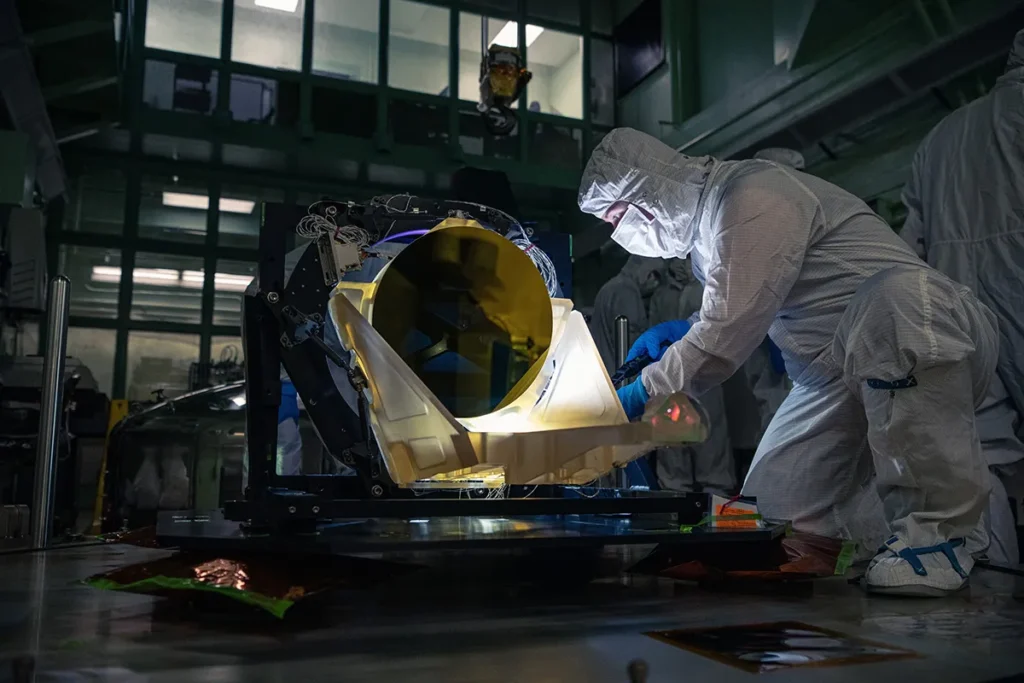
NASA says each telescope is to be made from Zerodur, a glass-ceramic valued for resisting changes in shape as temperatures vary. The telescope material and mirror geometry matter because the planned observatory must measure extraordinarily small shifts in distance.
L3Harris supplied a prototype in 2024 that NASA has already tested. The latest assignment builds on lessons from that earlier hardware rather than starting the optical development process from scratch.
NASA also reported delivery of a metal structural model in June 2026. That model and the glass telescope serve different engineering tasks: one helps evaluate structural behavior, while the other tests the optical assembly proposed for the mission.
The LISA test telescope is therefore a bridge between a successful developmental prototype and eventual flight-qualified hardware. Performance claims about the final mission cannot be inferred from the contract announcement alone.
How the Three-Spacecraft LISA Observatory Would Work
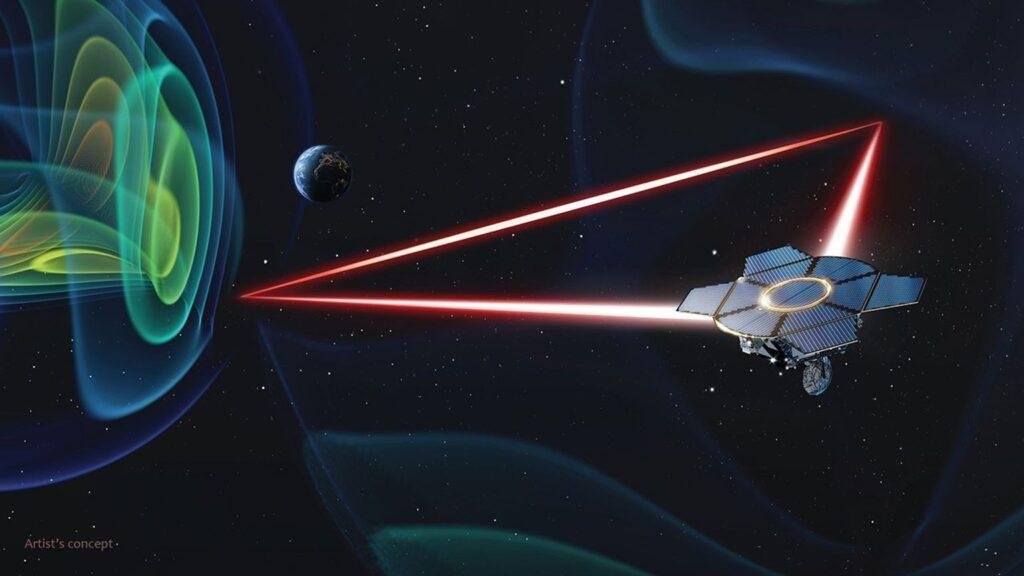
ESA plans a formation of three spacecraft moving in an Earth-following orbit. NASA describes the formation as a triangle with sides around 2.5 million kilometers long, linked by infrared laser measurements.
Each spacecraft would carry two telescopes and a free-floating gold-platinum proof mass. Engineers intend to measure tiny changes between spacecraft as gravitational waves pass through their formation.
These waves can be generated by accelerating high-mass objects, including orbiting compact stars and merging black holes. LISA is designed to detect lower-frequency signals than many observatories on Earth can measure.
A space observatory of this kind depends on several technologies working together: quiet proof masses, stable lasers, exacting optical surfaces and methods for measuring interference with unusual accuracy.
What NASA Is Supplying to ESA’s Mission
Although ESA leads LISA, NASA is contributing telescopes and additional mission systems. Its identified work also includes laser technology, charge-management devices and scientific analysis support.
Earlier work provided a foundation for the concept. NASA points to the 2016 LISA Pathfinder demonstration, which showed that forces unrelated to gravity could be suppressed sufficiently for the precision measurement approach.
The new engineering unit does not establish the flight delivery date for all telescopes. ESA and NASA must still complete component verification, integration planning and additional mission-level reviews before launch.
FAQ: LISA test telescope
What is the LISA test telescope?
It is an engineering unit NASA is commissioning from L3Harris to verify telescope design ahead of flight hardware.
When is LISA expected to launch?
NASA describes the ESA-led observatory as planned for the mid-2030s.
What will LISA study?
It is intended to measure low-frequency gravitational waves from objects such as merging black holes and compact binary stars.
Looking Ahead
The next measurable LISA test telescope milestone will be delivery and evaluation of the engineering unit, followed by progress toward flight assemblies. NASA has not given a firm handover date for this unit in the announcement reviewed.
Sources