Webb fast radio burst research has pinpointed the host galaxy of the most distant radio burst yet localized, after the James Webb Space Telescope revealed a galaxy that ground-based instruments could not see.
The radio flash, designated FRB 20240304B, was recorded by the MeerTRAP team with South Africa’s MeerKAT telescope on March 4, 2024. NASA reported the new Webb observations on October 8, 2026.
The result narrows the environment in which this burst occurred, but it does not settle the larger question of what physical objects generate every fast radio burst.
Table of Contents
Webb Fast Radio Burst Host Was Too Faint to Spot
The radio observation gave astronomers an accurate position on the sky, yet the largest conventional ground-based optical telescopes could not identify a corresponding host. Researchers therefore used Webb’s infrared instruments to search the field.
Webb’s Near-Infrared Camera detected a small, actively star-forming dwarf galaxy at the position of the burst. Spectroscopic observations provided a redshift of 2.148, meaning the signal dates to an era about three billion years after the big bang.
That measurement goes beyond a rough distance estimate from radio data alone. Assigning an actual galaxy to the burst lets researchers examine the stellar environment and compare it with closer events.
Webb fast radio burst: What the Signal Reveals About Intervening Space
Fast radio bursts are brief pulses of radio energy lasting milliseconds. As their signals travel across the universe, matter along the path affects how different radio frequencies arrive, allowing observations to probe structures between the source and Earth.
NASA says the radio signal carried evidence of two foreground cosmic structures, including a galaxy cluster at redshift 0.3 and the nearer Virgo Cluster. Such information can make a burst useful as a probe of otherwise difficult-to-map material.
The host identification does not prove that either foreground structure generated the radio burst. They are intervening regions through which its radiation traveled toward the receiver.
Origin Theories Still Require More Evidence
Astronomers have proposed highly magnetized neutron stars, known as magnetars, as sources of some fast radio bursts. The underlying population remains uncertain, particularly for one-off events that cannot be localized again through repeat flashes.
The newly characterized host adds another data point: the burst arose in a faint galaxy with ongoing star formation. Researchers can compare this environment with those of previously studied bursts to see whether their host properties share a pattern. The Webb fast radio burst analysis resolves a galaxy that remained undetectable in earlier ground-based optical searches.
NASA says improved radio surveys may find additional distant events, while Webb can investigate faint host galaxies. No future observation has yet been reported as a confirmed detection of a repeating signal from FRB 20240304B.
FAQ: Webb fast radio burst
What did Webb fast radio burst research identify?
It is a brief, intense flash of radio energy, usually lasting only milliseconds, whose physical source is often uncertain.
What did Webb discover about this burst?
Webb identified a faint star-forming dwarf galaxy and measured its redshift, allowing researchers to establish the burst’s distance.
Did Webb prove fast radio bursts come from magnetars?
No. Magnetars are one leading hypothesis, but the new host-galaxy observation does not settle the origin of all bursts.
Looking Ahead
The researchers expect future MeerKAT discoveries to provide more remote bursts that Webb can study. Comparing a larger set of host galaxies may help distinguish competing source theories.
Sources
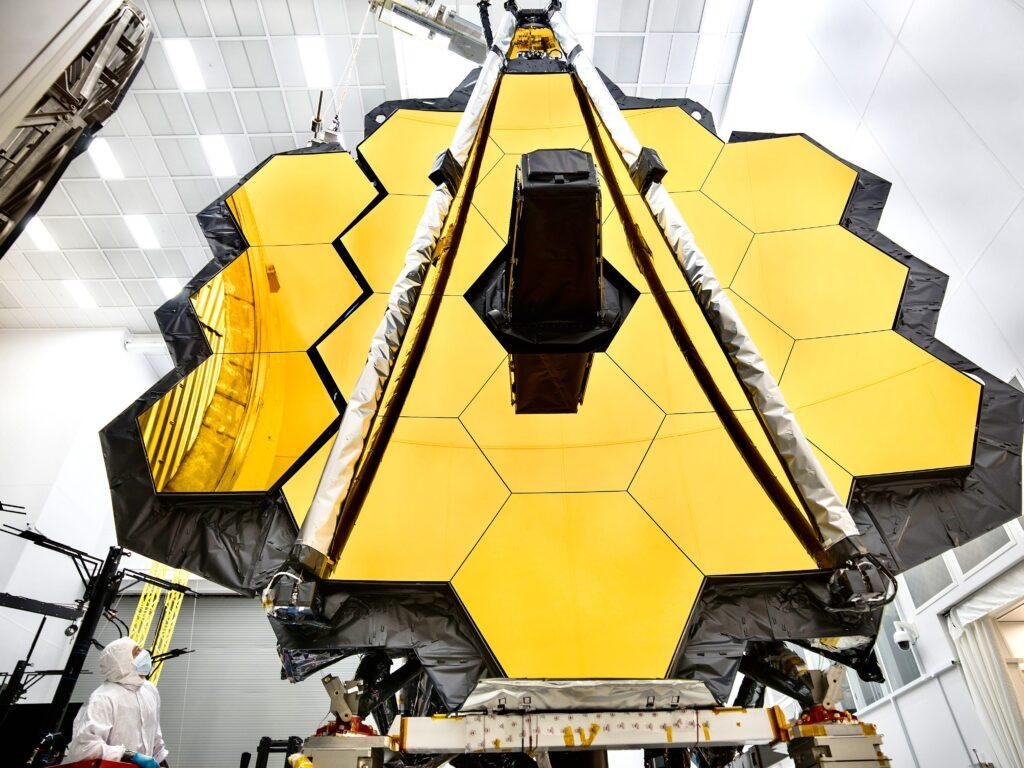
Image credit: NASA / Chris Gunn (US-GOV-PUBLIC-DOMAIN; reuse terms). Featured image is an archival or contextual illustration, not the reported event.