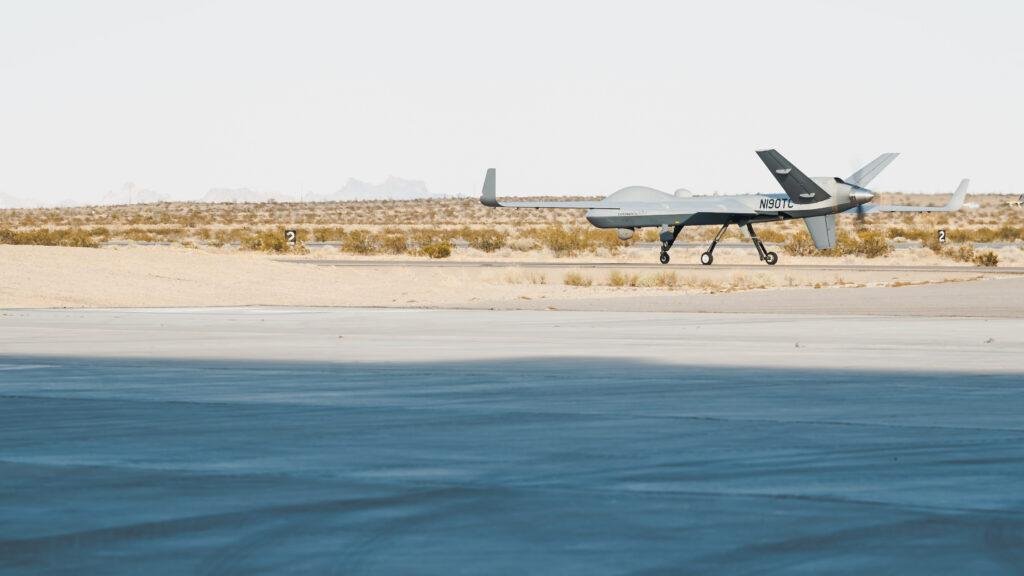
Coast Guard MQ-9B procurement moved from planning to an order on Sept. 25, 2026, when the U.S. Coast Guard placed a $247.8 million purchase with General Atomics for four long-range unmanned aircraft systems, ground control stations and supporting equipment.
The service announced the acquisition on Oct. 9, confirming that the order was placed through an existing U.S. Customs and Border Protection (CBP) contract. The aircraft are intended to expand maritime surveillance, search-and-rescue support, border security and counterdrug operations.
The purchase marks a shift toward Coast Guard ownership of long-range drones after years of operating CBP aircraft through an interagency partnership. However, the service has not identified the specific MQ-9B configuration, delivery schedule or permanent operating locations.
What the $247.8 Million Order Includes
The Coast Guard MQ-9B acquisition covers four remotely piloted aircraft, ground control stations and related equipment. The $247.8 million figure applies to the announced purchase package, not solely to the aircraft themselves.
According to the Coast Guard, the new systems will improve its ability to monitor offshore waters, protect critical infrastructure and identify suspicious activity across large maritime areas. The service also plans to use them for search-and-rescue support, drug interdiction and efforts against illegal, unreported and unregulated fishing.
Anthony Antognoli, the service’s assistant commandant and program executive officer for robotics and autonomous systems, said the aircraft would extend surveillance coverage and help crews identify potential threats earlier. The acquisition is intended to improve the collection and sharing of intelligence during operations far from shore.
A Coast Guard spokesperson told Breaking Defense that the aircraft are not expected to carry weapons. The service’s public announcement did not provide a detailed sensor or equipment configuration.
Aircraft Configuration and Maritime Capabilities
The MQ-9B family includes the SkyGuardian and the maritime-focused SeaGuardian. General Atomics describes SeaGuardian as a remotely piloted aircraft designed for persistent surveillance over large ocean areas using satellite communications and mission-specific sensors.
According to the manufacturer, SeaGuardian can remain airborne for more than 30 hours, depending on its configuration. It can incorporate maritime surveillance radar, automatic identification system data and other intelligence-gathering equipment. General Atomics lists a mission radius of approximately 1,200 nautical miles for a standard maritime surveillance and anti-submarine warfare configuration.
Those manufacturer specifications should not be treated as confirmed capabilities of the Coast Guard’s purchased aircraft. The service has publicly identified them only as MQ-9B systems. Defense Daily reported that the Coast Guard had not answered questions about whether the order specifically involves SeaGuardian aircraft.
Until the final configuration is disclosed, the aircraft’s precise sensor package, operational endurance and maritime equipment remain unconfirmed.
CBP Partnership Preceded Independent Ownership
The Coast Guard’s experience with long-range remotely piloted aircraft predates this purchase. Its crews have operated CBP-owned MQ-9 aircraft through a partnership established in the mid-2000s, including operations associated with San Angelo, Texas.
Military Times reported in September 2025 that Coast Guard officials planned to acquire their own drones rather than rely exclusively on CBP aircraft. That earlier reporting described approximately $266 million in anticipated funding and referred to MQ-9 Alpha aircraft. The October 2026 announcement identifies an actual $247.8 million MQ-9B order, so the earlier funding estimate should not be mistaken for the final purchase price.
The Coast Guard pointed to previous CBP operations as evidence of the value of long-endurance surveillance. According to the service, CBP MQ-9A aircraft operating with Joint Interagency Task Force South directly contributed to operations that seized approximately 60,700 pounds of illegal drugs, valued at $306 million, and apprehended around 20 smugglers during fiscal 2026.
Those figures describe broader enforcement operations supported by the aircraft. They do not establish that drones independently carried out the seizures or apprehensions.
Funding and Unanswered Deployment Questions
The Coast Guard said the purchase is financed through fiscal 2025 budget reconciliation funding and fiscal 2026 appropriations. It reported that reconciliation legislation provided nearly $25 billion for service investments and that approximately $16.3 billion in new assets and capabilities had been ordered using those funds.
The MQ-9B purchase forms part of that wider modernization effort, but the announced order does not establish when the aircraft will enter operational service. The Coast Guard has not publicly specified delivery dates, future bases, training arrangements or an initial operational capability target.
In 2025, Coast Guard officials discussed potentially operating their own unmanned aircraft from locations on both U.S. coasts. Those earlier intentions should not be interpreted as confirmed basing decisions for the newly purchased MQ-9Bs.
FAQ: Coast Guard MQ-9B Acquisition
Has the Coast Guard operated MQ-9 drones before?
Yes. Coast Guard personnel have previously operated CBP-owned MQ-9 aircraft through an interagency partnership. The new purchase provides the service with its own MQ-9B systems.
Will the new Coast Guard drones carry weapons?
They are not expected to be armed, according to a Coast Guard spokesperson quoted by Breaking Defense. The service has not publicly detailed the aircraft’s complete equipment configuration.
Is the Coast Guard buying the MQ-9B SeaGuardian?
That has not been confirmed. The official announcement identifies the MQ-9B aircraft family without specifying the SeaGuardian variant.
Looking Ahead
The next significant developments will be confirmation of the aircraft configuration, delivery arrangements and future operating locations. The Coast Guard has not announced a timetable for those decisions or for the aircraft to begin operational missions. Until further details are released, the $247.8 million Coast Guard MQ-9B purchase should be understood as a confirmed acquisition rather than an operational fleet already in service.
Sources
- U.S. Coast Guard announcement, reproduced by Seapower — Oct. 9, 2026
- Breaking Defense — Coast Guard Places $248 Million Order for First MQ-9B Drones
- Defense Daily — Coast Guard Buys Its Own MQ-9B Long-Range UAS
- Military Times — Coast Guard to Get First MQ-9 Drones
- General Atomics Aeronautical Systems — MQ-9B SeaGuardian Capabilities