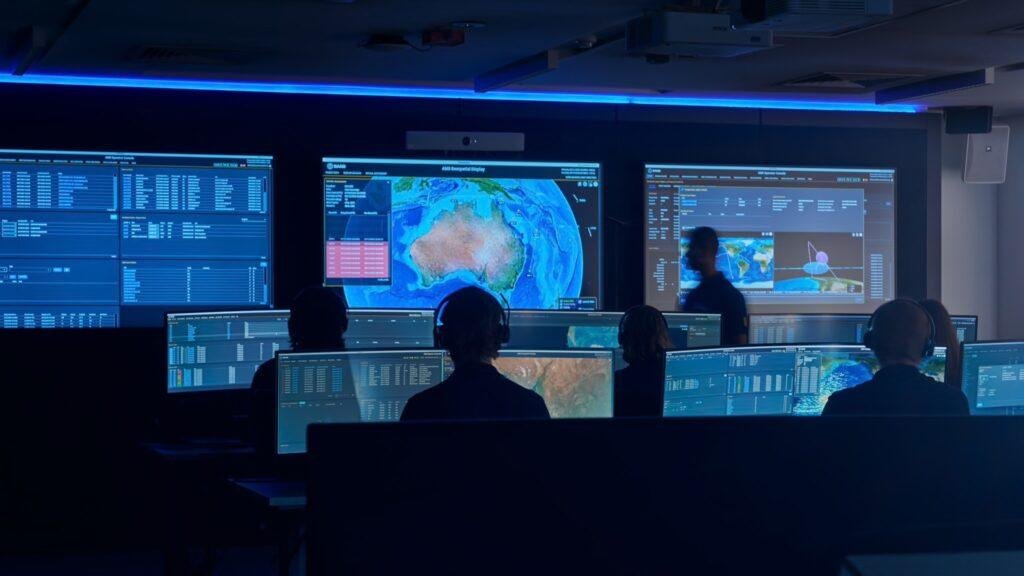
Saab Allied Mission System, a software platform intended to help operators monitor and manage activity in space, was unveiled Oct. 20 by the Swedish defense company. Saab describes the system as a cloud-based product that combines space-domain awareness information, mission management and command-and-control tools. The announcement concerns a product launch, not a verified record of combat operations or a signed contract with a named military customer.
The company says the platform brings together data from multiple sensors and external information sources. Its intended users could use those inputs to assess what objects are doing in orbit and coordinate responses. In an environment where space activity is growing, combining observations from separate systems is a practical engineering challenge, but the product’s effectiveness remains to be demonstrated in real customer operations.
Table of Contents
How Saab Allied Mission Uses Data
Space-domain awareness involves tracking objects and interpreting what their positions and movements may mean for satellites and other infrastructure. A single sensor generally cannot observe every spacecraft continuously, so software that can combine inputs may offer a more complete operational picture. Saab says AMS integrates information from its own sources and third-party assets through an open architecture. The announcement does not specify the full inventory of sensors available to any particular customer.
Automated analysis is another advertised function. The system is intended to turn observations into information operators can use to prioritize decisions and task other assets. Such automated insights still require trusted data, sensible thresholds and human oversight. Saab did not disclose independent accuracy statistics or a standardized benchmark that would support calling its software more capable than every existing competing platform.
The primary announcement is available at the original source.
Command and Control in a Space Context
The term command and control covers the processes used to direct and coordinate assets. For space operators, that may involve arranging observation requests, keeping track of task priorities and sharing information across teams. Saab describes AMS as offering mission-management functions and the ability to coordinate assets, with scope to connect the system to wider operations across different military domains.
The platform is not itself a newly launched satellite. No orbital insertion, spacecraft separation or satellite deployment occurred as part of the Oct. 20 software announcement. Confusing a mission-management system with a new spacecraft would misstate both the technology and the actual news.
A Product Designed for Further Integration
Saab says AMS uses an open architecture and is intended for continuous development. That suggests customers could integrate additional sensors or services as operational needs change. The company’s release describes the approach but does not publish detailed interface specifications, software-assurance certificates or an implementation timetable for outside organizations.
Claims about cloud-based resilience, speed and decision support therefore remain statements of design intent. In defense applications, customers will also evaluate cybersecurity controls, information classification, interoperability and resilience to interruptions. Those topics matter even when a launch announcement does not supply the engineering evidence needed to answer them fully.
What Is Known About Deployment
The company has announced the Allied Mission System and explained its advertised capabilities. It has not, in the source reviewed, identified a signed customer contract with delivery quantities, a declared operational deployment date or the results of an independent field evaluation. Any later agreement should be treated as a separate milestone with its own evidence.
Saab describes the work as developed to help allies make faster and better-informed choices about activity in orbit. Whether that promise is achieved will depend on customer integration and actual use. For now, the verifiable event is the public launch of a software platform for space operations.
FAQ: Saab Allied Mission
What is Saab Allied Mission System?
It is Saab’s newly announced cloud-based software platform for integrating space observations, mission planning and control functions.
Did Saab launch a spacecraft with Saab Allied Mission?
No. The Oct. 20 announcement introduced a software product rather than a satellite or launch vehicle.
Has a military customer deployed the system?
The opened release does not establish a named operational customer or a completed field deployment.
Looking Ahead
Future announcements about customer selection, technical qualification, field testing or integration with allied networks will clarify how AMS performs outside demonstrations. Until then, performance benefits should be attributed to Saab rather than presented as independently proven results.
For related TAD reporting, see Space Force and military space operations.
Sources