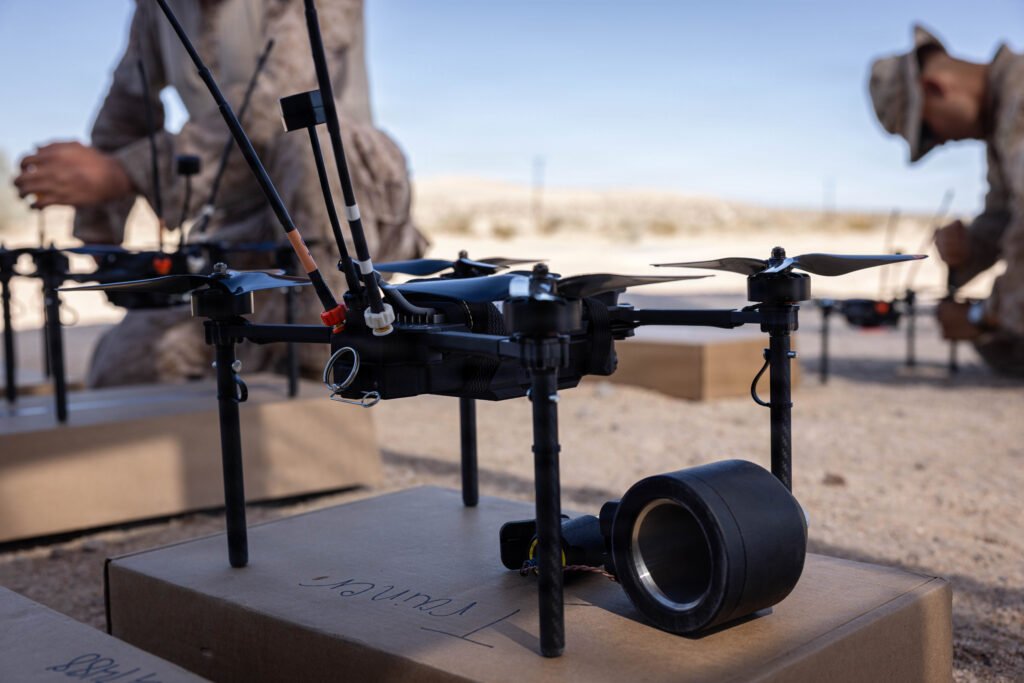
Neros Archer drones carried out two live-fire strike scenarios during an Oct. 20 Marine Corps exercise at Camp Fuji in Japan, according to a service account reported on Oct. 28. Marines from Battalion Landing Team 1/1 of the 31st Marine Expeditionary Unit tested the small first-person-view aircraft.
The service said both scenarios produced successful detonations at targets. That result describes the exercise, not verified combat use. The activity forms part of efforts to integrate small uncrewed strike systems with Marine ground units and reconnaissance teams.
Table of Contents
Neros Archer Drones Tested at Camp Fuji
The Marine Corps account published through DVIDS describes a proof-of-concept exercise at Combined Arms Training Center Camp Fuji. The battalion landing team conducted two missions based on different tactical scenarios, using the Archer as a one-way attack aircraft under operator control.
The Marine Corps described the activity as the first use of this drone type in an exercise at Camp Fuji. That geographical claim does not mean the Archer had never flown elsewhere. Japanese observers were present, and the service said the scenarios were designed to show how new equipment could fit into an expeditionary unit.
The exercise involved explosive payloads and range safety personnel, according to military reporting. The publicly available account confirms successful target strikes but gives limited measured information on flight distance, target speed or resistance to electronic interference. It is therefore a tactical demonstration rather than a comprehensive qualification report.
How Marine Hunter-Killer Teams Operate
The Marine concept pairs reconnaissance and attack elements. An intelligence, surveillance and reconnaissance aircraft may locate or follow a target and pass information to another operator controlling the attack drone. The effectiveness of that sequence depends on target identification, communications and the training of the crews involved.
USNI News reported that junior enlisted Marines were selected for a three-week training course and then used the first-person-view systems. Teaching operators within a ground formation is different from relying on a specialized manned aviation squadron to conduct every mission, but it does not remove command oversight or weapons safety requirements.
Small attack drones and longer-range missiles fill different roles. In related coverage, TAD examined the ARRW hypersonic production award. The two programs are distinct, with sharply different aircraft, weapons, manufacturing and intended employment.
What the Japan Exercise Can Establish
The Oct. 20 activity shows that Marines can operate the particular configuration in controlled range conditions and coordinate a strike sequence. It does not establish performance against a defended formation, in bad weather, or during simultaneous large-scale operations with hostile electronic activity.
The Marine Corps previously contracted for Archer systems for broader Fleet Marine Force use, according to USNI. The exercise account did not give a new procurement quantity, per-unit cost or schedule for outfitting every expeditionary unit. Those procurement questions remain separate from the training result.
The venue matters because the 31st Marine Expeditionary Unit trains in the western Pacific and must work with allied forces. Demonstrations in Japan can inform operating procedures, yet the public release does not assert that the aircraft are already integrated into a permanent wartime operational plan.
FAQ: Neros Archer drones
What did Neros Archer drones do in Japan?
The Marine Corps reports two attack-drone strike scenarios at Camp Fuji on Oct. 20, both ending in target detonations.
Were the drones used in combat?
No combat deployment was reported; the announced flights were conducted during a controlled military exercise.
Which Marine formation ran the test?
Battalion Landing Team 1/1 of the 31st Marine Expeditionary Unit conducted the scenarios.
Looking Ahead
Future reporting on Neros Archer drones should distinguish additional range trials and operator training from permanent fielding or combat use. The Marine Corps has not announced a complete distribution timetable or quantified operational test results for the fleet in this account.
Sources
Marine Corps release via DVIDS