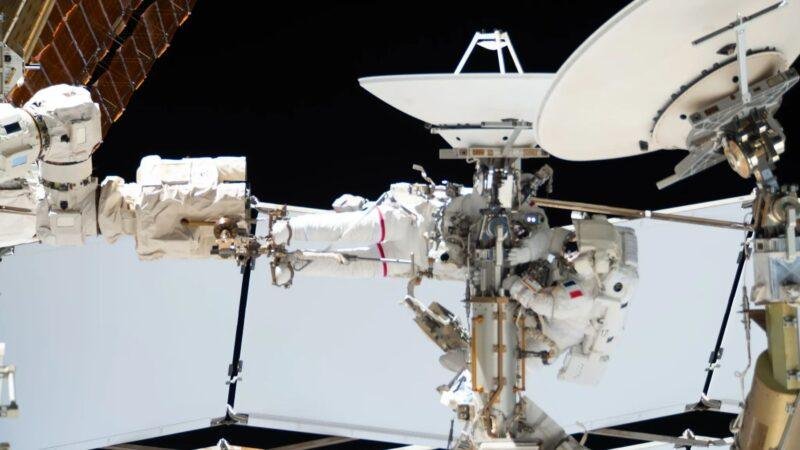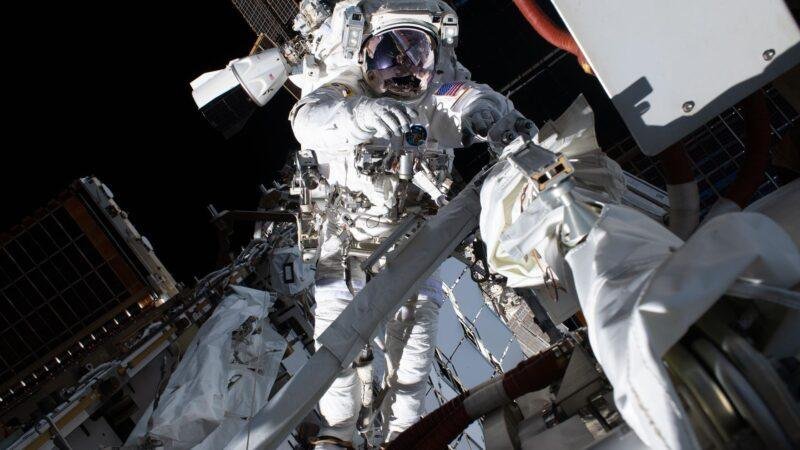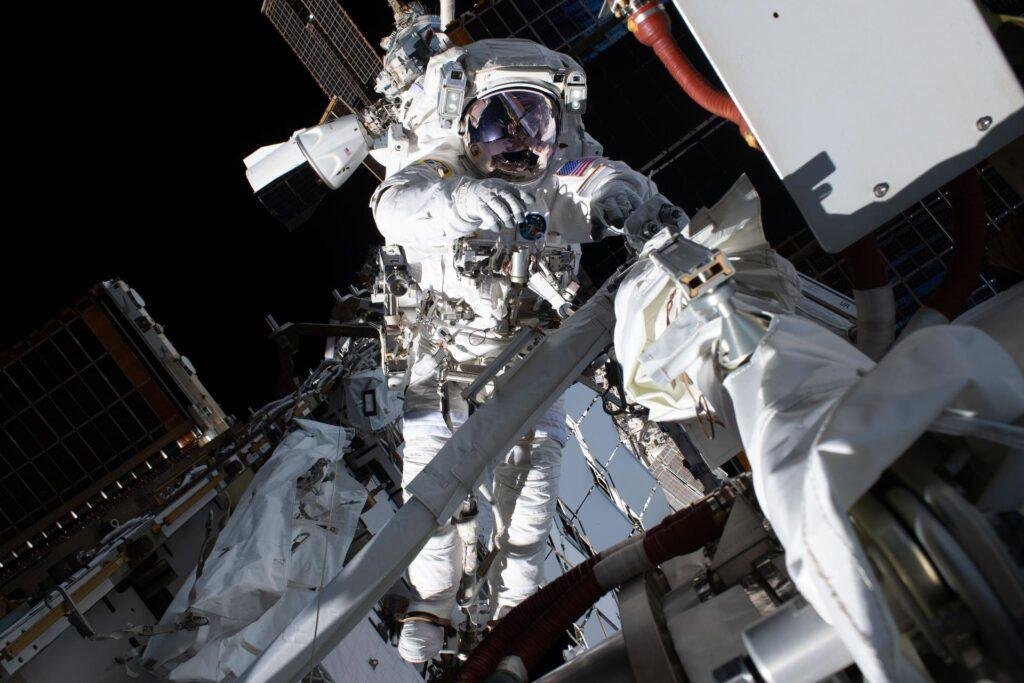
ISS spacewalk 100 began on Oct. 29, 2026, as NASA astronaut Anil Menon and Canadian Space Agency astronaut Joshua Kutryk switched their spacesuits to battery power at 7:57 a.m. EDT and prepared to work outside the International Space Station. Their principal task is installation and deployment of the station’s seventh roll-out solar array on the 2A electrical power channel. The beginning of the activity is confirmed; completing the installation remains a separate milestone.
NASA scheduled the spacewalk as part of a two-outing effort to finish the orbital laboratory’s solar-power augmentation. A second outing, called U.S. spacewalk 101, is planned for Nov. 5 to install the eighth and final array on the 3B channel. The October operation brings the crews to the exterior of an occupied station where electrical work requires carefully coordinated robotic and suit procedures.
Table of Contents
ISS Spacewalk 100 Begins With Two Crew Members
Menon and Kutryk left the Quest airlock area for the operation. The battery-power switch is the standard start marker for the spacewalk clock. Kutryk is a Canadian Space Agency astronaut, and his participation represents a Canadian contribution to an international station maintained by partner space agencies. NASA was providing live coverage of the work as the astronauts moved through planned tasks.
The primary announcement provides the source details behind this report.
A spacewalk may take many hours because astronauts must translate along the station exterior, secure tools and components, and manage equipment without losing control of loose items. The task list remains subject to real-time direction from flight controllers in Houston. Starting the activity on schedule should not be confused with a verified deployment or completed electrical connection.
Seventh Solar Array Targets the 2A Power Channel
The new hardware is an International Space Station Roll-Out Solar Array, commonly called an IROSA. Instead of replacing every older panel, the newer array increases available output through additional solar collection on the station’s truss. NASA identified channel 2A as the location for the seventh installation, adding a source of electrical energy to support the laboratory’s continuing operations.
The arrays are engineered to operate as part of the station’s existing power architecture, which distributes electricity among experiment facilities, life-support equipment, communications and other systems. NASA has said the improvements also support its eventual safe and controlled deorbit planning. They are not propulsion units, and this spacewalk does not itself change the station’s orbital destination or retirement schedule.
Two Spacewalks Complete a Longer Upgrade Sequence
NASA’s schedule calls for the same pair to return outside on Nov. 5 for the eighth array, this time at the 3B channel. Together, the eight roll-out solar arrays are expected to expand available power by up to 30 percent. NASA estimates the enhancement will lift station electricity generation capacity from roughly 160 kilowatts to about 215 kilowatts once the work is finished.
Those figures are program targets for the full completed configuration, not a measured result from the October outing. The performance of the entire augmented system will depend on deployment and checkout of the remaining equipment. The two planned outings are also numbered in the broader history of station maintenance; the 100 and 101 labels designate U.S. spacewalks from the station rather than the total number worldwide.
Mission Operations and Confirmation Still Matter
Flight controllers and crew inside the station support the exterior workers with suit monitoring, communication and robotics. The station’s Canadarm2 robotic system can assist with positioning and handling equipment during complex external tasks. Ground teams continually check the relative location of tools and astronauts because accidental interference with station structures is an operating risk.
NASA did not promise that every planned task would be completed at the moment of departure. Weather at the launch site is irrelevant to this work because the astronauts are already on orbit, but operational limits still include suit resources, crew fatigue and hardware behavior. TAD previously previewed the activities in its report on planned spacewalks; this article records the new confirmed start, not an inferred successful conclusion.
For relevant background, TAD previously previewed the station’s two planned power-system spacewalks.
FAQ: ISS spacewalk 100
Who took part in ISS spacewalk 100?
NASA astronaut Anil Menon and Canadian Space Agency astronaut Joshua Kutryk began the outing Oct. 29, 2026.
Which array is being installed?
The crew planned to deploy the seventh IROSA on the International Space Station’s 2A electrical channel.
Is the ISS solar upgrade already finished?
No. NASA scheduled another spacewalk for Nov. 5 to deploy an eighth array; October completion had not been independently confirmed when this report was prepared.
Looking Ahead
ISS spacewalk 100 will have reached its immediate goal only after NASA confirms the seventh solar array was deployed and the required installation checks were completed. The next announced outing is scheduled for Nov. 5 and would install the eighth array. NASA’s reported up-to-30-percent power increase applies to the completed program rather than the start of the October spacewalk.
Sources
- NASA — Astronauts begin spacewalk to install roll-out solar arrays
- NASA — Preview of U.S. spacewalks 100 and 101