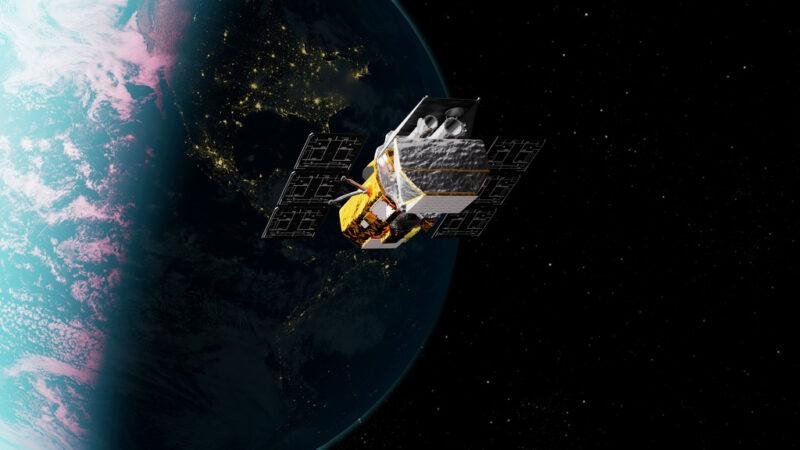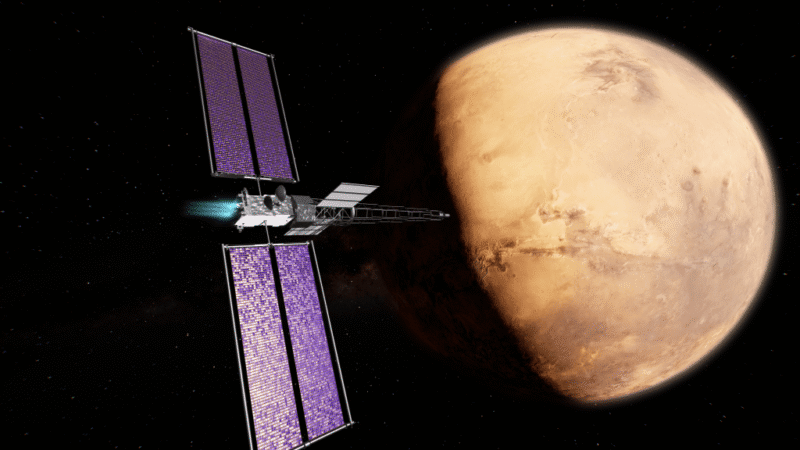
NASA ESCAPADE flybys are scheduled for Nov. 7 and 9, when the agency’s two Mars-bound spacecraft will separately return close to Earth and fire their engines to begin the next leg of their journey. NASA outlined the plan on Nov. 2, describing a gravity-assisted maneuver combined with a roughly nine-minute engine burn for each vehicle.
The first spacecraft is expected to pass Earth at about 5 a.m. Eastern time on Nov. 7. The second is planned for around 6 a.m. Eastern time on Nov. 9. Those are upcoming operations, not completed maneuvers; spacecraft navigation and mission control must execute both burns as planned.
ESCAPADE stands for Escape and Plasma Acceleration and Dynamics Explorers. Its mission is to study how the solar wind interacts with the Martian environment and contributes to atmospheric loss, using observations from two spacecraft rather than one.
Table of Contents
NASA ESCAPADE flybys use Earth to reach Mars
NASA says each spacecraft will combine gravitational acceleration from Earth with a trans-Mars injection burn near closest approach. The burn is planned to last approximately nine minutes. Rather than simply passing the planet and relying only on gravity, the vehicles will add propulsion at a carefully selected point on the trajectory.
The maneuver is commonly described as an Oberth maneuver. NASA said no earlier spacecraft bound for Mars had successfully used such a powered Earth flyby. That statement refers to the particular technique and destination; it does not mean gravity-assist missions themselves are new to spaceflight.
The agency said the burn should increase each spacecraft’s speed by more than 1,000 miles per hour. At the close approach, the spacecraft are expected to pass roughly 600 to 1,100 miles above Earth. Such figures are planned navigation values that mission teams will confirm after execution.
Why the spacecraft took a longer path
ESCAPADE launched in November 2025 when Earth and Mars were on opposite sides of the Sun. Conventional Mars transfer windows depend on a favorable alignment that occurs approximately every 26 months. NASA instead placed the spacecraft on a looping route near the Earth-Sun Lagrange point L2 before sending them back toward Earth for the powered flybys.
That route has allowed the twin vehicles to collect additional observations of Earth’s distant magnetotail. The magnetotail is a region shaped by the solar wind interacting with the planet’s magnetic field. Scientists expect those measurements to add context to the mission’s later investigation of the Martian environment.
The flybys are designed to place the spacecraft on a trajectory toward Mars without requiring their original launch date to coincide with the traditional transfer window. The approach is a demonstration of mission design as well as a step toward ESCAPADE’s central science program.
Planned Mars arrival and opportunities to observe
After both flybys, NASA projects a cruise of about 10 months, with Mars arrival targeted for Sept. 7 and Sept. 9, 2027, respectively. Mission controllers would then prepare the spacecraft for coordinated observations of the planet’s magnetic environment and its response to particles flowing from the Sun.
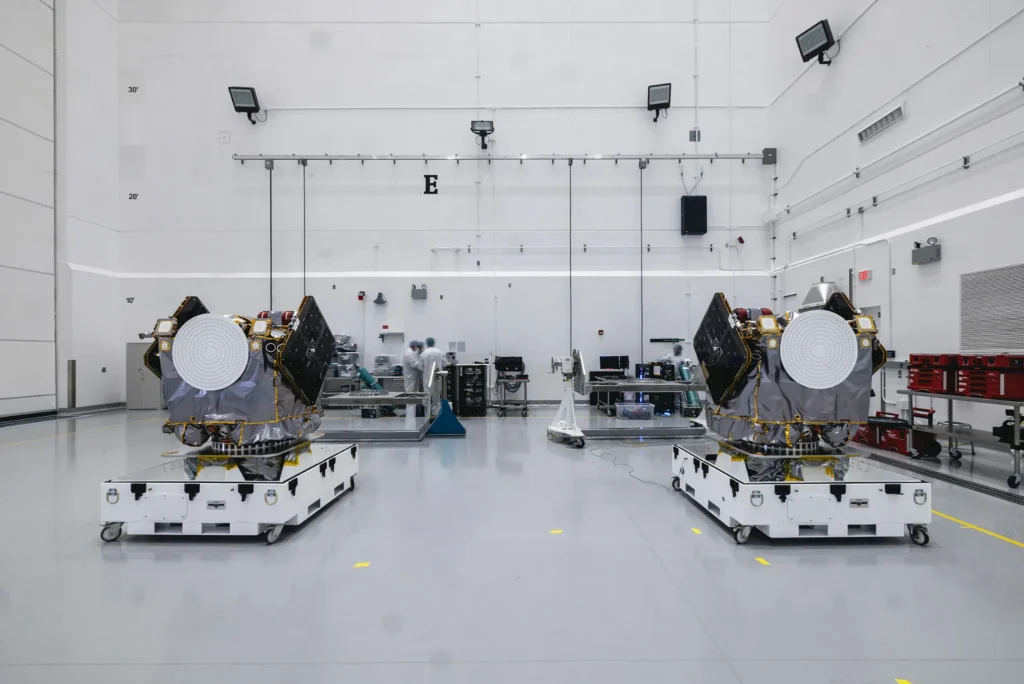
NASA said the spacecraft may be faintly observable with telescopes from parts of the United States before closest approach and from southern Australia during the burns. The agency published viewing guidance and noted that observers should not expect bright naked-eye objects. Each spacecraft is approximately refrigerator-sized.
For broader Mars-flight development context, The Aviation Diary previously reported on the unrelated SR-1 Freedom spacecraft effort. ESCAPADE has its own trajectory, funding and science objectives and should not be confused with that program.
FAQ: NASA ESCAPADE flybys
When will NASA ESCAPADE flybys occur?
The two powered flybys are planned for Nov. 7 and 9, 2026, with closest approaches around 5 a.m. and 6 a.m. Eastern time, respectively.
What will the two ESCAPADE spacecraft study?
They will measure how the solar wind interacts with Mars and how that interaction influences the loss of atmosphere to space.
When are the spacecraft expected at Mars?
NASA targets Sept. 7 and 9, 2027, for the two arrivals, subject to successful flybys and subsequent navigation.
Looking Ahead
The next measurable milestones are the two scheduled engine burns and confirmation that both spacecraft have entered their intended Mars trajectories. NASA also expects to discuss scientific observations collected during the long Earth-proximity phase. Neither flyby should be described as successful before mission confirmation.
Sources