A Boeing logistics contract announced October 12 will test whether commercial distribution systems can help U.S. military organizations move and track supplies in the Indo-Pacific under difficult operating conditions. Boeing Global Services says it received the Contested Logistics and Distribution Demonstration award from U.S. Indo-Pacific Command.
The project focuses on information systems, inventory visibility and a controlled shipment exercise. Boeing plans to combine its commercial logistics network with handling procedures for government-furnished materials, then evaluate how the process behaves when conditions become constrained.
This is a demonstration rather than proof of a deployed regional supply system. Boeing has not disclosed a contract dollar value or a timetable for converting the findings into a permanent military logistics arrangement.
Table of Contents
Boeing Logistics Contract Covers Three Test Phases
The first part of the effort will integrate enterprise resource planning data and build accurate electronic catalog records for the test materials. Boeing says it will validate government data and support automated ingestion of relevant item information into its own ERP environment.
The second phase turns to physical movement. Teams will receive, inspect, store and dispatch a test shipment through a commercial distribution network while attempting to preserve chain of custody and visibility as material travels between points.
The final phase is an operational assessment. Boeing plans to produce an after-action review identifying bottlenecks, compliance concerns and areas requiring improvement if the model is considered for broader use. Successful receipt of a test consignment alone would not establish system-wide readiness.
Why Indo-Pacific Defense Logistics Are Being Examined
Large aviation and defense platforms depend on continuous access to spare parts, specialist tools and traceable documentation. When supplies cannot be located or transported on schedule, even an otherwise serviceable system can become unavailable for its intended mission.
Boeing says its approach is intended to examine whether selected work can be shifted onto commercial distribution capacity and whether that could reduce dependence on scarce strategic airlift. That is an objective under evaluation, not a demonstrated reduction in military flights.
The company specifically highlights supply-chain visibility, responsiveness and the ability to function during degraded conditions. These goals link logistics planning to operational readiness, but the scope of the actual trial should not be confused with a full-scale contested deployment.
Quality Control and Tracking Are Central to the Trial
Boeing’s description includes inspection, inventory control, automated cataloging and in-transit tracking. Accurate item identification and handling records matter because defense customers must know what has moved, where it is stored and which requirements apply to it.
The company also lists quality assurance, compliance and host-nation conditions as considerations. Different customs, storage and defense-material procedures can affect how any commercial network handles government-controlled cargo across regional boundaries.
Boeing Global Services describes the exercise as a way to learn where processes work and where they need redesign. Neither the final results nor any subsequent procurement decision have been announced, and there is no basis yet to assume a new network will be deployed.
FAQ: Boeing logistics contract
What is the Boeing logistics contract for?
It supports a U.S. Indo-Pacific Command demonstration evaluating inventory-data integration, controlled material movements and commercial supply-chain resilience.
Will the contract replace military airlift?
No replacement has been announced. Reducing some reliance on strategic airlift is an aim to assess, not a confirmed outcome.
Has the Boeing logistics contract been fully demonstrated?
No. Boeing has announced the award and the planned phases; it has not reported the completed outcome of the trial.
Looking Ahead
The next meaningful evidence will be the physical distribution trial and Boeing’s after-action assessment, especially data on traceability, bottlenecks and compliance. No dollar amount, specific shipment route or operational rollout schedule was disclosed in the October 12 announcement.
Sources
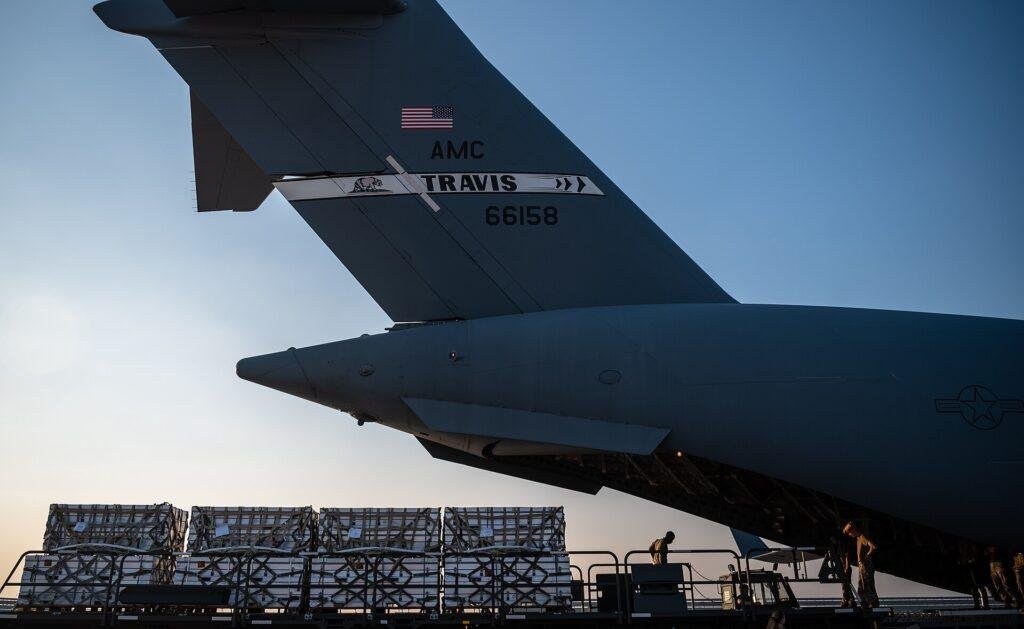
Featured image: U.S. Air Force personnel load cargo onto a C-17 in October 2023. This is a contextual file photo, not Boeing’s 2026 logistics trial. Photo: U.S. Air Force / Tech. Sgt. Alexander Cook. License: U.S. Government Public Domain. Source: Wikimedia Commons image page (license). Image scaled for web without other edits.