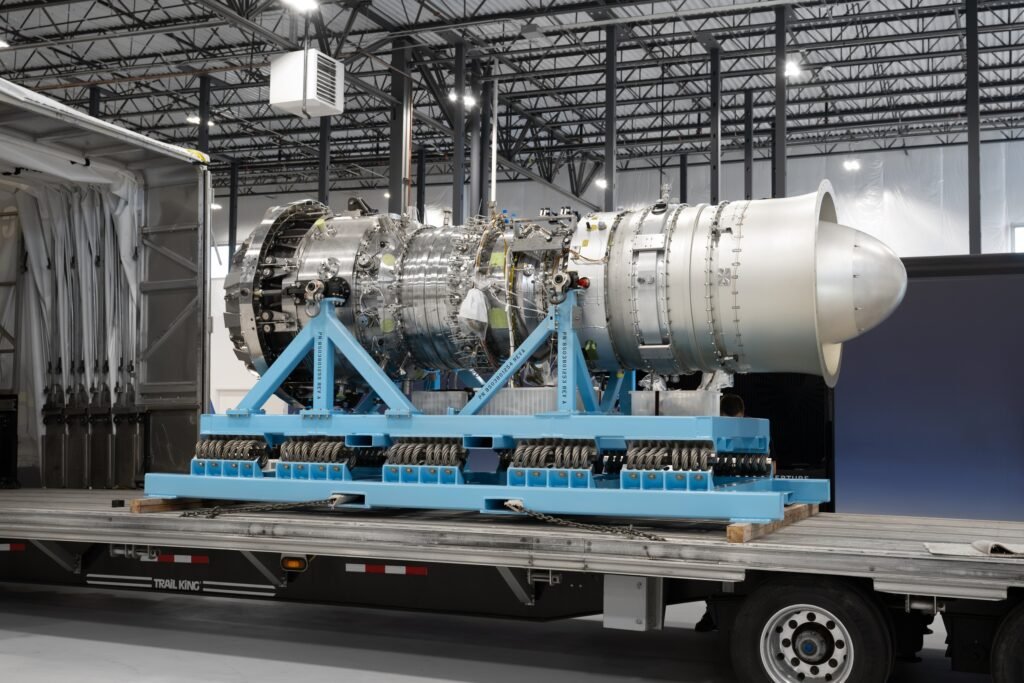
The Boom Sprint Core ran for the first time during a ground test at Colorado Air and Space Port on November 21. Aviation Week reported that Boom Supersonic reached first ignition on its second attempt, a step toward an industrial gas turbine and the Symphony aircraft engine planned for the company’s Overture airliner.
Boom kept the initial run brief to gather data. Founder and chief executive Blake Scholl told Aviation Week the core reached 6,500 rpm and the team monitored the test with nearly 2,000 sensors. The aircraft engine still requires integration and its own test and certification program.
Table of Contents
What the Boom Sprint Core demonstrated
First ignition lets engineers measure how a prototype core behaves as a working assembly. The core brings together the compressor, combustion section and turbine. Their operation during the same run supplies data that component tests alone cannot capture. The Colorado test established that the assembled hardware could start and run briefly under the conditions used.
Scholl said Boom planned to broaden the range of test conditions over the following two months. The initial run provides a reference for that work. The reported speed is a point reached during testing, and the results published so far describe the core in the test facility.
Two products share one starting point
Boom is developing the core for its 42-megawatt Superpower industrial turbine and for Symphony, the turbofan intended for Overture. The company is pursuing the power-generation version first. Aviation Week reported that the proposed propulsion and power products are based on the same high-pressure core architecture.
They will eventually do different jobs. A stationary turbine has to deliver power to generating equipment. An aircraft engine has to produce thrust while operating across the speeds, altitudes and other conditions its airplane encounters. That is why the common core can provide useful evidence to both programs while each still needs its own validation.
What remains before Symphony can fly
Boom developed and flew its XB-1 demonstrator before this core test. Overture is the proposed passenger aircraft, and the first run was a ground test of hardware for future engines. Integrating and testing a complete Symphony turbofan would mark another stage before flight testing and certification.
Those differences are important when comparing supersonic projects. TAD’s coverage of NASA’s X-59 flight to Texas documented a research aircraft already in flight testing. Boom’s latest milestone gives its engineers data from an operating core on the ground, with the full engine and airliner still ahead.
FAQ: Boom Sprint Core
When did the Boom Sprint Core first run?
Aviation Week reported that Boom ran the prototype on November 21 at Colorado Air and Space Port.
What engine is planned for Overture?
Boom plans to use its Symphony turbofan, which will draw on the core technology tested in Colorado.
What is the first planned product to use the core?
Boom is pursuing the Superpower industrial gas turbine first, with the Symphony aircraft engine to follow.
Looking Ahead
The next step for the Boom Sprint Core is a planned expansion of ground testing. Additional runs will give engineers more information before the company can demonstrate a complete engine.
Sources
- Aviation Week first-run report with Boom’s CEO
- AVweb coverage of the prototype test
- Boom Supersonic’s prototype core announcement
- Featured image — Nathan Leach-Proffer / Boom Supersonic (Boom editorial use permission).
Related profiles