NASA X-59 flight testing took an unusual turn Oct. 28, 2026, when the experimental quiet-supersonic aircraft departed Edwards Air Force Base in California on a cross-country journey that included stops in El Paso and Fort Worth, Texas. The trip is tied to a planned appearance at Kennedy Space Center’s November aviation event in Florida. Departure and Texas stops are reported; a completed arrival at Kennedy is not yet established in this account.
The trip comes a year after the narrow, long-nosed X-59 first flew on Oct. 28, 2025. NASA says the research aircraft has completed more than 40 additional test flights since then, gradually expanding its operational envelope. The journey offers a different test of practical operation away from the California flight-test region, but it is not the start of routine commercial supersonic passenger service.
Table of Contents
NASA X-59 Flight Leaves Its California Test Area
The X-59 has been flying from Edwards as part of NASA’s Quesst mission, designed to study whether a shaped airframe can produce a quieter sonic-thump signature. Air Data News and The Aviationist reported the October 28 route through El Paso and Fort Worth. Its planned destination is NASA’s Kennedy Space Center in Florida, where the aircraft is expected to appear during the MAX POWER event Nov. 7 and 8.
The primary announcement provides the source details behind this report.
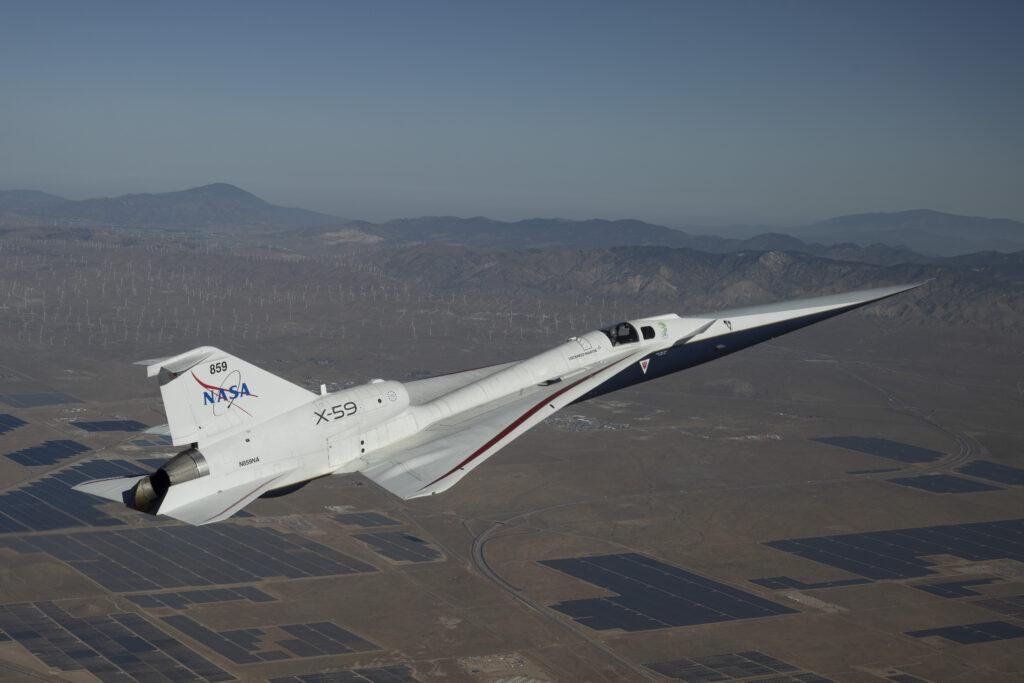
The aircraft’s registration is N859NA, and the reported cross-country legs did not include a test of passenger carriage. The X-59 is an experimental research airplane built around measurement of its acoustic effect on the ground. Transit flights can demonstrate normal handling, navigation and logistics, but public reports of an itinerary should not be used to claim that a demonstration event has already occurred.
One Year of Increasing Test Performance
NASA reported that its experimental aircraft had made more than 40 flights after its first flight anniversary. The campaign progressively increased speed and altitude as test teams verified handling characteristics and systems. Recent reported performance includes flight above 56,000 feet and speeds up to Mach 1.53, while test points around Mach 1.4 at 55,000 feet are important for the intended acoustic work.
Those performance figures do not constitute certification for passenger use. They are part of an engineering flight-envelope expansion in which research pilots and ground controllers verify a particular aircraft. The X-59’s distinctive pointed nose and top-mounted engine were designed in part to influence shock-wave behavior, and its specialized cockpit relies on displays rather than a conventional forward windscreen.
Quiet Supersonic Design Is the Research Goal
Ordinary supersonic aircraft can generate a pronounced sonic boom when pressure disturbances combine and reach the ground. NASA’s project aims to demonstrate whether carefully shaped shock waves can lower the perceived sound. The agency intends to collect measurements and community responses that may inform future decisions about restrictions on civil supersonic flight over populated areas.
An aircraft showing promising performance at speed does not automatically demonstrate that people will find its sound acceptable. That requires calibrated ground measurements and controlled listening and survey work under defined conditions. Regulators would still need their own evidence before reconsidering rules for commercial supersonic operations. The October travel leg is therefore a logistics and outreach milestone within a much larger research program.
Florida Appearance Does Not End the Test Campaign
NASA’s Kennedy event is an opportunity to present the experimental aircraft publicly and describe the engineering behind it. Air Data News reports the planned appearance on Nov. 7 and 8. The aircraft’s future test program remains focused on collecting acoustic data and validating the quiet-supersonic concept, rather than setting a target launch date for airline transport.
The route and timing can still change as the aircraft continues its trip. Weather, maintenance, airspace coordination and flight-test decisions may affect subsequent legs. TAD previously covered an X-59 inlet inspection; the aircraft’s departure from Edwards shows operational progress since those maintenance reports, not proof that all Quesst testing or certification work has been completed.
For relevant background, TAD previously reported the X-59’s maintenance and inlet inspection work.
FAQ: NASA X-59 flight
Where did the NASA X-59 flight travel?
Reports show the X-59 departed Edwards Air Force Base and stopped at El Paso and Fort Worth, Texas, on Oct. 28.
Why is the X-59 heading to Florida?
It is expected to appear at a NASA Kennedy Space Center event Nov. 7–8 while continuing the Quesst research campaign.
Does the flight mean commercial supersonic service is approved?
No. The X-59 is an experimental research airplane, and its testing is intended to inform future decisions about sonic-boom rules.
Looking Ahead
NASA X-59 flight operations will continue as the aircraft proceeds toward its planned Kennedy appearance and later returns to specialized research flying. The exact timing of the remaining travel legs has not been confirmed here. The more important future Quesst milestone will be measured acoustic data and community-response evidence, which must be evaluated before any regulatory changes could be considered.
Sources
- NASA — A year of progress since first X-59 flight
- Air Data News — X-59 trip to Florida
- The Aviationist — X-59 heads to Kennedy Space Center