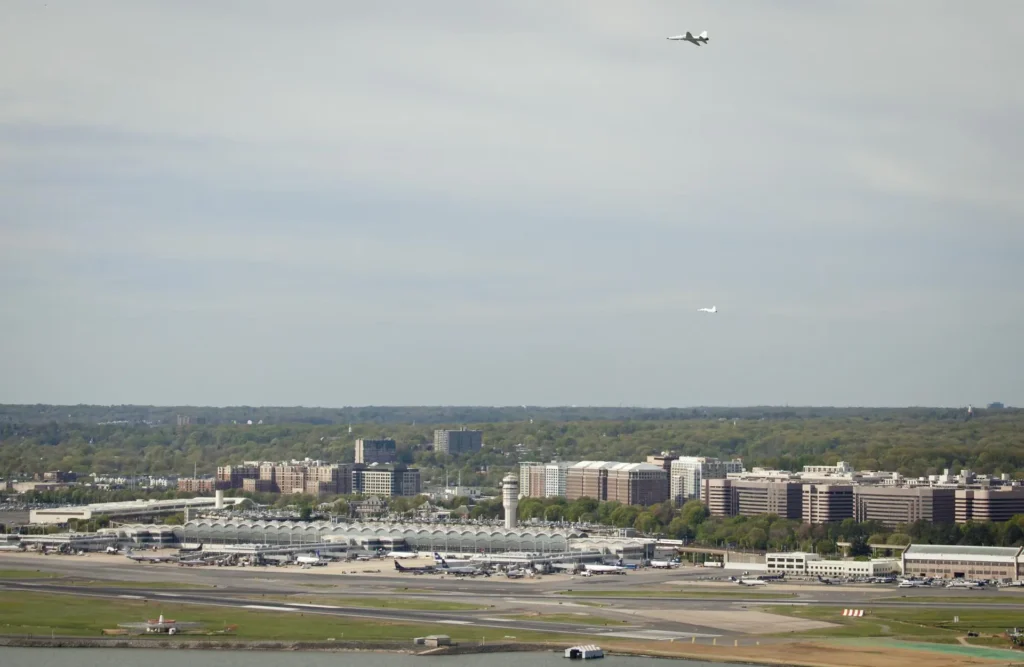
A Coast Guard emergency landing unfolded over the skies near Washington, D.C. on September 2, when a C-37A carrying Homeland Security Secretary Markwayne Mullin lost its right engine and diverted to Ronald Reagan Washington National Airport. The pilot declared an emergency, and the jet landed safely with all 14 people aboard unhurt.
The incident put a spotlight back on an aircraft DHS itself has called obsolete, and on a fleet-replacement effort that grew from a $50 million request to roughly $200 million while lawmakers questioned the timeline.
Table of Contents
Coast Guard Emergency Landing at DCA: What Happened
Secretary Mullin was traveling from Georgia to Washington on Wednesday afternoon, September 2, when the Coast Guard C-37A he was aboard lost its right engine mid-flight. The pilot diverted to Ronald Reagan Washington National Airport (DCA) and declared an emergency around 1:30 p.m. ET.
The Metropolitan Washington Airports Authority said the aircraft “landed safely, was thoroughly checked by Airports Authority Fire and Rescue personnel then proceeded off the runway.” No injuries were reported among the 14 people on board.
Mullin confirmed the landing on X shortly afterward, crediting the Coast Guard flight crew for handling the single-engine approach without incident.
Inside the Cockpit: The Pilot’s Emergency Call
Audio of the pilot’s radio call to DCA’s control tower captured the moment the crew reported the failure and requested priority handling.
“We just lost our right engine and would like to declare an emergency and immediate landing at DCA.”
The pilot told controllers the aircraft had 14 people aboard and roughly 2.5 hours of fuel remaining, giving the crew a comfortable margin to set up for the approach. Air traffic control cleared the jet to land on Runway 1.
On X, Mullin described the crew’s handling of the failure as routine despite the circumstances. “The United States Coast Guard pilots made the single engine landing feel routine. No panic, just straight professionalism,” he wrote, adding that the pilots told him afterward it was the first time either had lost an engine in flight.
The Aircraft: What Is the Coast Guard’s C-37A?
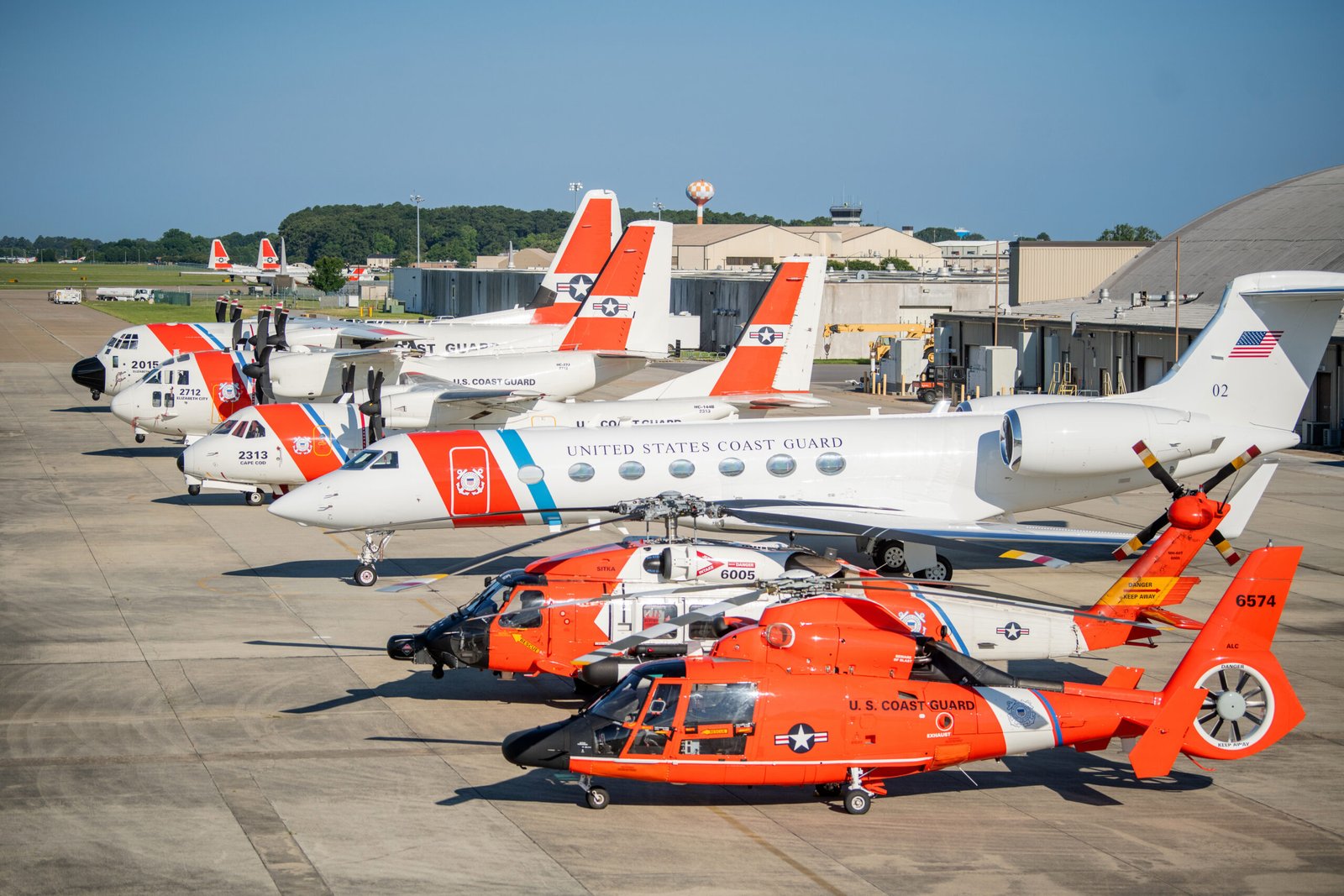
The C-37A is the military designation for a Gulfstream V, one of two long-range command and control aircraft (LRCCA) the Coast Guard has operated since 2002. Both jets, a C-37A and a C-37B, are based at Coast Guard Air Station Washington, D.C., and exist specifically to move the secretary of homeland security, the Coast Guard commandant, and other senior leaders anywhere in the world on short notice.
The mission requirement isn’t discretionary. Under guidance the White House issued in March 2004, the homeland security secretary’s duties were designated as requiring instantaneous secure communications and the ability to return to Washington or reach other destinations on an expedited basis in an emergency, similar to standards applied to the secretaries of state and war, the attorney general, and the directors of the FBI and CIA.
- Military variant of the Gulfstream V, in Coast Guard service since 2002
- One of two LRCCA jets based at Coast Guard Air Station Washington, D.C.
- Equipped with secure and non-secure voice and data communications for command-and-control use
- Reserved for required-use travel by DHS and Coast Guard senior leadership
A Fleet Already Under Scrutiny
Wednesday’s Coast Guard emergency landing lands in the middle of a running argument over how, and how fast, DHS should replace this exact aircraft. In a May 2025 statement, DHS said the Coast Guard’s LRCCA fleet was “22 years old and faces significant avionics and communications obsolescence issues,” and its fiscal year 2025 spending plan initially sought roughly $50 million to replace it.
That request grew substantially. By October 2025, the Coast Guard had shifted to a roughly $200 million purchase of two new Gulfstream G700s. The Coast Guard confirmed the recapitalization in an October 18, 2025 press release, framing it as a safety and readiness necessity rather than a discretionary upgrade.
“Modernizing the Coast Guard’s aging and obsolete aviation fleet is essential to ensuring our ability to successfully conduct national security missions.”
Adm. Kevin Lunday, acting Coast Guard commandant
The Coast Guard’s press release disclosed the toll the aging jets had already taken on operations: since January 2025, the service’s long-range command and control aircraft had racked up 30 days of unplanned maintenance, forcing six missions to be canceled outright.
The price jump drew pushback well before Wednesday’s incident. At a May 20, 2025 Senate hearing, then-Secretary Kristi Noem defended the original request, saying the existing jet had been in service “beyond its usable hours.” Days later, Democratic Reps. Bennie Thompson of Mississippi and LaMonica McIver of New Jersey pressed DHS on why replacing the executive jet should take priority over upgrading older Coast Guard aircraft used for search-and-rescue missions.
The first of the two new G700s was delivered in January 2026; the second has not yet reached DHS. It is unclear why the newer aircraft was not in service for Wednesday’s trip.
FAQ: Coast Guard Emergency Landing
Did the aircraft that had an engine failure belong to the new $200 million purchase?
No. The aircraft involved was the older C-37A, which has been in Coast Guard service since 2002. The newly purchased Gulfstream G700s are a separate acquisition; only one of the two has been delivered so far.
How serious is losing one engine on a C-37A?
The C-37A, like all twin-engine business jets, is certified to fly and land safely on a single engine. It is a serious mechanical failure requiring an emergency declaration and priority handling, but it is a scenario crews train for regularly.
Was anyone hurt in the emergency landing?
No injuries were reported. The Metropolitan Washington Airports Authority said the jet landed safely and was inspected by airport fire and rescue crews before taxiing off the runway.
Looking Ahead
DHS has not said whether Wednesday’s engine failure will change the delivery timeline for the second Gulfstream G700, which remains outstanding more than seven months after the first arrived. The incident is likely to resurface in future congressional discussion of the Coast Guard’s aviation budget, given how directly it illustrates the maintenance concerns the service cited when it sought the recapitalization in the first place.
Sources
- CBS News
- The Washington Post
- NBC News
- Fox News
- U.S. Coast Guard News (official press release)
- U.S. Coast Guard (aircraft fact sheet)
- U.S. Coast Guard (C-37B acquisition background)