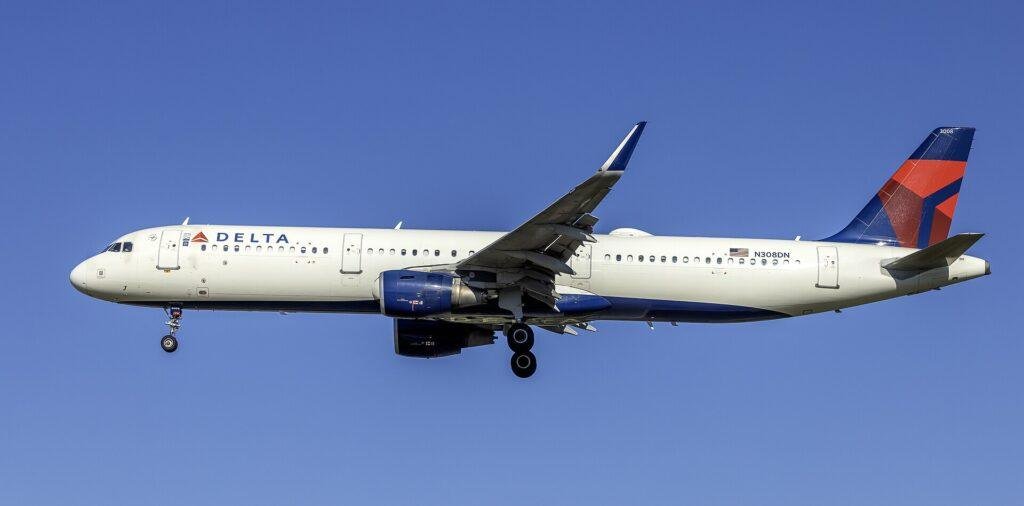
Delta A321 tailstrike investigators identified excessive aft sidestick input after a bounced landing and delayed intervention by the line check pilot as the probable cause of a July 14, 2026, event at New York LaGuardia Airport.
The National Transportation Safety Board published its final report on October 22. The aircraft, Delta flight 1181, sustained substantial damage during an attempted landing on runway 22, but none of the 188 passengers or six crew members was injured.
The findings concern a completed investigation into a July accident, not a new October flight incident. The report describes the sequence of aircraft handling and the training context; it does not establish a mechanical defect caused the tailstrike.
Table of Contents
Delta A321 Tailstrike Followed a Bounce
According to the NTSB, a first officer undergoing operational experience was flying the approach under supervision of a captain acting as line check pilot. The flight from Fort Lauderdale was the pair’s fourth leg together and the first officer’s third leg as pilot flying.
The aircraft’s airspeed fell below its target on short final. The first officer increased thrust but did not initially arrest the decline, the report says. A slightly late flare led to a firm landing and then a bounce.
After the bounce, investigators found that the first officer made excessive aft sidestick inputs. The A321’s pitch increased, and the rear fuselage contacted the runway before the captain assumed control and initiated a go-around.
Flight Data and Crew Actions
The flight-data record showed an initial touchdown at approximately seven degrees of pitch and 1.91 g vertical acceleration, according to the final report. Pitch then reached about 10.02 degrees before the go-around sidestick inputs were recorded.
Flight attendants heard a scraping sound during the landing attempt. After the crew landed successfully on a later approach, inspection found substantial damage to the lower fuselage, consistent with contact between the aircraft tail area and runway surface.
The NTSB did not identify a mechanical malfunction that contributed to the excessive pitch. Its probable-cause statement focused on the first officer’s control input and the check pilot’s delayed remedial action, not a weather emergency.
Why Bounced-Landing Recovery Matters
Delta’s procedures, described by the NTSB, call for crews to control descent after a shallow bounce and execute a go-around following a sufficiently hard bounce. The report indicates the investigators believed earlier recognition or intervention could likely have prevented the tailstrike.
The captain subsequently completed a go-around, and the first officer resumed control for an uneventful later landing, according to the report. The outcome illustrates how a serious aircraft-damage event can occur without an injury even though a flight ultimately lands safely. The NTSB did not describe any passenger injuries, but it classified the aircraft damage as substantial. Its report discusses flight crew handling during the training flight rather than recommending that passengers take any specific action.
The investigation’s safety analysis is separate from TAD’s reporting on an FAA equipment directive. That unrelated story does not explain this accident, whose probable cause has been published by the NTSB.
FAQ: Delta A321 tailstrike
What caused the Delta A321 tailstrike at LaGuardia?
The NTSB identified excessive aft sidestick input after the bounced landing and delayed intervention by the line check pilot.
Were passengers injured during Delta flight 1181?
No. The NTSB reported no injuries among 188 passengers and six crew members.
When did investigators release their final findings?
The NTSB report was published October 22, 2026, for the accident that occurred July 14.
Looking Ahead
The final report is published and does not announce a further investigative milestone. Delta’s subsequent internal training or operational responses have not been independently established here and should not be inferred from the NTSB findings alone. The Delta A321 tailstrike is a completed July event now documented by investigators; it should not be presented as a new October accident.
Sources
- NTSB final aviation report DCA26LA282, published October 22
- NTSB investigation docket and supporting records