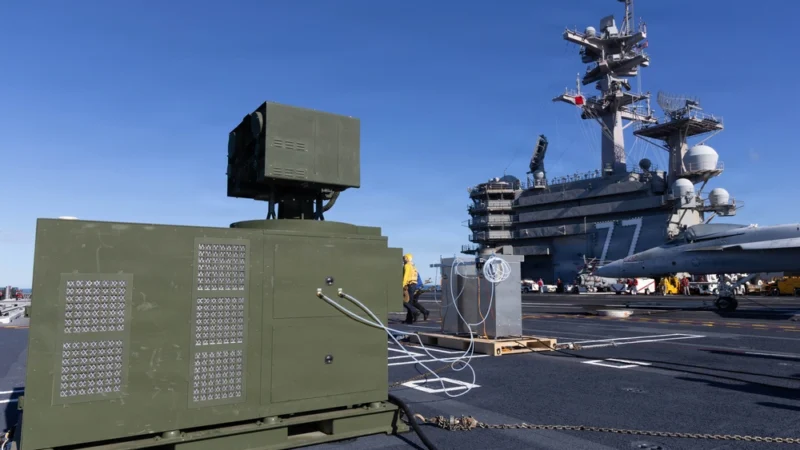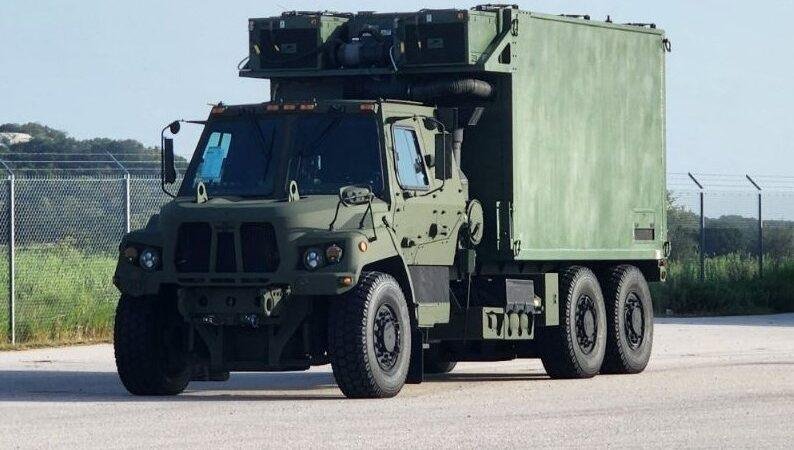

The Army has awarded AeroVironment an E-HEL laser contract worth $464.8 million, marking the service’s first-ever production contract for a high-energy laser weapon system. The award, announced September 2, moves the Enduring-High Energy Laser program from prototype demonstrations to fielded hardware meant to knock down small drones cheaply and repeatedly.
The contract lands less than a week after The Aviation Diary reported on a related Army laser system downing suspected cartel drones over the Rio Grande Valley, and it caps a bumpy two years for military lasers at the U.S. border that included a mistaken balloon strike and an unplanned airspace shutdown.
Table of Contents
What the Army Just Bought
The Army’s Portfolio Acquisition Executive for Fires office issued AeroVironment an other-transaction agreement for production under the Enduring-High Energy Laser program, the service confirmed in a September 2 release. It’s the first time the Army has signed an E-HEL laser contract for production, rather than a prototype or research deal, for a high-energy laser weapon.
“This first of its kind directed energy program will enable our formations to defeat unmanned systems and dominate from the outset. Pairing human ingenuity with advanced technology is what ensures our Army will continue to outpace America’s adversaries.”
Gen. Christopher LaNeve, Vice Chief of Staff of the Army
AeroVironment executives told reporters ahead of the official announcement that this E-HEL laser contract is worth $464.8 million and covers delivery of “dozens” of the company’s LOCUST X3 laser systems over the next several years, along with system support and training. AeroVironment plans to back the production ramp-up with a $30 million expansion of its Albuquerque, New Mexico, manufacturing facility, announced in March.
How E-HEL Works
E-HEL is an electrically powered laser weapon built to counter small and medium drones at a fraction of the cost of a missile intercept. The Army says the system offers a low cost-per-shot and effectively carries a “magazine” that regenerates as long as it has power, rather than one that depletes with each engagement.
The program was built around a modular open systems approach spanning 11 major interfaces, so the laser isn’t locked into a single vehicle or site. The Army says it can be deployed from fixed bases, semi-fixed tactical sites, or mobile combat vehicles, which is intended to let the service swap in upgraded components as the technology matures rather than redesigning the whole system.
- LOCUST X3: a 30-kilowatt, platform-agnostic laser weapon
- Designed to integrate with the Joint Light Tactical Vehicle, with palletized configurations also available
- AeroVironment is also assessing integration with the Infantry Squad Vehicle
- Targets Group 1-3 unmanned aircraft systems, the smaller classes of drones
“The key to successfully countering all levels of drones is a layered defense of sensors and effectors. AV and the Army have worked for years to develop directed energy solutions, and we are proud to give our soldiers a decisive edge against drone threats.”
Mike Obadal, Under Secretary of the Army
From Border Controversy to Production Contract
This contract arrives days after directed-energy weapons made a very different kind of headline. The Aviation Diary reported August 27 that the Army’s Multi-Purpose High Energy Laser, a related prototype system, was used to shoot down three suspected cartel drones in Texas’ Rio Grande Valley — a clean engagement that stood in contrast to a rockier February incident, when a LOCUST system fired near Fort Bliss shut down El Paso airspace for hours after destroying what turned out to be a children’s party balloon rather than a drone.
AeroVironment is the same manufacturer behind the LOCUST family of systems referenced in that earlier incident, and the E-HEL production contract represents the next generation of that same push toward fielded, truck- and vehicle-mounted directed-energy weapons. The AMP-HEL prototypes used in the August border engagement are described by the Army as the direct predecessor to the E-HEL program now moving into production.
Notably, the Locust X3 has already been tested at White Sands Missile Range under Joint Interagency Task Force 401, the same organization overseeing counter-drone operations at the southern border, and the testing reportedly helped secure a Department of War-FAA agreement clearing the system for domestic use — a direct response to the coordination failures that caused February’s airspace shutdown.
A Rocky Road to This Contract
Directed-energy counter-drone weapons have been treated as science-and-technology projects for years rather than programs of record, which is part of why this E-HEL laser contract is being framed as a milestone rather than a routine award.
“The E-HEL program is an example of how the Army has successfully utilized MOSA, a key element of acquisition reform, as part of our efforts to field technology quickly with an interface to upgrade in the future. Directed energy weapons have been considered S&T projects, and I’m proud that the Army is moving at speed and scale to deliver this first time capability.”
Brent Ingraham, Assistant Secretary of the Army for Acquisition, Logistics and Technology
The February El Paso incident and a reported friendly-fire episode involving a Customs and Border Protection drone days later prompted a joint FAA-Pentagon coordination test at White Sands in March, aimed at setting clearer protocols for operating directed-energy systems near civilian airspace. The Pentagon has since agreed to give the FAA mandatory advance notice before activating high-energy laser systems — the kind of procedural fix this contract’s testing regime appears to have been built around from the start.
FAQ: E-HEL Laser Contract
Is E-HEL the same system that was used at the border in August?
Not exactly. The August 27 border engagement used the Army’s Multi-Purpose High Energy Laser (AMP-HEL) prototype, which the Army describes as E-HEL’s direct predecessor. This E-HEL laser contract covers the production-ready successor now under contract with AeroVironment.
What does E-HEL actually shoot down?
The system is designed to defeat Group 1-3 unmanned aircraft systems, the Army’s classification for smaller drones, rather than larger fixed-wing or crewed aircraft.
How many laser systems will AeroVironment deliver?
AeroVironment says the contract covers “well into the dozens” of LOCUST X3 systems over the next several years. The company has not disclosed an exact number.
Looking Ahead
The Pentagon has separately said it plans to install laser and microwave counter-drone systems at five additional U.S. bases by the end of 2026, including Fort Bliss and Fort Huachuca. With this E-HEL laser contract now signed and AMP-HEL prototypes already seeing operational use at the border, expect continued overlap between the two programs as the Army works to convert years of prototype testing into fielded units.
Sources